
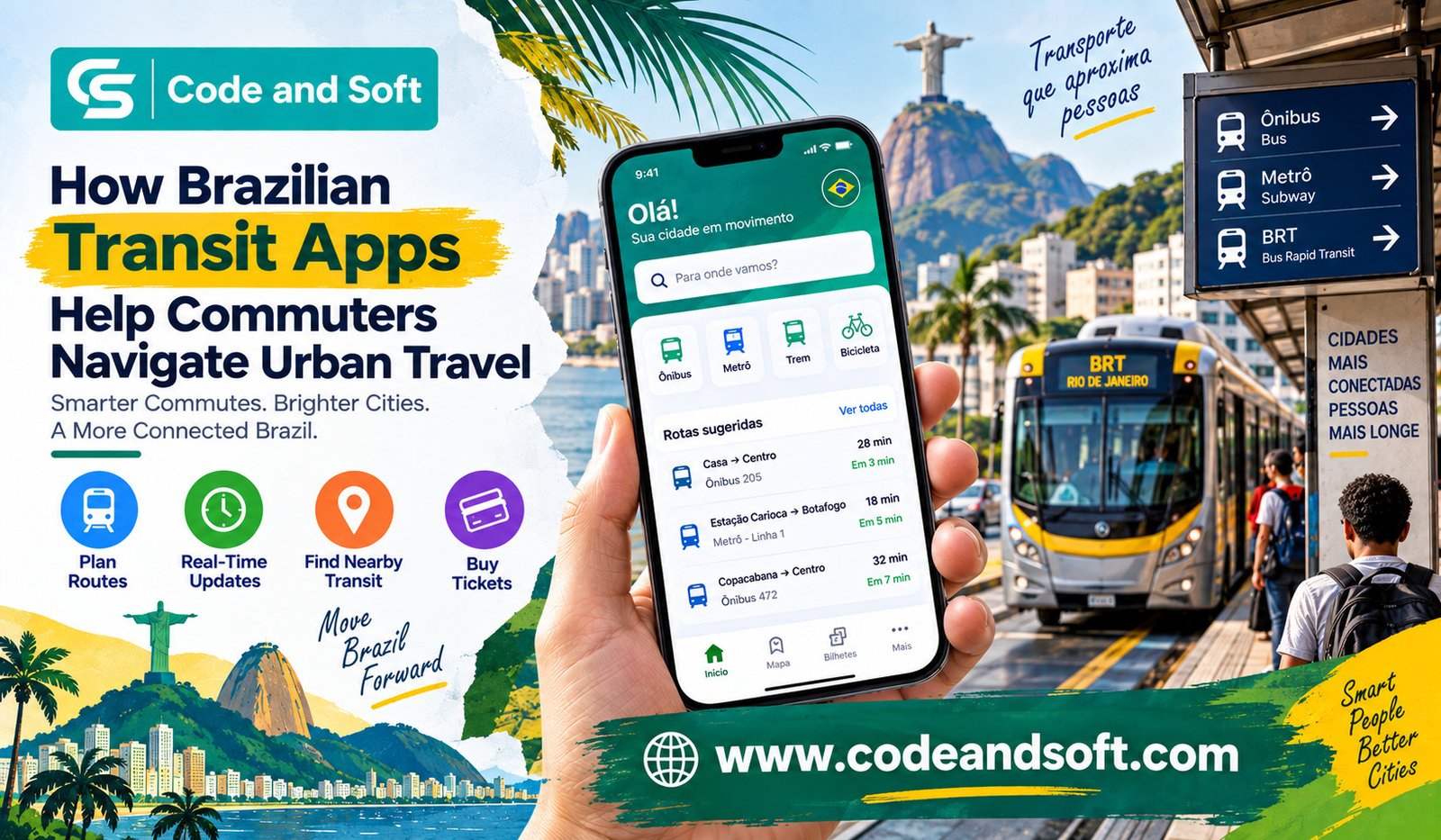

Getting around a Brazilian city can be exciting, but daily urban travel can also test your patience. Whether you are heading to work, university, a shopping district, or a weekend destination, knowing which bus to catch, where to change lines, or how long your journey will take can make a huge difference.
This is where transit and mobility apps become useful. With the right combination of apps, you can check routes, compare travel options, follow buses, book longer-distance trips, and even switch between public transport and ride-hailing when your plans change.
The Transport Apps Use In Brazil has grown around the way people actually move through cities: buses, trains, metro systems, ride-hailing services, and intercity coaches all play a role. Instead of relying entirely on printed schedules or asking for directions, you can now keep much of that information on your phone.
Here are some of the apps you can use to make urban and regional travel in Brazil more manageable.
Cittamobi: A Practical Choice for Everyday Bus Travel
If you frequently depend on buses, Cittamobi can become one of the most useful apps on your phone.
The app focuses heavily on public transportation and can help you find routes, locate nearby stops, and follow your journey. Depending on the city and available data, you can also access information about bus arrivals and estimated travel times.
What makes this particularly useful is the difference between planning a journey from home and trying to catch a bus while you are already standing at a busy stop. Instead of wondering whether your bus is coming soon, you can check available information before deciding what to do next.
For your daily commute, that can mean fewer unnecessary waits and a clearer idea of how much time you need to leave home.
If you live in a city supported by Cittamobi, it is worth checking how much local transit information is available before making it your primary commuting app.
Moovit: Planning Public Transport Across Brazilian Cities
Moovit is another familiar name when it comes to public transportation.
You can use it to plan journeys involving buses, metro services, trains, and other forms of public transport where coverage is available. Rather than simply showing you a destination on a map, the app can help you understand the steps involved in getting there.
For example, imagine you need to travel across a large city during the morning rush. You may need to take one bus, transfer to another service, and then walk the final few minutes. Moovit can help you see that journey as a sequence instead of leaving you to figure out each part separately.
That is especially useful when you are unfamiliar with a neighbourhood.
Another advantage is that you can compare different public transport possibilities. A route with fewer transfers may be more comfortable, while another route might get you there faster. Having those choices in front of you lets you decide based on what matters most at that moment.
Google Maps: More Than Just Directions
You probably already know Google Maps as a navigation tool, but it can also be surprisingly useful for public transport in Brazil.
When public transportation information is available for your location, you can enter your destination and compare options such as buses, trains, metro services, walking, driving, and ride-hailing.
This becomes particularly handy when you are travelling somewhere for the first time.
Instead of searching separately for a bus route and then checking the location of your destination, you can use one map to understand the entire journey. You can see where you need to start walking, where you may need to change services, and how far your final stop is from the destination.
Google Maps can also be useful alongside dedicated transit apps. For instance, you might use Moovit or Cittamobi to investigate public transport details and Google Maps to understand the surrounding streets and landmarks.
Using more than one app does not necessarily make travel complicated. In many cases, it gives you a useful backup when information differs between services.
Uber and 99: When Public Transport Isn’t Enough
Public transport will not always be the most convenient option.
Perhaps you are travelling late at night, carrying several bags, visiting a location far from a bus or metro station, or simply running behind schedule. This is where ride-hailing apps such as Uber and 99 can complement your transit apps.
Rather than viewing ride-hailing as an alternative to public transportation in every situation, you can treat it as another part of your travel toolkit.
For example, you could take a bus for most of your journey and then use a ride-hailing service for the final part. In another situation, you might compare the cost and estimated travel time of public transportation with a direct ride.
That flexibility matters in large urban areas. Your cheapest option is not always the fastest, and your fastest option is not necessarily the most practical.
Having Uber or 99 available lets you make that decision based on your circumstances rather than being locked into one form of transportation.
Of course, you should still follow normal safety practices when using ride-hailing services, including checking the vehicle and driver details shown in the app before entering.
Buser: A Useful Option for Intercity Travel
Not every journey ends within the same city.
If you are travelling between Brazilian cities, Buser can be useful for finding and booking intercity bus trips. Instead of focusing solely on local commuting, it gives you another option when your travel plans extend beyond your everyday route.
This can be helpful when you are planning a weekend trip, visiting friends or family in another city, or travelling for work.
The important distinction is that Buser serves a different purpose from apps such as Cittamobi and Moovit. You would generally use the latter to understand urban public transportation, while Buser can help with longer-distance coach travel.
That means you can keep both types of apps available without expecting one application to handle every journey.
Bookaway and Other Travel Platforms
For longer journeys, you can also look at platforms such as Bookaway, where available, to explore transportation options between destinations.
The benefit of using an intercity travel platform is convenience. Instead of visiting multiple transport providers individually, you may be able to compare available journeys and booking information in one place.
This becomes particularly helpful when you are travelling through unfamiliar parts of Brazil and need to connect different cities.
Before booking, however, you should always check the departure location carefully. Brazilian cities can be large, and a bus terminal on one side of a metropolitan area may be quite far from where you are staying.
And More: Building Your Own Travel App Combination
There is no single app that will necessarily be perfect for every Brazilian commuter.
Your best setup depends on where you live, how often you use public transport, and how far you normally travel.
You might use:
- Cittamobi for local bus information.
- Moovit for planning public transport journeys.
- Google Maps for maps, directions, and broader journey planning.
- Uber for convenient ride-hailing.
- 99 as another ride-hailing option.
- Buser for intercity bus travel.
- Bookaway for exploring longer-distance transportation options.
- Local transit operator apps where your city provides them.
- Payment or mobility apps that support local transportation services.
The key is not to download every transportation app you can find. Instead, choose a small combination that matches your routine.
Why Transport Apps Use In Brazil Is Becoming So Useful
The biggest advantage of transportation apps is not simply that they put maps on your phone. They help you make decisions while you are travelling.
You can check whether a public transport route makes sense before leaving home. You can look for alternatives if a journey becomes inconvenient. You can compare public transportation with a ride-hailing service. And when travelling between cities, you can investigate coach connections without planning everything manually.
This can make urban travel feel less uncertain.
For visitors, these apps can also reduce the stress of navigating an unfamiliar city. You do not necessarily need to understand the entire transportation network before starting your trip. You can break the journey into manageable steps and follow the information as you go.
For regular commuters, the benefit is even more practical. A few minutes saved each day can add up over weeks and months.
Making Your Daily Journeys Easier
To get the most from Brazilian transit apps, it helps to use them as planning tools rather than waiting until you are already lost.
Before leaving, check your route and estimated journey time. If you need to make a connection, give yourself some extra time rather than assuming everything will run exactly according to schedule.
It is also smart to keep a backup option in mind. If your preferred bus route becomes inconvenient, you might switch to another public transport route or use a ride-hailing service for part of the journey.
You should also remember that app information can change. Transit services may be affected by traffic, road conditions, operational changes, events, or other disruptions. When your journey is particularly important, check the latest information rather than relying entirely on an earlier route search.
Final Thoughts
Brazilian cities are busy, diverse, and constantly moving. For you as a commuter, navigating that environment becomes much easier when you have reliable digital tools available.
Cittamobi and Moovit can help you understand public transportation, while Google Maps gives you a broader view of routes and locations. Uber and 99 provide flexible ride-hailing alternatives, and Buser or Bookaway can become useful when your plans extend beyond the city.
The real value of the Transport Apps Use In Brazil is the flexibility they give you. You can choose how you want to travel instead of depending on one method for every situation.
Once you find the combination that works for your daily routine, checking a route, comparing options, and getting from one place to another can become a much simpler part of your day.