eChoosing a programming language can be an important decision for anyone starting or changing a software development career. C# and Java are two established programming languages that continue to be used for web applications, enterprise software, backend systems, cloud services and many other types of projects.
At first glance, C# and Java can look quite similar. Both use object-oriented programming, have C-style syntax, provide automatic memory management and offer extensive libraries. However, their ecosystems, common development environments and areas of popularity are different.
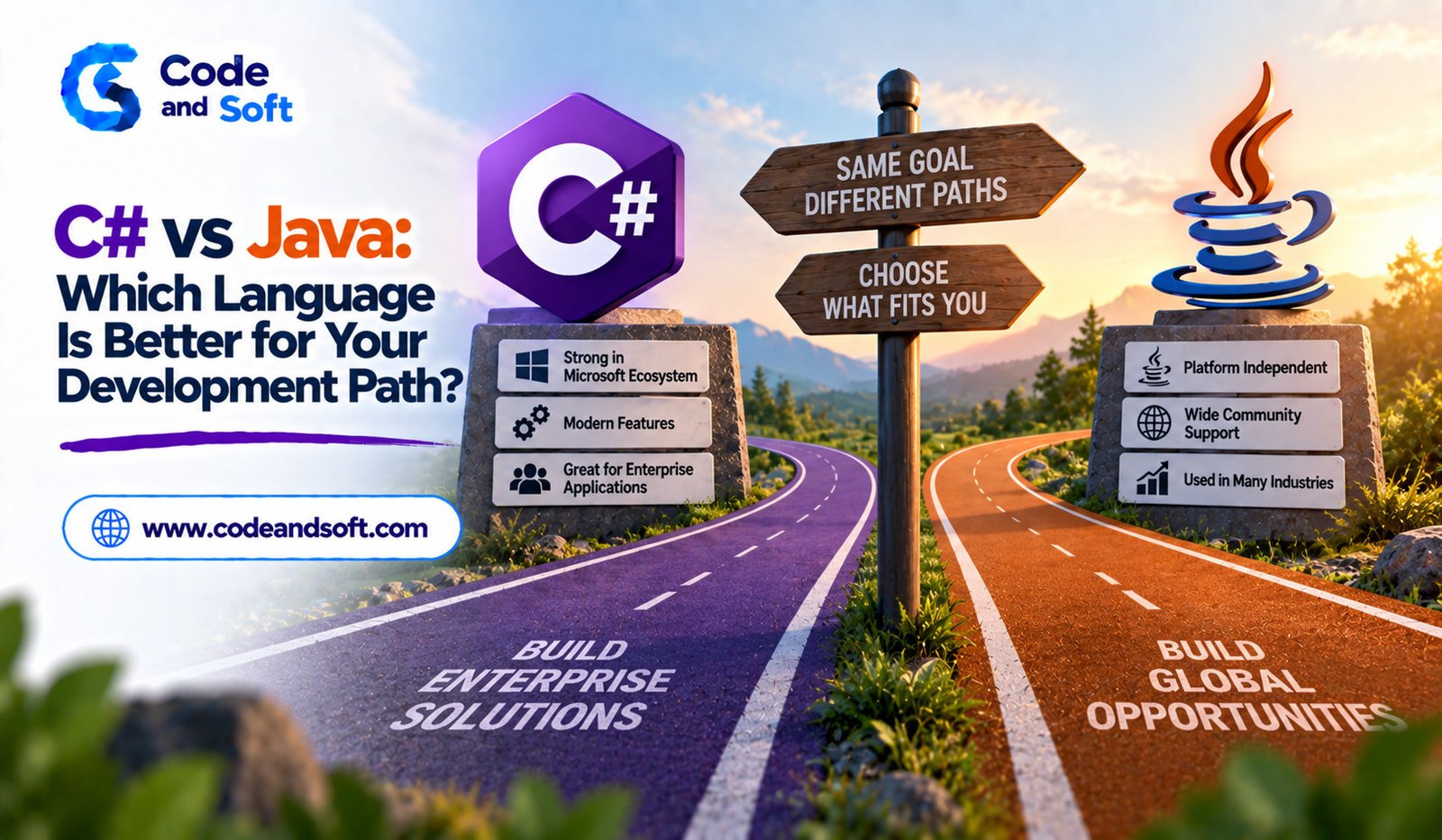
So, when comparing C# vs Java, there is no universal winner. The better choice depends on what you want to build, which ecosystem interests you and the type of development career you want to pursue.
Understanding C# and Java
C# is a programming language closely associated with the .NET ecosystem. It was created by Microsoft and has evolved into a modern language used for web development, desktop applications, cloud services, enterprise software, game development and more.
Java is a long-established programming language known for its portability and extensive use in enterprise applications, backend systems, Android development historically, financial technology and large-scale software.
Both languages are compiled into intermediate representations that run through their respective runtime environments. C# applications commonly run on the .NET runtime, while Java applications run on the Java Virtual Machine, or JVM.
Syntax and Learning Experience
C# and Java share many basic syntax patterns.
Both languages use classes, methods, variables, loops, conditional statements and interfaces. A developer familiar with one language can often understand the basic structure of the other relatively quickly.
For beginners, C# may feel approachable because modern C# provides concise syntax and several language features designed to reduce repetitive code. Features such as properties, pattern matching and LINQ can make certain programming tasks more expressive.
Java also has a structured and readable syntax. Its long history means developers can find extensive educational material and examples covering almost every fundamental programming concept.
The difficulty of either language depends less on syntax and more on the programming concepts being learned.
C# and the .NET Ecosystem
One of C#’s biggest strengths is its relationship with .NET.
.NET provides libraries, runtime features and frameworks that allow developers to build different types of applications. Developers can use C# for web APIs, backend systems, desktop software, cloud applications and other projects.
ASP.NET Core is particularly important for developers interested in web development. It provides tools for creating modern web applications and backend services.
C# is also strongly associated with Unity game development, making it an interesting option for programmers who want to explore interactive applications and games.
Java and the JVM Ecosystem
Java’s ecosystem is one of its strongest advantages.
The JVM provides a runtime environment that supports Java applications across different operating systems. Java also has a large collection of frameworks and libraries for enterprise and backend development.
Frameworks such as Spring have helped Java become an important technology for large-scale business applications and backend services.
Java is also widely used in organizations that maintain large software systems. Developers working with banking platforms, enterprise applications, business services and distributed systems may encounter Java frequently.
Performance Comparison
Both C# and Java can provide strong application performance.
Their runtimes use techniques such as just-in-time compilation and runtime optimization to improve execution.
In most ordinary application development, choosing between C# and Java based only on raw performance is unlikely to be useful. Application architecture, database operations, network communication, algorithms and data structures can have a much greater effect on real-world performance.
Both languages can support demanding software when applications are properly designed and optimized.
Web and Backend Development
Both C# and Java are strong choices for backend development.
C# developers commonly use ASP.NET Core to build APIs, web applications and backend services. Its integration with the wider .NET ecosystem can be particularly useful for teams already working with Microsoft technologies.
Java developers have access to frameworks such as Spring for building APIs and enterprise applications. Java’s long presence in backend development has resulted in a mature ecosystem containing many tools and libraries.
For someone interested in backend development, either language can provide a solid career path.
The better choice may depend on the companies and technologies commonly used in the market where the developer wants to work.
Enterprise Software Development
Enterprise software is an area where both C# and Java are particularly strong.
Large organizations often need software that can handle substantial workloads, integrate with databases and external systems, support security requirements and remain maintainable over many years.
Java has a long history in enterprise development, particularly in large organizations and backend systems.
C# is also widely used for business applications, especially in organizations that rely heavily on Microsoft’s broader technology ecosystem.
For enterprise developers, knowledge of software architecture, databases, APIs, testing, security and cloud platforms is often just as important as the choice between the two languages.
Desktop Application Development
C# has a strong position in Windows-oriented desktop development through .NET technologies.
Developers interested in building desktop applications for Windows may find C# and the .NET ecosystem particularly convenient.
Java can also be used for desktop applications through available Java UI technologies, but its modern usage is more strongly associated with backend and enterprise development.
Therefore, developers specifically interested in Windows desktop software may have a natural reason to consider C#.
Game Development
Game development creates another important difference.
C# is widely associated with Unity, a game development platform used to create games and interactive experiences across multiple platforms.
Java is not generally the first choice for mainstream commercial game development, although Java has been used in games and game-related projects.
If game development is a major career goal, C# can therefore be an attractive language to learn.
Cloud and Modern Application Development
Both ecosystems have strong connections with modern cloud development.
C# integrates closely with Microsoft’s Azure ecosystem, making it a natural choice for teams already using Microsoft cloud services.
Java is also widely used for cloud applications and distributed backend systems. Its mature ecosystem and JVM-based technologies make it suitable for building scalable services.
Cloud developers should therefore look beyond the language itself. Understanding containers, APIs, databases, distributed systems, security and cloud architecture can have a major impact on career opportunities.
Community and Career Opportunities
Both C# and Java have large developer communities.
Java’s long history has created a broad ecosystem of libraries, frameworks, educational resources and enterprise applications. This can be useful for developers looking for jobs in organizations with established Java systems.
C# benefits from the large .NET ecosystem and strong adoption in Microsoft-focused development environments.
Career opportunities vary by country, industry and company. A developer should research the technologies used by employers they are interested in rather than choosing a language based only on general popularity.
Which Language Is Easier to Learn?
Neither language is inherently easy or difficult.
Beginners who already understand programming fundamentals may find it relatively easy to move between C# and Java because many concepts are shared.
The most important concepts to learn include variables, methods, classes, objects, interfaces, collections, exception handling and asynchronous programming.
Once these concepts are understood, learning another similar language becomes much easier.
C# vs Java: Which Should You Choose?
C# may be a strong choice if you are interested in the .NET ecosystem, Windows application development, ASP.NET Core, Microsoft technologies or Unity game development.
Java may be a better fit if you are interested in enterprise backend development, JVM-based technologies, large-scale business systems or organizations that rely heavily on Java and Spring.
However, your first programming language does not permanently determine your career. Software developers often learn multiple languages throughout their careers.
Learning one deeply can actually make learning the other easier because many programming principles overlap.
How to Decide Between C# and Java
Instead of asking which language is universally better, consider your development goals.
If you want to build a web API, both languages can work. If you want Windows-focused desktop applications or Unity games, C# may provide a more direct path. If you want to work with large Java enterprise systems, Java may be the more appropriate starting point.
You should also consider local job listings, the technologies used by companies you want to join and the ecosystem you find more interesting.
Most importantly, choose a language and start building projects. Practical experience will teach you much more than endlessly comparing programming languages.
Final Thoughts
C# and Java are both powerful choices for modern software development. They share many programming concepts while offering different ecosystems and areas of specialization.
C# provides a strong path into .NET, ASP.NET Core, Windows development, cloud applications and game development. Java offers a mature ecosystem with a particularly strong presence in enterprise and backend software.
There is no single answer to the C# vs Java question for every developer. The best language is the one that matches your goals, interests and target development environment.
Whichever language you choose, focus on learning programming fundamentals, building real projects and understanding how software is designed. Those skills will remain valuable even when you eventually move from one programming language to another.