
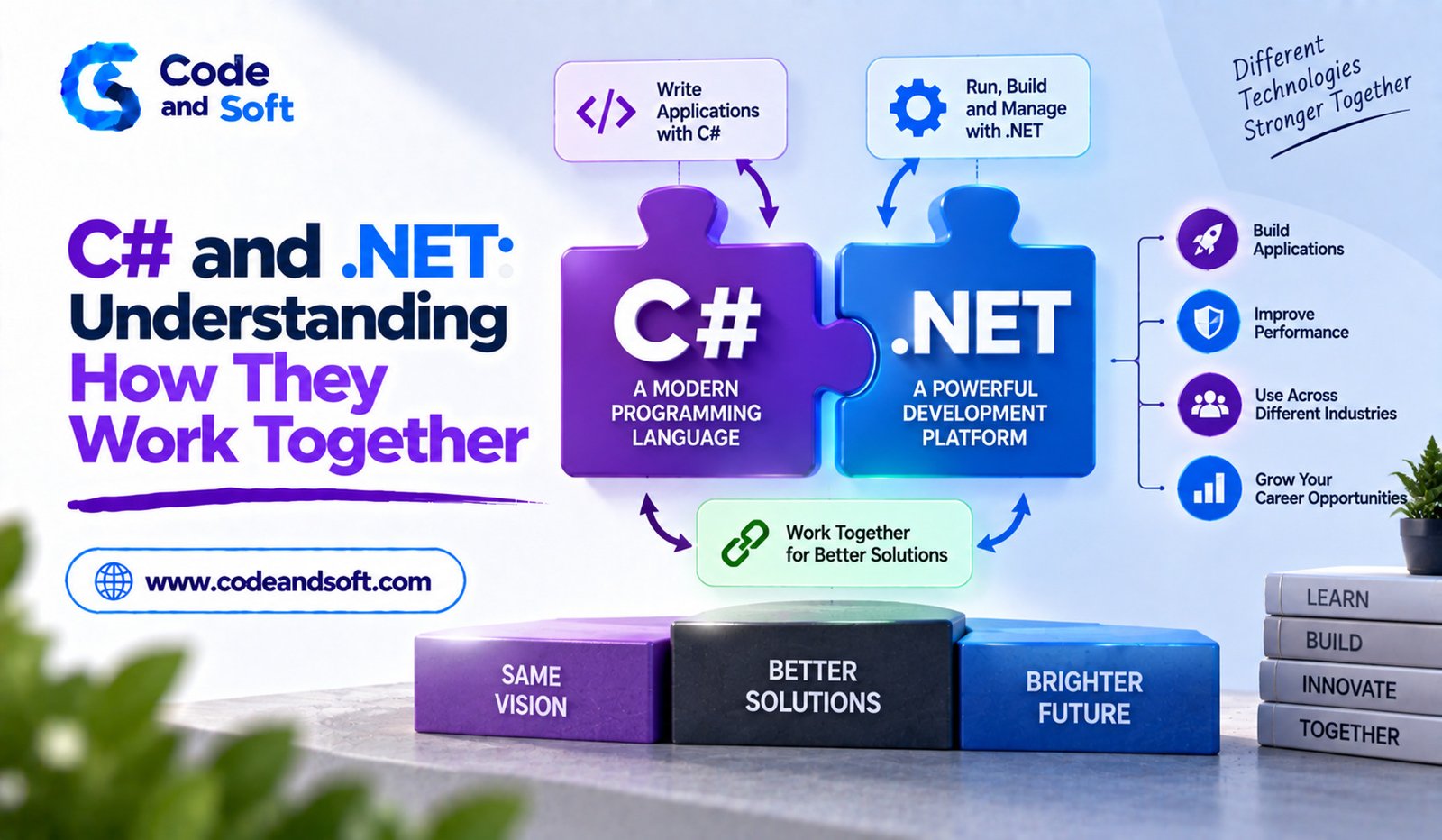
C# and .NET are two terms that developers frequently encounter when entering Microsoft’s software development ecosystem. Beginners sometimes use the names interchangeably, but they are not the same thing. C# is a programming language, while .NET is a development platform that provides the runtime, libraries, tools and frameworks needed to build and run applications.
Understanding how C# and .NET work together is important for anyone planning to develop web applications, Windows software, APIs, cloud services or enterprise systems. Once the relationship becomes clear, many concepts in the .NET ecosystem become easier to understand.
What Is C#?
C# is a modern, general-purpose programming language developed by Microsoft. It is designed to support different programming styles, although object-oriented programming is an important part of the language.
Developers use C# to write instructions that tell an application what to do. These instructions can perform calculations, process data, communicate with databases, interact with users and connect to external services.
A simple C# program might look like this:
using System;
class Program
{
static void Main()
{
Console.WriteLine(“Hello from C#”);
}
}
The C# language defines the syntax and rules used to write this code. However, the language itself is only one part of a complete application development environment.
This is where .NET becomes important.
What Is .NET?
.NET is a development platform used to create and run different types of applications.
It provides a runtime environment, standard libraries, development tools and frameworks that developers can use to build software.
With .NET, developers can create applications such as web APIs, web applications, Windows software, background services, cloud applications and other types of programs.
C# is one of the main languages used with .NET, but it is not the only language supported by the platform.
This means that C# and .NET have different roles. C# is used to write application logic, while .NET provides much of the environment required to execute and support that application.
How C# Code Runs on .NET
When developers write a C# program, the code is processed by a compiler.
The compiler converts the C# source code into an intermediate form that can be executed by the .NET runtime.
The .NET runtime then manages the execution of the application.
This model provides several useful capabilities, including memory management, exception handling and runtime services.
For beginners, the important idea is that C# source code does not simply run directly from the text file. It passes through compilation and the .NET runtime before the application performs its work.
The Role of the .NET Runtime
The runtime is an important part of how .NET applications operate.
It provides services that help programs execute without requiring developers to manually manage every low-level operation.
One major feature is automatic memory management. C# applications can create objects without requiring developers to manually release every object in the same way they might in languages with manual memory management.
The runtime includes a garbage collector that identifies objects that are no longer being used and can reclaim their memory.
This does not mean developers can completely ignore memory usage. Efficient resource management remains important, especially for large applications.
.NET Class Libraries
Another major part of .NET is its collection of libraries.
Developers frequently need functionality for working with files, collections, dates, networking, text, JSON and other common tasks.
Instead of implementing these features from scratch, developers can use the libraries available through .NET.
For example, a C# application can use a collection such as:
List<string> names = new List<string>();
names.Add(“Amit”);
names.Add(“Priya”);
names.Add(“Ravi”);
The List<T> functionality is provided through the .NET libraries, while C# provides the language syntax used to work with it.
This relationship between language features and platform libraries is one reason C# development can be productive.
C# and Object-Oriented Programming
C# provides strong support for object-oriented programming, and .NET applications frequently use classes and objects to organize functionality.
For example, an application could define a class representing a customer:
public class Customer
{
public string Name { get; set; }
public string Email { get; set; }
}
The application could then create and use customer objects.
Object-oriented programming becomes particularly useful in larger .NET applications because different parts of the software can be separated into logical components.
This makes applications easier to understand, test and maintain.
C# and ASP.NET Core
One of the most important examples of C# working with .NET is ASP.NET Core.
ASP.NET Core is a framework within the .NET ecosystem for building web applications, web APIs and backend services.
A developer can use C# to define application logic, process requests, communicate with databases and return information to clients.
For example, an API could receive a request for product information, retrieve the required data and return a response.
This makes C# and .NET a popular combination for backend development.
C# for Windows Applications
C# can also be used to build Windows applications using .NET-supported technologies.
A desktop application might be used for inventory management, accounting, employee records or internal business operations.
The user interface allows people to interact with the application, while C# can handle events, calculations, validation, database communication and business logic.
This demonstrates another advantage of the relationship between C# and .NET: developers can use the same core language across different application types.
C# and Databases
Many real-world applications need to store information in databases.
A C# application can communicate with a database through .NET data-access technologies and libraries.
For example, an enterprise application might store customer records, product information and transactions in a database. C# code can retrieve those records, process them and send updated information back to the database.
Developers can also use object-relational mapping tools to make database interaction more convenient.
Understanding both C# programming and .NET data-access technologies is therefore valuable for developers interested in business applications.
Asynchronous Programming With C# and .NET
Modern applications frequently perform operations that involve waiting.
Network requests, database queries and file operations may take time to complete. If an application blocks unnecessarily during these operations, it can become less responsive.
C# provides async and await for asynchronous programming, while .NET provides the underlying APIs and runtime support.
A simplified example is:
public async Task LoadDataAsync()
{
var data = await GetDataAsync();
Console.WriteLine(“Data loaded”);
}
This approach allows developers to write asynchronous code in a way that is relatively readable.
Asynchronous programming is particularly important for web applications and services that need to handle many operations efficiently.
What About .NET Framework?
Beginners may encounter the term “.NET Framework” when researching C#.
.NET Framework is Microsoft’s older Windows-focused framework. Modern .NET is the newer, cross-platform evolution of the .NET ecosystem.
Today, developers starting new applications will commonly encounter modern .NET rather than choosing the older .NET Framework for new development.
The distinction is worth knowing because older tutorials and enterprise applications may still use .NET Framework.
C# Is Not the Same as .NET
A simple way to remember the difference is to think of C# as the language and .NET as the platform.
C# defines how developers write program instructions.
.NET provides the runtime, libraries and frameworks that help those instructions become functioning applications.
For example, a developer might write a C# class, use a .NET collection, access a .NET API and run the application through the .NET runtime.
They work closely together, but they serve different purposes.
Why Developers Learn Both
Learning C# without understanding .NET can limit a developer’s ability to build practical applications.
Similarly, understanding .NET concepts without learning C# makes it difficult to take full advantage of the platform when C# is the chosen language.
Developers therefore commonly learn them together.
The learning process can begin with C# fundamentals such as variables, conditions, loops, methods, classes and collections. After that, developers can explore .NET libraries, file handling, databases, APIs and application frameworks.
This gradual approach provides both programming knowledge and platform knowledge.
Where C# and .NET Are Used
The combination of C# and .NET can be used across many areas of software development.
Developers can build Windows applications, web APIs, enterprise software, cloud services, backend systems, business tools and other applications.
C# can also be used in game development environments such as Unity, while .NET provides a broader ecosystem for general application development.
This flexibility makes the combination useful for developers who want to explore different areas without completely changing their programming language.
Final Thoughts
C# and .NET are closely connected, but understanding their different roles makes the ecosystem much easier to learn.
C# is the programming language used to write application logic, while .NET provides the runtime, libraries and frameworks that help developers build and run applications.
Together, they can support everything from simple console programs to Windows applications, web APIs and large enterprise systems.
For beginners, the best approach is to learn C# fundamentals first and then gradually understand how .NET provides the tools and environment around the language. Once this relationship becomes clear, concepts such as ASP.NET Core, database access, asynchronous programming and enterprise application development become much easier to understand.
Learning C# and .NET together therefore provides a strong foundation for developers who want to build modern applications across the Microsoft development ecosystem.