
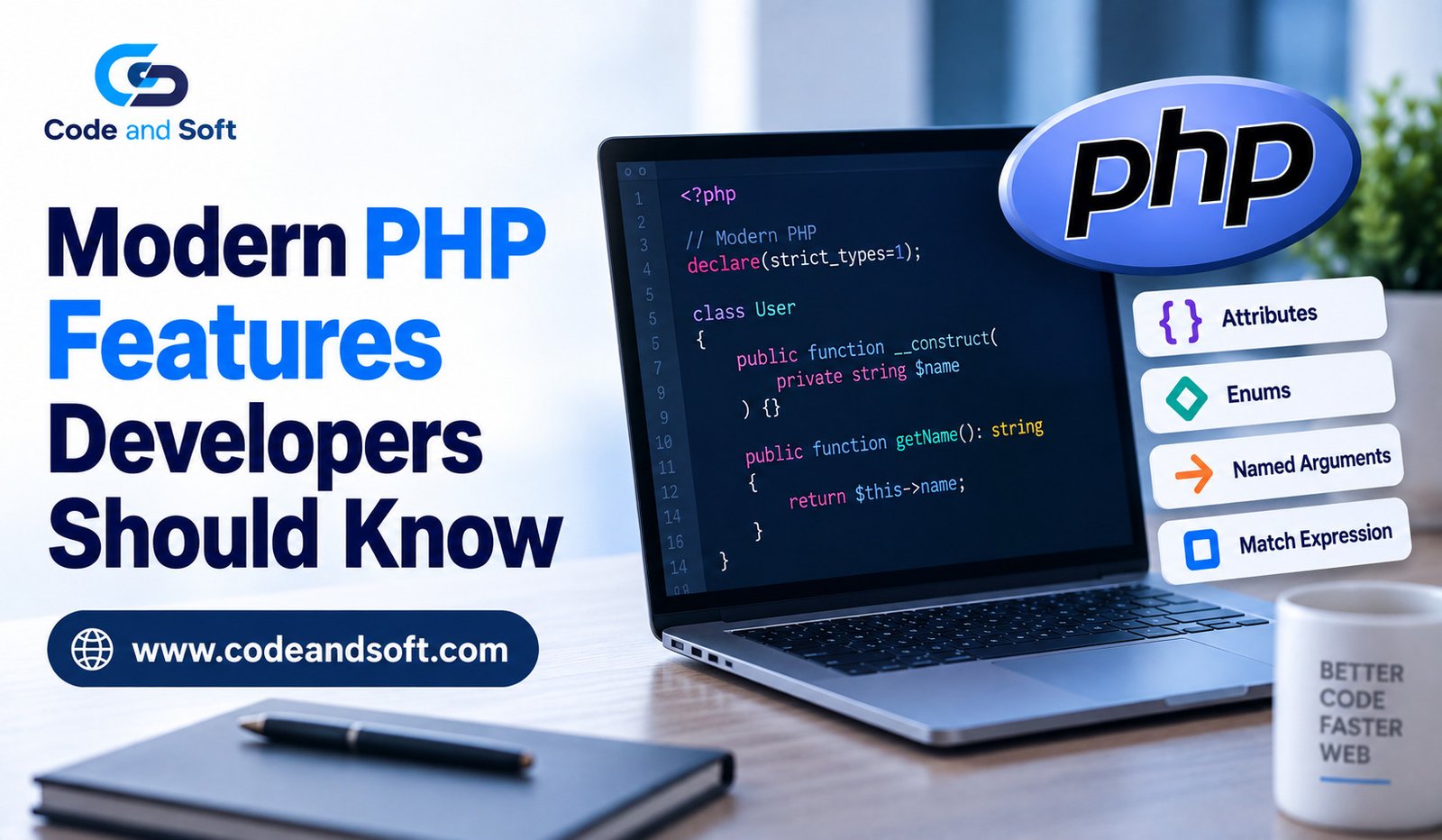

PHP has changed a lot over the years. What started as a simple language for building web pages has grown into a powerful choice for modern websites, web applications, online stores, APIs, and business software. New versions of PHP have made the language cleaner, faster, safer, and easier to work with.
For developers who learned PHP several years ago, some of the newer features may feel unfamiliar. The good news is that these features are designed to make everyday programming easier. They can help developers write code that is clearer, reduce common mistakes, and spend less time solving problems that modern PHP can handle for them.
If you are working with PHP today, understanding its newer features is important. You do not need to learn everything at once. Knowing what has changed and where each feature can help is a great starting point.
Why Modern PHP Matters
Older PHP code can still work, but modern PHP offers better ways to solve many common problems. Newer versions have introduced improvements to the way developers work with data, handle errors, define functions, create classes, and organize applications.
Modern PHP is also much faster than many older versions. Better performance means websites and applications can respond more quickly while using server resources more efficiently.
Another important change is that modern PHP encourages developers to write clearer code. Features such as named arguments, union types, match expressions, attributes, and constructor property promotion reduce the amount of repeated code developers need to write.
This does not mean every older PHP project needs to be completely rewritten. Instead, developers can understand the newer features and use them when improving existing code or creating new applications.
Typed Properties Make Code Easier to Understand
One useful improvement in modern PHP is typed properties. A property is simply a value stored inside a class. In older PHP code, developers could create properties without clearly saying what kind of value they should contain.
Modern PHP allows developers to specify the expected type.
For example, a developer can tell PHP that a user’s age should be an integer or that a user’s name should be a string.
This makes the code easier to understand. When another developer opens the file months later, they can quickly see what kind of information each property is expected to hold.
It can also help PHP catch certain mistakes earlier. If a property is expected to contain a number but receives an unsuitable value, PHP can report the problem instead of allowing confusing behavior to continue.
Typed properties are especially useful in larger applications where many classes and files work together.
Union Types Allow More Than One Type
Sometimes a value may reasonably have more than one possible type. Modern PHP supports union types for this situation.
For example, a function may accept either an integer or a string. Instead of leaving this unclear, the developer can state both possible types.
This makes the function easier to understand and provides PHP with more information about how the function should be used.
Before union types became available, developers often had to explain these situations through comments or simply rely on developers knowing the expected behavior. Modern PHP lets the code itself provide that information.
This can make a project easier to maintain, especially when several developers are working on the same application.
Named Arguments Make Function Calls Clearer
Modern PHP also supports named arguments. Normally, when calling a function, developers provide values in a particular order.
With named arguments, a developer can identify each value by its parameter name.
This is helpful when a function has several values that may be difficult to distinguish. Instead of wondering which value belongs in which position, the code clearly shows what each value means.
Named arguments can also make code easier to read. Someone looking at the function call does not always need to open the function definition to understand what the values represent.
This is a small feature, but it can make everyday PHP code much more readable.
Match Expressions Provide a Cleaner Alternative to Some Switch Statements
PHP has supported switch statements for a long time. They are still useful, but modern PHP introduced match expressions as another way to compare a value with different possibilities.
A match expression can return a result directly. It also uses strict comparison, which means PHP does not casually treat different types of values as the same.
For simple situations, match can make code shorter and easier to read than a long switch statement.
For example, an application might need to convert a user’s account status into a message. Instead of writing several lines for each possibility, a match expression can directly return the correct message.
This does not mean match should replace every switch statement. Developers should choose the option that makes the particular piece of code easiest to understand.
Nullsafe Operator Reduces Repeated Checks
Working with data that may or may not exist is common in web applications. A user may not have a profile photo, an address may not be available, or a related record may be missing.
In older PHP code, developers often had to write several checks before accessing information.
The nullsafe operator makes some of these situations much easier to handle. It allows PHP to stop safely when an earlier value is null rather than continuing with an invalid operation.
This can reduce repeated checking and make the code shorter.
The important point is not simply that the code becomes shorter. It also becomes easier to see the intended behavior: if the value is available, continue; if it is not, return null.
Constructor Property Promotion Reduces Repeated Code
Classes can sometimes contain a lot of repeated code. A developer may need to create a property and then write a constructor that receives a value and assigns that value to the property.
Modern PHP introduced constructor property promotion to simplify this process.
Instead of writing the property and assignment separately, the developer can define the property directly in the constructor.
This is particularly helpful for classes that mainly store information. It reduces unnecessary lines while keeping the purpose of the class clear.
For developers working with many classes, this feature can save time and make files less crowded.
Attributes Make Extra Information Easier to Add
Modern PHP introduced attributes as a way to attach additional information to classes, methods, properties, and other parts of code.
In older applications, developers sometimes used comments or special text formats to provide this kind of information.
Attributes provide a standard way to store such information directly in the code.
They can be useful when working with tools and frameworks that need to understand how a particular class or method should behave.
For example, a framework might use an attribute to understand that a particular method handles a certain web request.
The main benefit is that the information becomes part of the PHP code in a structured form rather than being hidden inside specially formatted comments.
Enums Make Fixed Choices Safer
Enums are another important modern PHP feature. An enum is useful when a value should come from a limited set of choices.
Imagine an application where an order can be “pending,” “paid,” “shipped,” or “cancelled.” Without an enum, developers might use plain strings throughout the application.
That can lead to spelling mistakes or inconsistent values.
An enum allows developers to define the available choices in one place. The rest of the application can then use those defined choices.
This makes code easier to understand and reduces the chance of accidentally using an invalid value.
Enums are especially useful for applications with clearly defined states, categories, or statuses.
Readonly Properties Help Protect Important Data
Some information should not change after it has been created. Modern PHP supports readonly properties for this purpose.
Once a readonly property has been given its value, it cannot normally be changed afterward.
This is useful when creating objects that represent information that should remain stable. It can prevent accidental changes later in the program.
For example, an object representing a particular record may contain an ID that should never change. Making that property readonly communicates this rule directly in the code.
It is another example of modern PHP helping developers express their intentions more clearly.
Fibers Support More Flexible Program Flow
Modern PHP also introduced fibers. They are designed for situations where a program needs to pause one piece of work and continue it later.
This is a more advanced feature, so many everyday PHP developers may not need to work with fibers directly.
However, fibers are important because they give PHP applications more options for handling certain tasks that involve waiting or switching between pieces of work.
Developers may encounter fibers through libraries and frameworks even if they never write a fiber themselves.
The important thing is to understand what they are for rather than trying to use them everywhere.
Improved Error Handling
Modern PHP has also improved the way developers can handle errors.
Older PHP applications often mixed normal errors, warnings, and exceptions in ways that could make problems difficult to understand. Modern PHP provides a more consistent approach for serious programming errors.
The Throwable system allows developers to work with both exceptions and other serious errors through a common structure.
This makes it easier to catch problems, record useful information, and provide an appropriate response.
Good error handling is especially important for websites and applications because a small programming mistake should not expose sensitive information or create a confusing experience for users.
Better String Handling
Modern PHP continues to make working with strings more convenient. Developers can use clearer syntax and built-in functions to work with text.
One useful example is str_contains(), which makes it simple to check whether one string contains another.
There are also functions such as str_starts_with() and str_ends_with(), which make common text checks easier to understand.
Instead of using complicated older approaches for simple checks, developers can now use functions that clearly describe what they are doing.
This is another small improvement that makes everyday code more readable.
Improved Performance
Modern PHP is not only about new language features. Performance has also improved significantly across recent PHP versions.
Faster PHP can help applications handle more requests while using fewer server resources. This is valuable for everything from small websites to large online platforms.
Developers should still write efficient code, but they can benefit from the improvements already built into newer PHP versions.
Keeping PHP updated can therefore provide benefits beyond access to new syntax. It can also improve the overall running experience of an application, provided the application and its dependencies support the newer version.
Modern PHP Encourages Cleaner Code
One of the biggest advantages of modern PHP is that developers have more ways to express their ideas directly in code.
Types can describe expected values. Enums can describe fixed choices. Named arguments can explain function calls. Match expressions can make comparisons clearer. Readonly properties can show that information should not change.
None of these features automatically makes an application good. Developers still need to choose sensible names, keep functions understandable, handle errors properly, and avoid unnecessary complexity.
The value of modern PHP comes from using these features where they genuinely make the code easier to read and maintain.
Should Older PHP Projects Be Updated?
If you are working on an older PHP project, moving to a newer version can be worthwhile, but it should be planned carefully.
Older projects may depend on functions, libraries, or coding practices that are no longer recommended. Simply changing the PHP version without testing the application can cause unexpected problems.
A better approach is to check the application’s current PHP version, review its libraries, test the application, and then upgrade in stages where necessary.
Once the application is running on a supported modern PHP version, developers can gradually introduce newer features when updating parts of the code.
Final Thoughts
Modern PHP is very different from the PHP many developers remember from years ago. It has become a cleaner, faster, and more capable language for building modern web applications.
Features such as typed properties, union types, named arguments, match expressions, the nullsafe operator, constructor property promotion, attributes, enums, and readonly properties can make everyday programming easier.
Developers do not need to use every new feature simply because it exists. The best approach is to understand what each feature does and use it when it makes the code clearer, safer, or easier to maintain.
For anyone still using older PHP practices, learning these modern features is a practical way to bring existing skills up to date. Even learning a few of them can make a noticeable difference in how clean and comfortable PHP development feels.