Introduction
Businesses today generate more data than ever before. From customer interactions and sales transactions to financial records and operational activities, organizations have access to massive amounts of information. However, collecting data alone is not enough. Companies need effective ways to analyze information and convert it into valuable insights.
For many years, Traditional Business Intelligence (BI) tools helped organizations understand their data through reports, dashboards, and analytics. These systems allowed businesses to track performance and make decisions based on historical information.
Now, a new generation of analytics tools powered by Artificial Intelligence (AI) is changing how companies interact with data. AI dashboards can automatically analyze information, identify patterns, predict future outcomes, and provide recommendations.
This has created an important question:
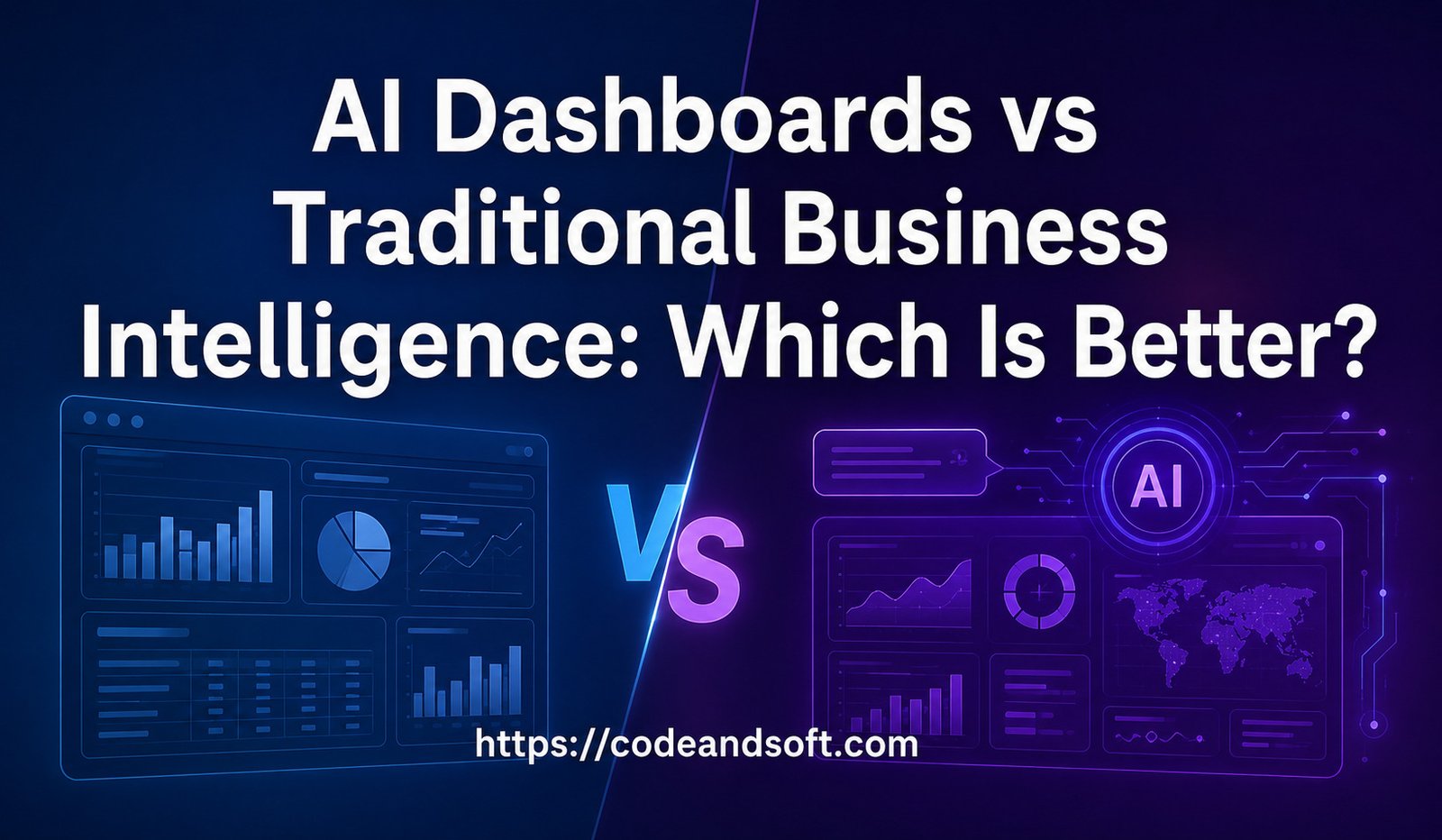
AI dashboards vs traditional Business Intelligence — which one is better?
The answer depends on business goals, data requirements, and the level of automation an organization needs. While traditional BI remains valuable for reporting and monitoring, AI dashboards provide advanced capabilities that help businesses make faster and more predictive decisions.
This article explains the differences between AI dashboards and traditional BI, their benefits, limitations, and how businesses can choose the right solution.
What Is Traditional Business Intelligence?
Traditional Business Intelligence refers to tools and processes that help companies collect, organize, analyze, and visualize business data.
Traditional BI systems mainly focus on understanding historical and current performance.
They help businesses answer questions like:
- What happened?
- How did sales perform?
- Which products generated the most revenue?
- Which areas need improvement?
Traditional BI platforms typically use:
- Data warehouses
- Reports
- Dashboards
- Charts
- Key performance indicators (KPIs)
Examples of traditional BI activities include creating monthly sales reports, tracking financial performance, and monitoring operational metrics.
What Are AI Dashboards?
AI dashboards are advanced analytics platforms that combine traditional dashboard capabilities with artificial intelligence and machine learning.
Unlike traditional dashboards that mainly display information, AI dashboards actively analyze data and provide insights.
AI dashboards can:
- Detect patterns automatically
- Predict future trends
- Identify unusual activities
- Generate recommendations
- Answer questions using natural language
For example, instead of only showing that sales decreased by 10%, an AI dashboard may explain possible reasons and suggest actions to improve performance.
AI Dashboards vs Traditional BI: Key Differences
| Feature | AI Dashboards | Traditional Business Intelligence |
| Main Purpose | Predict, analyze, and recommend actions | Report and visualize data |
| Data Approach | Future-focused and intelligent | Historical and current analysis |
| Automation Level | High automation | Requires more manual analysis |
| User Interaction | Natural language queries | Filters, reports, and dashboards |
| Decision Support | Provides recommendations | Provides information |
| Technology | AI, machine learning, automation | Reporting, analytics, visualization |
| User Skills | Easier for non-technical users | Often requires analytical knowledge |
1. Data Analysis Capabilities
Traditional BI
Traditional BI tools analyze existing data and present results through dashboards and reports.
Users usually need to:
- Select metrics
- Create reports
- Apply filters
- Interpret results
For example, a sales manager may analyze quarterly revenue reports to understand business performance.
AI Dashboards
AI dashboards go beyond reporting by automatically analyzing information.
They can:
- Find hidden patterns
- Identify important changes
- Explain data relationships
- Predict future results
For example, an AI dashboard can identify that sales are declining because customer demand has shifted toward competitor products.
Winner: AI Dashboards
AI dashboards provide deeper analysis with less manual effort.
2. Decision-Making Support
Traditional BI
Traditional BI provides information that helps managers make decisions.
However, users must interpret the data themselves.
Example:
A dashboard shows declining customer retention rates, but managers must investigate the reasons.
AI Dashboards
AI dashboards provide more direct decision support.
They can suggest:
- Recommended actions
- Potential risks
- Growth opportunities
Example:
An AI dashboard may suggest improving customer engagement strategies because certain customer groups show signs of leaving.
Winner: AI Dashboards
AI tools provide more proactive decision support.
3. Speed and Efficiency
Traditional BI
Traditional BI often requires analysts to:
- Prepare data
- Build reports
- Update dashboards
- Analyze results
This process can take time.
AI Dashboards
AI-powered systems automate many analytical tasks.
They can quickly:
- Process large datasets
- Generate insights
- Create summaries
- Detect trends
Winner: AI Dashboards
AI reduces manual work and speeds up analysis.
4. Ease of Use
Traditional BI
Traditional BI tools have become easier to use, but some users still require training to understand dashboards and analytics.
Business users may need help from data analysts for complex queries.
AI Dashboards
For example:
“Why did revenue decrease last month?”
The AI system can analyze data and provide an explanation.
Winner: AI Dashboards
AI dashboards make analytics more accessible to non-technical users.
5. Predictive Analytics
Traditional BI
Traditional BI mainly focuses on what has already happened.
It can show:
- Previous sales performance
- Historical trends
- Past customer behavior
AI Dashboards
AI dashboards use machine learning models to predict future outcomes.
They can forecast:
- Customer demand
- Sales trends
- Market changes
- Potential risks
Winner: AI Dashboards
Predictive capabilities give businesses a future-focused advantage.
6. Customization and Flexibility
Traditional BI
Traditional BI dashboards are usually created based on predefined requirements.
Changing dashboards may require technical support.
AI Dashboards
AI-powered systems can adapt based on user behavior and changing data patterns.
They can provide personalized insights for different users.
Winner: AI Dashboards
AI offers more flexibility and personalization.
Benefits of Traditional Business Intelligence
Although AI dashboards are growing rapidly, traditional BI still provides important advantages.
Reliable Reporting
Traditional BI is excellent for creating accurate and consistent reports.
Performance Tracking
Businesses can easily monitor KPIs and operational metrics.
Data Visualization
BI dashboards provide clear charts and graphs for understanding performance.
Established Technology
Many organizations already have BI systems integrated into their operations.
Better Control
Traditional BI often provides structured reporting with defined processes.
Benefits of AI Dashboards
Automated Insights
AI dashboards automatically discover important trends and patterns.
Predictive Capabilities
Businesses can forecast future outcomes and prepare strategies.
Faster Analysis
AI reduces the time required for data processing.
Natural Language Interaction
Users can communicate with data using simple questions.
Improved Decision-Making
AI recommendations help businesses make proactive decisions.
Limitations of Traditional BI
Despite its advantages, traditional BI has some limitations.
Requires Manual Analysis
Users often need to interpret reports themselves.
Limited Predictive Ability
Traditional BI mainly focuses on past and present information.
Data Dependency
Poor data quality can affect report accuracy.
Slower Decision Process
Manual reporting processes may delay insights.
Limitations of AI Dashboards
AI dashboards also have challenges.
Higher Implementation Costs
Advanced AI solutions may require more investment.
Data Quality Requirements
AI systems need accurate and well-organized data.
Lack of Human Judgment
AI recommendations still require human evaluation.
Technical Complexity
Some organizations may need expertise to implement AI solutions properly.
AI Dashboards vs Traditional BI: Which Should Businesses Choose?
The right choice depends on business requirements.
Traditional BI May Be Better If You Need:
- Standard reporting
- Performance monitoring
- KPI tracking
- Historical analysis
- Structured dashboards
For example, a company that mainly needs monthly financial reports may find traditional BI sufficient.
AI Dashboards May Be Better If You Need:
- Predictive insights
- Automated analysis
- Real-time recommendations
- Advanced forecasting
- Faster decision-making
For example, an e-commerce company predicting customer demand may benefit from AI dashboards.
Can Businesses Use Both AI Dashboards and Traditional BI?
Yes. Many organizations are combining both approaches.
Traditional BI provides a strong foundation for:
- Data management
- Reporting
- Performance tracking
AI dashboards add advanced capabilities such as:
- Prediction
- Automation
- Intelligent recommendations
Together, they create a complete analytics strategy.
For example:
A manufacturing company can use traditional BI to monitor production performance and AI dashboards to predict equipment failures.
Conclusion
AI dashboards and traditional Business Intelligence both play important roles in modern data analysis. Traditional BI remains valuable for reporting, monitoring performance, and understanding historical information.
However, AI dashboards provide advanced capabilities by predicting trends, automating analysis, and delivering intelligent recommendations.
For businesses that need simple reporting and performance tracking, traditional BI may still be the right choice. Organizations looking for faster insights, predictive analytics, and automated decision support may benefit more from AI-powered dashboards.
The future of business analytics is not about replacing traditional BI completely but combining reliable reporting with artificial intelligence to create smarter, faster, and more effective decision-making systems.