
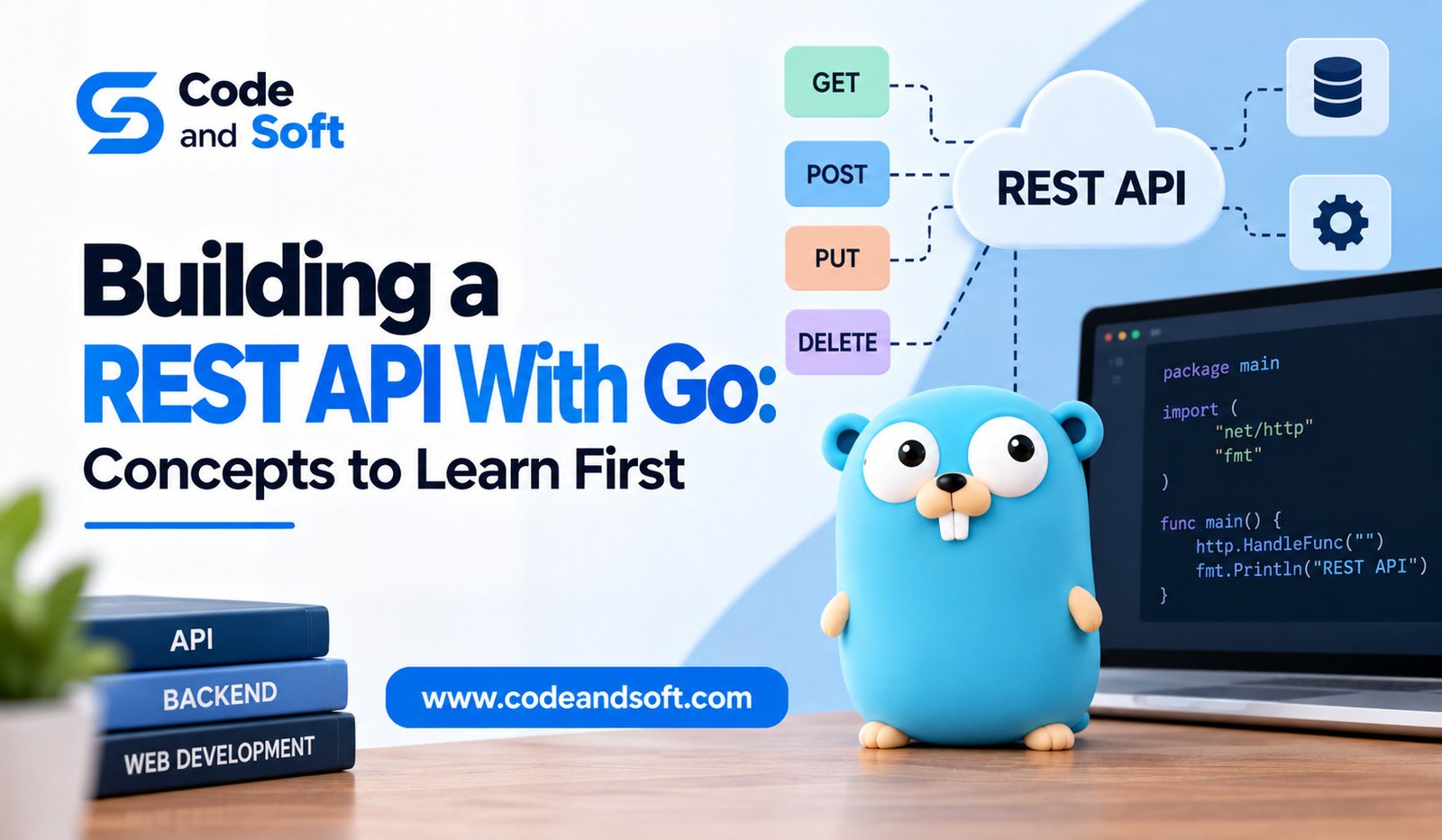
Go has become a popular programming language for building backend services, web applications, and APIs. Its straightforward syntax, strong performance, built-in concurrency features, and useful standard library make it a practical choice for developers who want to create reliable server-side applications.
For beginners, however, building a REST API with Go is easier when a few important programming and web development concepts are understood first. Instead of immediately creating routes and connecting a database, it helps to understand how Go handles functions, structures, packages, HTTP requests, JSON data, errors, and concurrency.
Learning these foundations can make REST API development much easier and help developers write cleaner and more maintainable backend code.
What Is a REST API?
A REST API allows different software applications to communicate over HTTP. A client, such as a web application or mobile app, sends a request to a server. The server processes that request and returns a response.
REST APIs commonly use HTTP methods for different operations. A GET request can retrieve information, POST can create new information, PUT or PATCH can update existing information, and DELETE can remove information.
For example, an application that manages products might use endpoints such as /products to work with a collection of products. A request to retrieve products could return JSON containing product details.
Before building such an API in Go, developers should understand basic HTTP concepts, including methods, status codes, headers, URLs, request bodies, and responses.
Understanding Go Packages
Go organizes code using packages. A package groups related functions, types, and other declarations into a reusable unit.
The main package is commonly used for executable applications. A Go backend application may also contain separate packages for database operations, business logic, authentication, and other responsibilities.
Understanding packages is important because a REST API can quickly grow beyond a single source file. Separating responsibilities helps keep the project organized and makes individual parts easier to maintain.
Go’s standard library also provides packages specifically useful for web development. The net/http package is especially important because it provides tools for creating HTTP servers and handling requests.
Learn Structs Before Working With API Data
Go does not use traditional classes in the same way as languages such as Java or C#. Instead, structures, commonly called structs, are widely used to represent related data.
For example, an API that manages customer information could represent a customer using fields such as an ID, name, and email address.
Structs are particularly important when working with JSON. Go can map JSON data to struct fields and convert structs back into JSON responses.
Developers should become comfortable with defining structs, accessing their fields, creating struct values, and using struct tags. These concepts appear frequently when designing request and response models for REST APIs.
JSON Is a Core REST API Concept
JSON is one of the most common formats used to exchange data between clients and REST APIs.
A client might send information representing a new user in JSON format. The Go server can decode that request into a struct, validate the information, process it, and return another JSON response.
Go provides the encoding/json package for working with JSON. Developers should understand two basic operations: decoding JSON received by the server and encoding Go data into JSON for the client.
Understanding JSON also helps developers recognize problems such as incorrect field names, missing values, invalid data types, and malformed request bodies.
Learn HTTP Servers and Handlers
The HTTP server is the foundation of a REST API. Go’s standard library includes functionality for creating servers without requiring a large web framework.
An HTTP handler receives a request and produces a response. Developers should understand how a handler accesses information from the request and writes information back to the client.
For example, a handler may examine the HTTP method, read URL parameters, process a request body, call application logic, and then return a JSON response.
Once handlers become familiar, developers can begin organizing them around API resources such as users, products, orders, or articles.
Understand Routing
Routing determines which piece of application code should handle a particular request.
For example, an API may have separate routes for retrieving all products, retrieving one product, creating a product, and deleting a product.
A route usually combines a URL pattern with an HTTP method. Learning routing helps developers understand how a REST API is structured and how different operations are connected to different handlers.
Go developers can begin with routing capabilities available through the standard library and later explore dedicated routing packages when their applications require more advanced functionality.
HTTP Status Codes Matter
A REST API should communicate the result of a request clearly. HTTP status codes provide an important part of that communication.
A successful request might return a status such as 200. A newly created resource can commonly use 201. If a requested resource does not exist, 404 may be appropriate. Invalid client input can result in a 400-level response, while unexpected server problems may require a 500-level response.
Learning these status codes before building an API helps developers create predictable services. Clients can then determine whether an operation succeeded or failed without relying only on response text.
Error Handling in Go
Error handling is a major part of Go programming. Instead of relying heavily on exceptions, Go commonly returns errors explicitly from functions.
REST APIs need error handling at many stages. A request body may contain invalid JSON, a database operation may fail, authentication may be unsuccessful, or a requested resource may not exist.
Developers should learn how to check returned errors and provide useful responses to clients. Consistent error handling also makes backend applications easier to troubleshoot.
A good API should avoid exposing unnecessary internal details. Responses should communicate what went wrong while keeping sensitive implementation information private.
Learn Interfaces and Dependency Separation
Interfaces become increasingly useful as Go API projects become larger.
An interface can define behavior without requiring the rest of the application to depend on a specific implementation. For example, application logic can work with a data-storage interface rather than being tightly connected to one database system.
This approach can make applications easier to test and maintain. Developers do not need to master advanced interface patterns immediately, but understanding how interfaces work provides a strong foundation for larger backend projects.
Understand Middleware
Middleware is another important concept for REST API development.
Middleware can execute logic before or after a request reaches its main handler. Common uses include logging, authentication, request tracking, rate limiting, and security-related checks.
For example, an authentication middleware can examine a request before allowing it to reach a protected endpoint.
Learning middleware helps developers understand how cross-cutting concerns can be handled separately instead of repeating the same code inside every API handler.
Database Basics Are Also Important
Most practical REST APIs need persistent data. This makes database knowledge useful when moving beyond simple examples.
Developers should understand basic concepts such as tables, records, primary keys, relationships, queries, indexes, and transactions. They should also learn how Go applications communicate with databases.
The database layer should generally remain separate from HTTP handlers. A clean structure might divide the application into routing, handlers, business logic, and data-access responsibilities.
This separation makes it easier to modify one part of the application without affecting everything else.
Learn Authentication and API Security
Security should be considered from the beginning of API development.
Developers should understand concepts such as authentication, authorization, password hashing, tokens, secure headers, input validation, and HTTPS.
Authentication answers the question of who a user is, while authorization determines what that user is allowed to do.
API endpoints that modify or expose private information should not automatically be treated as public. Proper validation and access control are essential for protecting applications and their users.
Testing Makes Go APIs More Reliable
Testing is another concept worth learning early.
A REST API can contain many possible request combinations, including valid input, invalid input, missing data, unauthorized access, and unexpected conditions.
Go includes built-in testing support that allows developers to create automated tests for functions and HTTP handlers. Testing API behavior can reveal problems before an application reaches production.
Developers can start with simple tests and gradually introduce broader integration testing as the project grows.
Concurrency and Goroutines
One of Go’s major strengths is concurrency. Goroutines provide a lightweight way to execute functions concurrently, while channels can help coordinate communication between concurrent operations.
However, beginners should not add concurrency simply because Go makes it available. REST API development should first focus on correct request handling, data management, validation, and error handling.
Once these fundamentals are understood, learning goroutines and concurrency patterns can help developers build services capable of handling demanding workloads more effectively.
Build a Small API Before a Large One
The best way to learn REST API development with Go is to start with a small project.
A simple task-management API can provide valuable practice. Begin with a few endpoints for creating, retrieving, updating, and deleting tasks. Store the data in memory initially, then introduce a database later.
After that, add validation, structured errors, middleware, authentication, logging, and automated tests.
This gradual approach allows each concept to be understood independently instead of introducing too many technologies at once.
Final Thoughts
Building a REST API with Go becomes much easier when the underlying concepts are learned first. Go packages, structs, JSON, HTTP handlers, routing, status codes, error handling, interfaces, middleware, databases, security, and testing all contribute to a strong backend foundation.
Go’s simplicity makes it possible to start with a relatively small amount of code and gradually build more sophisticated services. Rather than depending immediately on multiple frameworks and libraries, beginners can first understand how HTTP APIs work using Go’s core features.
Once these fundamentals are comfortable, developers can explore more advanced topics such as authentication systems, database optimization, API versioning, caching, observability, automated deployment, and scalable architecture. This foundation can turn a basic Go project into a reliable REST API suitable for real-world applications.