
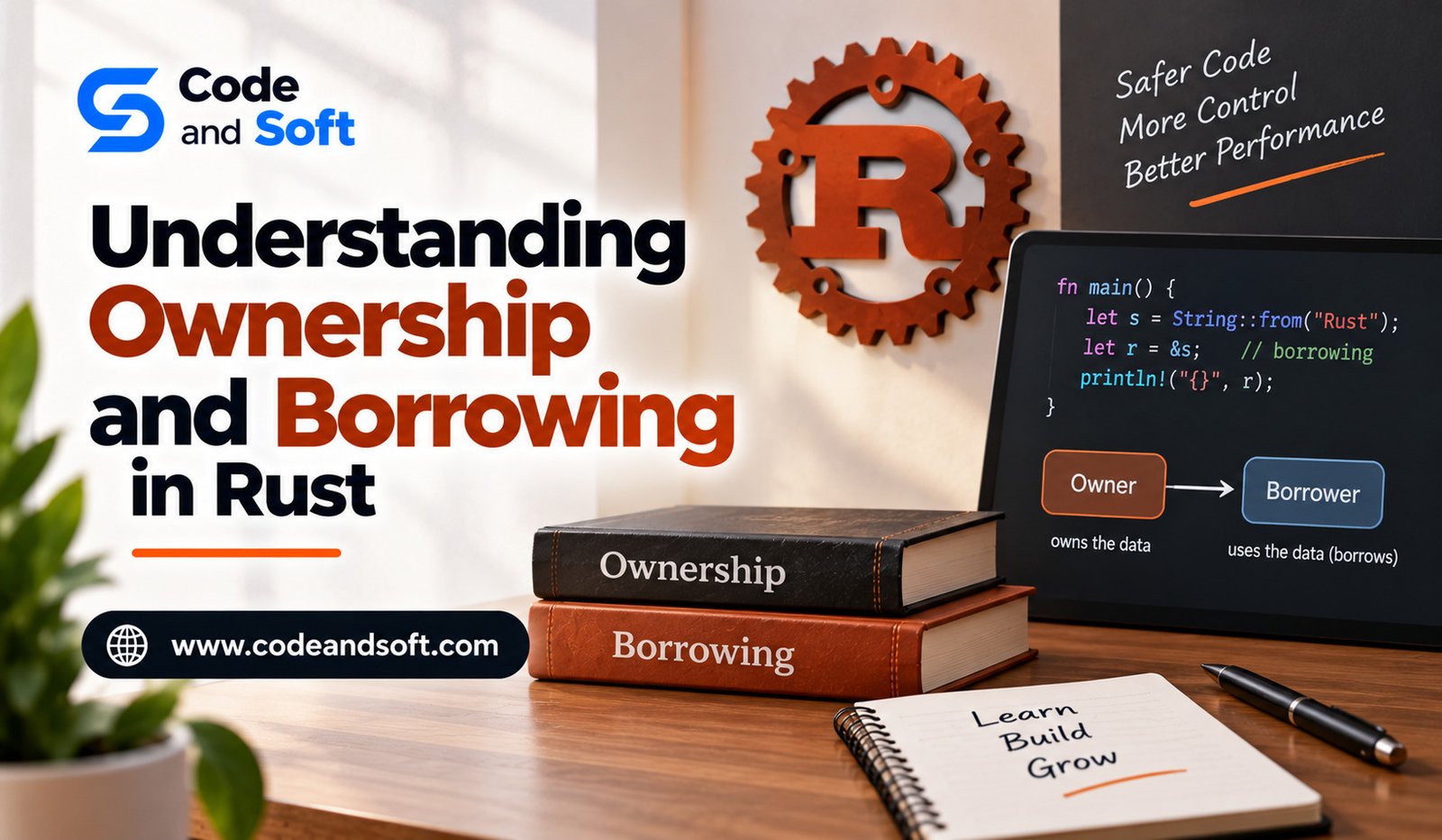

Rust is known for combining strong performance with memory safety, and one of the main reasons it can achieve this balance is its unique ownership system. Unlike languages that rely heavily on garbage collection or leave memory management entirely to the programmer, Rust uses ownership and borrowing rules to manage memory at compile time.
For beginners, ownership and borrowing can initially feel different from concepts found in languages such as C++, Java, or Python. However, once the basic ideas become clear, they provide a structured way to write reliable and efficient programs.
Understanding ownership and borrowing is essential for anyone learning Rust because these concepts influence how variables, functions, references, collections, and data structures work throughout a Rust program.
What Is Ownership in Rust?
Ownership is Rust’s system for determining which part of a program is responsible for a particular piece of data. Every value stored in memory has an owner, and the ownership rules determine what happens to that value during the program’s execution.
Rust follows three fundamental ownership rules:
- Every value in Rust has an owner.
- A value can have only one owner at a time.
- When the owner goes out of scope, the value is automatically cleaned up.
Consider a simple example:
fn main() {
let name = String::from(“Rust”);
}
Here, the variable name owns the String. When the main function finishes and name goes out of scope, Rust automatically releases the memory associated with the string.
This automatic cleanup does not require a traditional garbage collector. Rust’s compiler determines when resources are no longer needed and inserts the appropriate cleanup behavior.
Stack and Heap Memory
To understand ownership more clearly, it helps to know the difference between stack and heap memory.
Simple values with a known, fixed size can generally be stored on the stack. Integers, Boolean values, and other small fixed-size types are examples.
A String, however, can grow during program execution. Its actual text is stored on the heap, while the String value itself contains information such as a pointer to that data, its length, and its capacity.
Ownership becomes especially important for heap-allocated data because Rust needs to know exactly when that memory should be released.
When the owner of a String leaves its scope, Rust automatically calls the necessary cleanup operation.
Moving Ownership Between Variables
One of the most important ownership concepts in Rust is the move.
Consider this code:
let first = String::from(“Hello”);
let second = first;
After this assignment, ownership of the string moves from first to second. The original variable can no longer be used.
For example:
let first = String::from(“Hello”);
let second = first;
println!(“{}”, first);
This code produces a compiler error because first no longer owns the string.
Why does Rust work this way?
If both variables were allowed to independently believe they owned the same heap allocation, both could attempt to clean up the same memory. That could lead to serious memory errors.
Rust avoids this situation by transferring ownership.
The move system may seem restrictive at first, but it prevents entire categories of memory-management problems before the program runs.
Copying Simple Values
Not every assignment results in a move. Types that implement the Copy trait can be copied instead.
For example:
let x = 10;
let y = x;
println!(“{}”, x);
println!(“{}”, y);
Both variables remain usable because integers have a fixed size and can be copied efficiently.
Types such as integers, Boolean values, and certain other simple types commonly implement Copy.
The distinction between copying and moving becomes important when working with larger or heap-allocated values.
Ownership and Functions
Ownership also applies when values are passed to functions.
For example:
fn display_message(message: String) {
println!(“{}”, message);
}
fn main() {
let text = String::from(“Learning Rust”);
display_message(text);
}
The String moves into the function. After calling display_message, the original text variable cannot be used because ownership has been transferred.
This behavior can be useful when a function should take complete responsibility for a value.
However, sometimes you want a function to use data without taking ownership. This is where borrowing becomes important.
What Is Borrowing in Rust?
Borrowing allows you to use a value without becoming its owner.
Instead of passing the actual value to a function, you can pass a reference to it.
fn display_message(message: &String) {
println!(“{}”, message);
}
fn main() {
let text = String::from(“Learning Rust”);
display_message(&text);
println!(“{}”, text);
}
The & symbol creates a reference to the value.
The function can access the string, but ownership remains with text. After the function finishes, text can still be used.
This is one of the most important advantages of borrowing because it allows data to be shared without transferring ownership.
Immutable Borrowing
A normal reference created with & is an immutable reference.
This means the borrowed data can be read but not modified through that reference.
For example:
fn show_length(text: &String) {
println!(“{}”, text.len());
}
The function can inspect the string without changing it.
Rust allows multiple immutable references to the same value at the same time. This is safe because none of those references can modify the underlying data.
This rule makes it easier to reason about how information is being accessed throughout a program.
Mutable Borrowing
Rust also supports mutable references using &mut.
For example:
fn add_text(text: &mut String) {
text.push_str(” Rust”);
}
fn main() {
let mut message = String::from(“Learning”);
add_text(&mut message);
println!(“{}”, message);
}
The mut keyword on the variable allows the value to be changed, while &mut allows a function to modify the borrowed value.
Rust places strict rules around mutable references. At a particular time, you generally cannot have multiple mutable references to the same value.
This restriction helps prevent data races and unexpected changes.
Borrowing Rules in Rust
Rust’s borrowing system follows several important principles.
You can have multiple immutable references at the same time, or you can have one mutable reference. You cannot freely combine multiple mutable references with immutable references when doing so could create conflicting access.
For example, this pattern is problematic:
let mut value = String::from(“Rust”);
let reference_one = &mut value;
let reference_two = &mut value;
Rust rejects this because two mutable references could potentially modify the same data at the same time.
Although these rules may initially feel strict, they protect programs from bugs that are difficult to detect in other languages.
Ownership, Borrowing, and Lifetimes
Ownership and borrowing are closely connected to lifetimes.
A lifetime describes how long a reference remains valid. Rust’s compiler analyzes references and ensures that they do not outlive the data they point to.
For example, Rust prevents a function from returning a reference to data that has already been destroyed.
This compile-time checking is one reason Rust can provide memory safety without depending on a garbage collector.
In many everyday programs, developers do not need to manually write lifetime annotations because Rust can infer them. Explicit lifetime syntax becomes more important in advanced code involving multiple references and complex relationships between data.
Why Ownership and Borrowing Matter
Ownership and borrowing are not simply additional Rust features. They form the foundation of the language’s approach to memory management.
They help Rust prevent problems such as use-after-free errors, double frees, dangling references, and many types of data races.
The biggest advantage is that many of these problems are detected during compilation rather than after a program has already been deployed.
This makes Rust especially attractive for systems programming, backend infrastructure, embedded software, command-line tools, and performance-sensitive applications.
Common Beginner Challenges
Many new Rust developers initially struggle with compiler messages related to moved values or borrowed data.
A common mistake is trying to use a variable after transferring its ownership. Another is attempting to create conflicting mutable and immutable references.
Instead of treating compiler errors as obstacles, beginners should use them as explanations of Rust’s safety model.
A useful learning approach is to start with simple values, then practice moving String values, passing ownership into functions, creating immutable references, and finally working with mutable references.
With repeated practice, these rules become much more intuitive.
Ownership and Borrowing Make Rust Different
Rust’s ownership and borrowing system gives the language a distinctive approach to memory management. Instead of relying entirely on a garbage collector or requiring developers to manually manage every allocation, Rust uses compile-time rules to control how data is created, moved, accessed, and cleaned up.
Ownership determines who is responsible for a value, while borrowing allows other parts of a program to temporarily access that value without taking control of it.
Once these concepts become familiar, many other Rust features start to make more sense. Functions, collections, references, lifetimes, and concurrency all build upon the same fundamental ideas.
For anyone learning Rust, mastering ownership and borrowing is one of the most valuable steps toward writing safe, efficient, and dependable programs.