
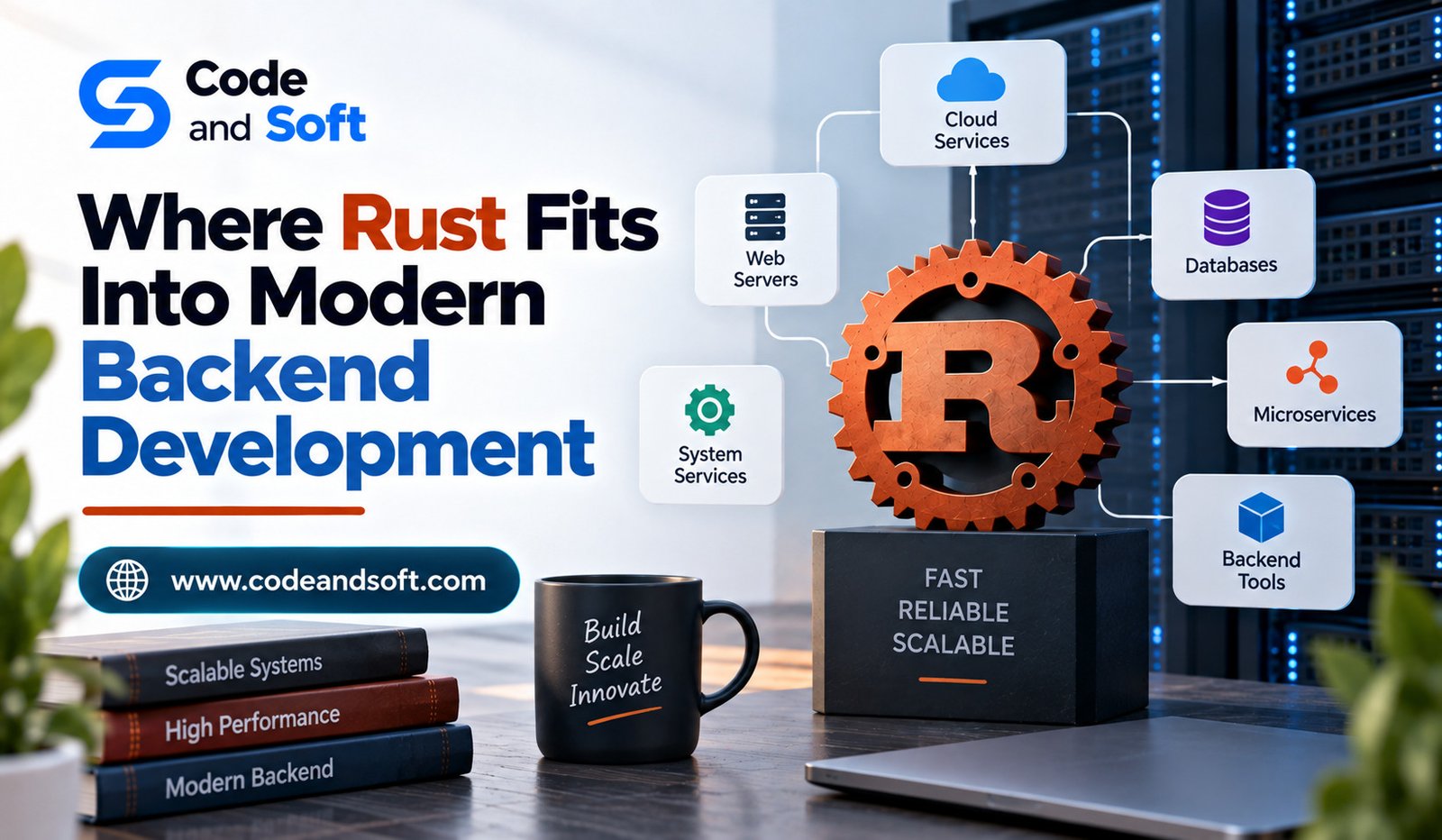

Backend development has changed significantly as applications have become more connected, data-driven, and performance-sensitive. Modern backend systems may need to handle large numbers of requests, communicate with databases and external services, process background jobs, manage real-time connections, and run reliably in cloud environments.
Rust has emerged as an interesting option for these workloads because it combines low-level performance with compile-time memory safety. While languages such as Java, JavaScript, Python, Go, and C# remain widely used for backend development, Rust offers a different approach for teams that need efficient resource usage and predictable performance.
Understanding where Rust fits into modern backend development requires looking beyond programming language popularity. The more useful question is where Rust’s strengths provide practical advantages and when those advantages justify its learning curve.
Why Rust Is Relevant to Backend Development
Rust was originally designed with systems programming in mind, but many of its characteristics also apply naturally to backend services.
Backend applications frequently need to run continuously, manage memory efficiently, process concurrent requests, and communicate with other services. Rust’s ownership model helps developers manage memory without relying on a traditional garbage collector, while its type system catches many programming mistakes during compilation.
Performance is another important factor. Rust code can be compiled into efficient native executables, making the language suitable for services where CPU usage, response time, and resource consumption matter.
This does not mean every backend application needs Rust. For many projects, developer productivity and ecosystem maturity may matter more than maximum performance. Rust becomes particularly interesting when performance, reliability, and resource efficiency are important parts of the application’s requirements.
Building High-Performance APIs
One of the clearest uses of Rust in backend development is building APIs.
An API acts as a communication layer between applications, clients, databases, and other services. A backend service may receive thousands of requests, validate incoming information, perform calculations, access storage, and return responses.
Rust can be used to create REST APIs, JSON-based services, and other network applications. Its compiled nature and efficient runtime characteristics can make it a strong option for performance-focused services.
Rust also provides frameworks and libraries that simplify common backend tasks such as routing, HTTP handling, request extraction, serialization, middleware, and application state management.
Developers can therefore build structured backend services without giving up the performance characteristics associated with systems programming.
Rust and Concurrent Applications
Concurrency is an important part of modern backend systems.
A service may need to handle many connections at the same time, execute independent tasks, process queues, or communicate with multiple external systems. Rust’s approach to concurrency is one of its major strengths.
The language’s ownership and type systems help prevent many unsafe patterns when data is shared between threads. Instead of allowing developers to freely access shared mutable memory, Rust requires code to follow rules that make concurrent access safer.
This can be especially valuable in backend applications that need to process large numbers of simultaneous operations.
Rust’s asynchronous programming ecosystem also supports applications that spend significant time waiting for network or storage operations. This makes it possible to design efficient services without creating an unnecessarily large number of operating-system threads.
Microservices and Distributed Systems
Modern backend architectures often divide large applications into smaller services.
A microservice may handle authentication, payments, notifications, search, reporting, data processing, or another specific responsibility. Each service can be developed, deployed, and scaled independently.
Rust can be a strong fit for microservices where low memory consumption and predictable performance are important.
A small Rust service can be compiled into a standalone executable and deployed as part of a containerized environment. This can simplify the runtime environment and reduce some of the dependencies associated with application stacks that require a larger runtime.
Rust is also useful when a service is expected to perform CPU-intensive work. Instead of moving every performance-sensitive component into a separate lower-level language, teams can implement the service itself in Rust.
Rust for Real-Time Backend Services
Some backend applications must respond to events quickly. Examples include messaging systems, multiplayer services, financial infrastructure, telemetry platforms, and live collaboration tools.
These applications often involve long-lived network connections and large numbers of simultaneous events.
Rust’s performance and concurrency features make it suitable for these workloads. Developers can build systems that maintain many connections while carefully controlling memory and processing resources.
Real-time applications also benefit from predictable behavior. A backend that experiences inconsistent pauses or excessive resource usage can negatively affect users.
Rust does not automatically guarantee perfect latency, but its low-level control can help teams design systems where resource behavior matters.
Rust for Backend Infrastructure and Platform Software
Rust is not limited to customer-facing APIs.
Backend infrastructure includes services that perform tasks such as data processing, message handling, proxying, networking, monitoring, configuration management, and internal automation.
These components often run continuously and may operate at significant scale. Efficiency can therefore have a direct effect on infrastructure costs.
Rust’s ability to produce native binaries makes it attractive for tools that need to start quickly, use limited memory, and operate reliably for long periods.
Infrastructure teams can also use Rust for specialized services where performance or memory safety is more important than having the largest possible developer pool.
Database Interaction in Rust
Database access is a central part of backend development, and Rust provides libraries for working with relational and other types of databases.
A typical Rust backend can receive a request, validate its data, query a database, process the returned records, and send a response to the client.
Rust’s strong type system can be helpful when modeling application data and converting information between database records and application structures.
Database performance, however, depends on much more than programming language choice. Query design, indexing, connection management, caching, database architecture, and network latency can have a far greater impact on many applications.
For this reason, Rust should be viewed as one part of the backend performance equation rather than a solution to every database bottleneck.
Rust and Cloud-Native Development
Cloud platforms have encouraged developers to think carefully about resource consumption.
Applications may run inside containers, scale horizontally, or be deployed as short-lived services. In such environments, efficient CPU and memory usage can become valuable.
Rust works well with containerized deployments because a compiled application can be packaged with the components required to run it, without necessarily needing a large language runtime.
Rust can also be used in cloud-native services that perform intensive background processing, API operations, event handling, and infrastructure tasks.
The language’s ability to produce compact native applications can be useful in environments where startup time and resource efficiency are important.
Where Rust May Not Be the Best Choice
Rust has clear strengths, but choosing it for every backend project would be unnecessary.
One of the main challenges is the learning curve. Concepts such as ownership, borrowing, lifetimes, traits, and advanced type-system features require time to understand.
For a small internal application where development speed matters more than runtime efficiency, a language with a simpler learning path may be more practical.
The availability of developers is another consideration. Teams already experienced with another backend ecosystem may be able to deliver a project faster without introducing a new language.
Rust’s growing ecosystem is capable, but some areas may not have the same breadth of third-party libraries, tutorials, and established patterns available in more mature backend ecosystems.
Where Rust Makes the Most Sense
Rust is particularly attractive when several requirements come together.
A backend service may be a strong candidate for Rust when it needs efficient resource usage, high concurrency, predictable performance, strong memory safety, and long-term reliability.
It can also make sense for performance-critical services inside a larger architecture. A company does not necessarily need to rewrite an entire backend in Rust. Instead, it can use Rust for the components where its characteristics provide the greatest value.
This selective approach can allow teams to benefit from Rust without making every part of an application dependent on the language.
Rust Compared With Other Backend Languages
Backend development does not have a single ideal language.
Python can be highly productive and has an extensive ecosystem. Java has a long history in enterprise software and large-scale backend systems. JavaScript and TypeScript are widely used across web development. Go is known for simplicity, efficient concurrency, and cloud infrastructure applications.
Rust approaches the problem from a different angle by emphasizing memory safety and low-level control while still supporting modern application development.
The right choice depends on the project’s requirements, team experience, expected traffic, operational constraints, and performance goals.
The Growing Role of Rust in Backend Engineering
Rust is gradually becoming more relevant to backend development because modern software increasingly needs to balance performance with reliability.
As applications move toward distributed architectures and resource-efficient cloud deployments, backend teams have more reasons to examine languages that provide strong control over system resources.
Rust fits particularly well in performance-sensitive APIs, concurrent services, infrastructure software, real-time systems, and specialized backend components.
Its future in backend development is unlikely to involve replacing every established language. A more realistic role is as a specialized and increasingly general-purpose option for services where safety, efficiency, and predictable performance provide meaningful advantages.
Final Thoughts
Rust fits into modern backend development as a performance-focused language capable of building reliable and efficient services. Its ownership model, concurrency guarantees, native performance, and memory-safety features give developers tools for handling demanding backend workloads without sacrificing low-level control.
It is not automatically the best choice for every API, web application, or business service. However, when an application needs efficient resource usage, high concurrency, strong reliability, or performance-sensitive processing, Rust can become a compelling backend technology.
For developers willing to learn its distinctive programming model, Rust offers a path from systems-level programming to modern APIs, microservices, cloud infrastructure, and real-time backend applications. Its place in backend engineering is therefore not about replacing every other language, but about providing a powerful option where safety and performance need to work together.