

Introduction
In 2026, businesses are operating in an environment where speed, accuracy, and adaptability determine success. Customer expectations are changing quickly, markets are becoming more competitive, and organizations are generating massive amounts of data every second. Traditional reporting methods that rely on historical data are no longer enough for companies that need to respond immediately to opportunities and challenges.
This is where Real-Time Business Intelligence (BI) becomes increasingly important. Real-time BI allows organizations to collect, analyze, and visualize data instantly, helping decision-makers understand current business conditions and take immediate action.
Unlike traditional BI systems that often analyze past performance, real-time Business Intelligence provides continuous updates from live data sources. Businesses can monitor sales, customer behavior, operations, financial performance, and market trends as they happen.
In 2026, real-time BI is becoming a critical technology for companies that want to improve efficiency, enhance customer experiences, reduce risks, and make faster data-driven decisions.
What Is Real-Time Business Intelligence?
Real-Time Business Intelligence is an advanced analytics approach that allows businesses to access and analyze updated information immediately after it is generated.
Traditional BI typically works with historical data collected over days, weeks, or months. Real-time BI uses live data streams from multiple sources and displays current information through interactive dashboards.
Real-time BI can analyze data from:
- Sales transactions
- Customer interactions
- Website activity
- IoT devices
- Financial systems
- Supply chain platforms
- Social media channels
- Business applications
For example, an online retailer can use real-time BI to monitor current customer purchases, track inventory levels, and adjust marketing strategies instantly.
Why Real-Time Business Intelligence Matters in 2026
1. Faster Decision-Making
One of the biggest advantages of real-time BI is the ability to make decisions quickly.
In the past, businesses often waited for weekly or monthly reports before taking action. However, delayed information can result in missed opportunities or increased risks.
Real-time BI provides immediate insights, allowing companies to:
- Identify problems quickly
- Respond to customer demands
- Adjust strategies instantly
- Take advantage of market changes
For example, a company can detect a sudden decline in sales and investigate the issue immediately instead of discovering it at the end of the month.
2. Better Customer Experiences
Customer expectations are higher than ever in 2026. People expect personalized services, faster responses, and seamless interactions.
Real-time BI helps businesses understand customers by analyzing live data such as:
- Browsing behavior
- Purchase history
- Customer feedback
- Support interactions
- Engagement patterns
Companies can use these insights to provide:
- Personalized recommendations
- Targeted offers
- Faster customer support
- Improved services
For example, streaming platforms can analyze viewing behavior in real time to recommend content based on user interests.
3. Improved Operational Efficiency
Businesses need efficient operations to reduce costs and remain competitive.
Real-time BI helps organizations monitor daily activities and identify inefficiencies immediately.
Companies can track:
- Production performance
- Employee productivity
- Inventory movement
- Equipment performance
- Supply chain activities
Manufacturers, for example, can use real-time data from machines to detect performance issues before they cause production delays.
4. Real-Time Fraud Detection and Risk Management
Fraud and security risks continue to be major concerns for businesses.
Real-time BI helps organizations identify unusual patterns and suspicious activities immediately.
Financial institutions can analyze:
- Transaction behavior
- Account activity
- Payment patterns
If the system detects unusual activity, businesses can take preventive action before major losses occur.
5. Smarter Inventory Management
Inventory management is a major challenge for retailers, manufacturers, and distributors.
Real-time BI provides updated information about:
- Stock availability
- Product demand
- Sales trends
- Supply chain movement
Businesses can avoid:
- Overstocking
- Product shortages
- Unnecessary storage costs
For example, retailers can automatically identify popular products and adjust inventory levels based on current demand.
6. Competitive Advantage
Markets change quickly, and businesses that respond faster often gain an advantage.
Real-time BI helps companies understand:
- Competitor activities
- Customer preferences
- Market trends
- Industry changes
Organizations can adjust their strategies based on current information rather than relying only on past data.
7. Better Financial Management
Financial decisions require accurate and timely information.
Real-time BI allows finance teams to monitor:
- Revenue performance
- Expenses
- Cash flow
- Profit margins
- Budget usage
Businesses can quickly identify financial problems and make adjustments before issues become serious.
How Real-Time Business Intelligence Works
Real-time BI involves several important technologies working together.
Data Collection
Real-time BI collects information continuously from different sources, including:
- Databases
- Cloud applications
- Sensors
- Websites
- Business systems
Data Processing
The collected data is processed immediately using advanced analytics technologies.
Modern systems use:
- Data streaming
- Cloud computing
- Artificial intelligence
- Machine learning
Data Visualization
The processed information is displayed through interactive dashboards.
Users can view:
- Live charts
- Performance indicators
- Alerts
- Trend analysis
Key Features of Real-Time BI Platforms
Live Dashboards
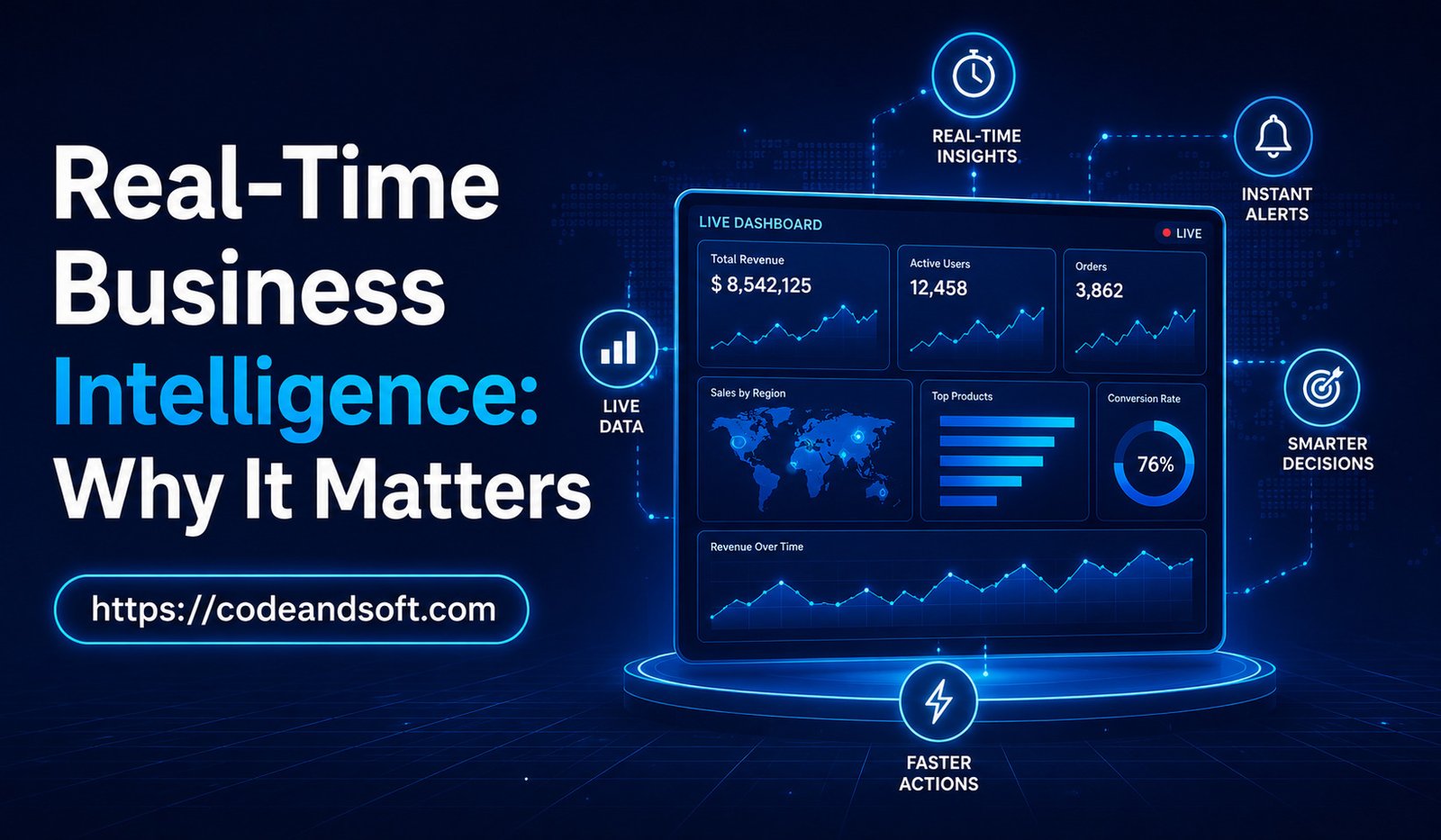
Real-time dashboards provide updated information without requiring manual report generation.
Businesses can monitor important metrics instantly.
Automated Alerts
Real-time BI systems can notify users about important events.
Examples:
- Sudden sales drops
- Inventory shortages
- Unusual transactions
Predictive Analytics
AI-powered BI platforms analyze current data to predict future outcomes.
Businesses can forecast:
- Customer demand
- Sales trends
- Operational risks
Self-Service Analytics
Modern BI platforms allow employees to analyze data without depending on technical teams.
Data Integration
Real-time BI connects multiple systems to provide a complete business view.
Real-Time BI Applications Across Industries
Retail
Retail companies use real-time BI for:
- Customer behavior analysis
- Dynamic pricing
- Inventory monitoring
- Sales tracking
Manufacturing
Manufacturers use real-time analytics for:
- Machine monitoring
- Production optimization
- Quality control
- Predictive maintenance
Healthcare
Healthcare organizations use real-time BI for:
- Patient monitoring
- Resource management
- Operational efficiency
Banking and Finance
Financial organizations use real-time BI for:
- Fraud detection
- Risk management
- Customer insights
Transportation and Logistics
Companies use real-time BI to track:
- Vehicle movement
- Delivery performance
- Route optimization
Real-Time BI vs Traditional BI
| Feature | Real-Time BI | Traditional BI |
| Data Updates | Instant or continuous | Periodic updates |
| Focus | Current and future decisions | Historical analysis |
| Decision Speed | Immediate | Slower |
| Reporting | Automated live dashboards | Scheduled reports |
| Data Sources | Live data streams | Stored historical data |
| Best For | Fast-changing environments | Long-term analysis |
Both approaches have value, but real-time BI provides a stronger advantage for businesses that need immediate insights.
Role of Artificial Intelligence in Real-Time BI
Artificial intelligence is making real-time BI more powerful in 2026.
AI helps businesses by:
Automatically Finding Patterns
AI systems can discover trends that humans may overlook.
Providing Recommendations
AI can suggest actions based on current data.
Predicting Future Events
Machine learning models can forecast possible outcomes.
Reducing Manual Analysis
AI reduces the need for constant human monitoring.
Challenges of Implementing Real-Time BI
Despite its benefits, real-time BI implementation can create challenges.
Data Management Complexity
Handling continuous data streams requires strong data infrastructure.
Higher Technology Costs
Advanced BI systems may require investment in software and cloud resources.
Data Security Concerns
Real-time data processing requires strong security measures.
Employee Training
Teams need proper training to use BI tools effectively.
Best Practices for Adopting Real-Time BI
Define Clear Objectives
Businesses should identify specific goals before implementation.
Choose the Right Data Sources
Focus on information that directly supports business decisions.
Maintain Data Quality
Accurate data is essential for reliable insights.
Invest in Security
Protect sensitive business information through proper security controls.
Train Employees
Ensure teams understand how to use dashboards and analytics.
Conclusion
Real-Time Business Intelligence is becoming a critical technology for businesses in 2026. As markets move faster and customer expectations increase, organizations need immediate access to accurate information to remain competitive.
By providing live insights, automated alerts, predictive analytics, and improved visibility, real-time BI helps businesses make faster decisions, optimize operations, and deliver better customer experiences.
Companies that adopt real-time Business Intelligence can respond quickly to changes, reduce risks, and discover new growth opportunities. In the future, real-time data analysis will not just be an advantage—it will become a necessity for businesses that want to succeed in a rapidly changing digital world.