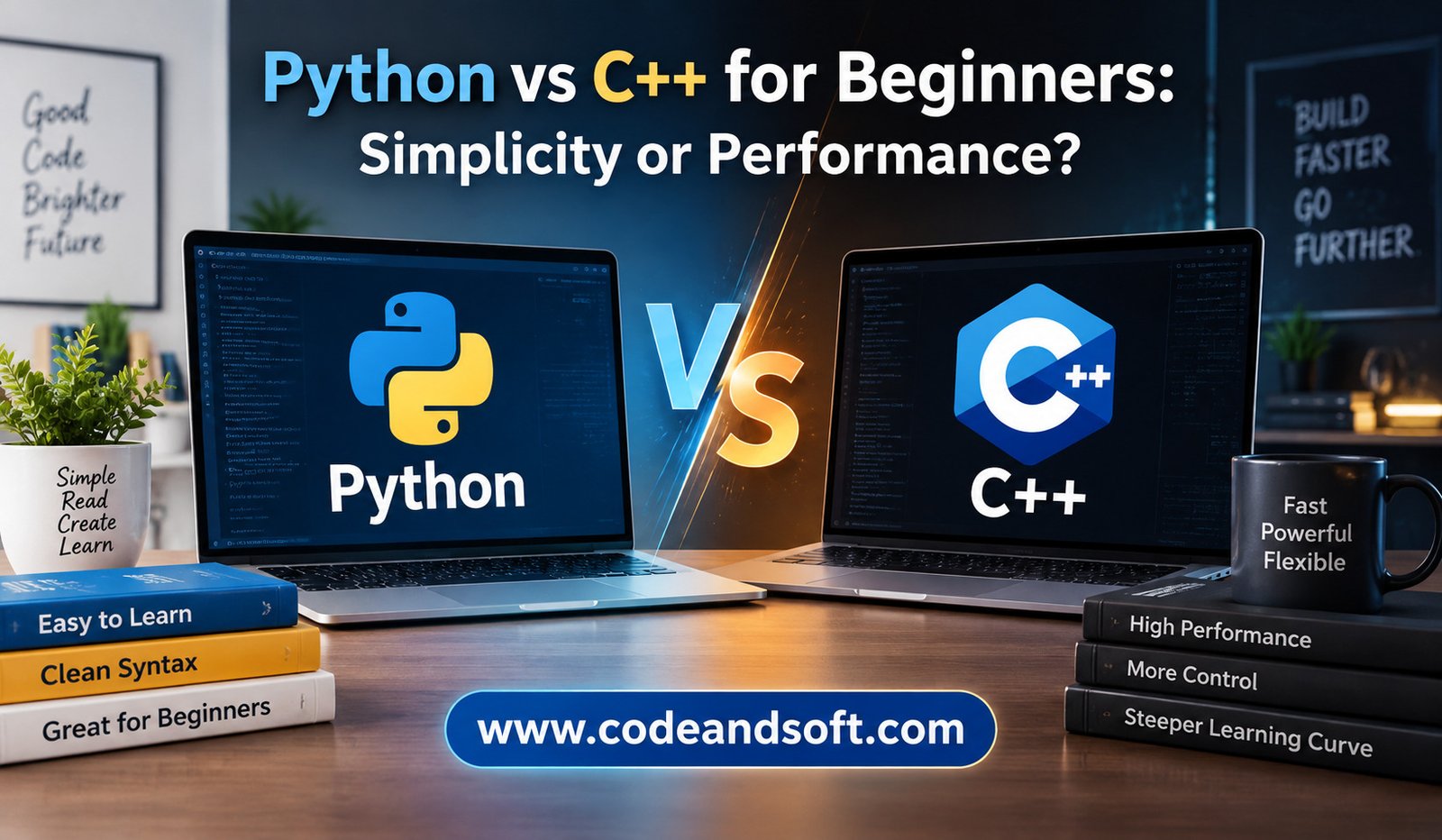

Choosing your first programming language can feel confusing. There are many popular options, but Python and C++ often stand out for beginners who want to learn programming seriously. Both languages are powerful, widely used, and capable of helping you build useful projects. However, they offer very different learning experiences.
Python is known for its simple and readable style. C++, on the other hand, gives programmers more control over how a computer uses its resources and is known for excellent speed. This creates an important question for new learners: should you choose simplicity with Python or performance with C++?
The right answer depends on what you want to learn, what you want to build, and how comfortable you are with technical details. This guide compares Python and C++ in simple terms so you can make a better choice.
Understanding Python and C++
Python is a general-purpose programming language that was designed with readability in mind. Its code is usually short and easy to understand. This makes it a popular choice for people who are learning programming for the first time.
Python is used for many different types of work. Developers use it to create websites, automate everyday tasks, work with data, build artificial intelligence applications, create tools, and develop many other kinds of software. Because the language is relatively easy to read, beginners can often start writing useful programs quickly.
C++ has been around for much longer and has a different approach. It gives programmers greater control over how their programs work and how computer resources are used. It is commonly used for game development, desktop software, operating systems, high-performance applications, and other projects where speed is especially important.
C++ can certainly be learned by beginners, but it generally requires more patience. New programmers need to understand more concepts before they can comfortably create larger programs.
Which Language Is Easier to Learn?
For most beginners, Python is the easier language to start with.
One reason is the way Python code looks. You can write a simple program using only a few lines, and those lines are often close to normal English. This allows beginners to focus more on understanding programming ideas instead of spending too much time worrying about complicated rules.
For example, displaying a message in Python is very simple. You can write a command that tells the computer to display the words you want. The code is short, clean, and easy to read.
C++ usually requires more code to perform even simple tasks. Beginners have to learn additional rules about how a C++ program is structured. At first, this can make small programs feel more complicated than they really are.
This does not mean C++ is a bad language for beginners. It simply means that the first stage of learning may feel heavier compared with Python.
If your main goal is to understand basic programming ideas quickly, Python usually provides a smoother beginning.
Python Has a Simpler Writing Style
A programming language is easier to learn when you can quickly understand what your own code is doing. Python does well in this area because it avoids a lot of unnecessary symbols and complicated instructions.
When you read Python code, you can often understand its purpose without knowing every technical detail. This is especially helpful during the early stages of learning.
C++ has a more detailed writing style. It uses additional symbols and requires programmers to pay closer attention to how information is stored and handled. These features can be useful when building advanced software, but they can also make the language feel difficult at first.
As you become more experienced, these differences become less important. However, for someone writing their first programs, Python’s simple style can make the learning process much less frustrating.
Which Language Helps You Learn Programming Faster?
Python can help beginners reach their first results faster.
Imagine that you want to create a small calculator, a simple text-based game, or a program that works with a file. Python lets you start experimenting without requiring you to understand too many computer-related details.
This quick progress can be encouraging. You write some code, run it, see the result, and then change it to see what happens. That process can help beginners develop confidence.
C++ may take longer to reach the same point because there are more concepts to understand. However, this extra effort can also be valuable. C++ teaches you more about what is happening inside the computer, which can give you a strong foundation for certain types of programming.
Therefore, Python may be better for quick progress, while C++ can provide a deeper understanding of how software interacts with the computer.
Python vs C++ Performance
When it comes to raw speed, C++ generally has the advantage.
C++ is designed to allow programs to run very efficiently. Programmers have more control over how computer memory and other resources are used. This makes C++ a popular choice for applications where every bit of performance matters.
Python is generally slower for many tasks because of the way Python programs are processed. For everyday applications, however, this difference is often not important.
A beginner building a small website, automation tool, calculator, or basic data project usually does not need the maximum possible speed. In these situations, Python’s simplicity can be more valuable than C++’s performance.
The difference becomes more important when working on demanding applications such as large games, advanced graphics software, or programs that need to process huge amounts of information very quickly.
So, while C++ wins the performance comparison, that does not automatically make it the better language for every beginner.
Which Language Is Better for Building Projects?
The best choice depends on the type of project you want to create.
Python is a strong option if you want to build small tools, websites, automation programs, data-related applications, or beginner-friendly software. You can also use it to explore artificial intelligence and machine learning.
C++ is a strong choice if you are interested in game engines, graphics, system software, performance-focused applications, or software that needs close control over computer resources.
This does not mean you can only use Python for simple projects or C++ for complicated projects. Both languages can be used for large and advanced software. The difference is that they approach programming in different ways.
Python usually lets you focus on what you want the program to do. C++ often requires you to pay more attention to how the program does it.
Python or C++ for Game Development?
Game development is one area where the choice can become interesting.
C++ has a strong position in the gaming industry because games can require fast graphics, quick responses, and efficient use of computer resources. Many major game tools and engines use C++ heavily.
Python can also be used for making games, especially simple games and learning projects. It is a good way for beginners to understand game logic without immediately dealing with the more complicated parts of C++.
If you want to learn programming through small games, Python can be a friendly starting point. If your long-term goal is professional game development, learning C++ can become very useful.
Python or C++ for Jobs?
Both languages can lead to programming careers.
Python is used across many industries, which gives beginners plenty of possible directions. It is popular in web development, data work, automation, artificial intelligence, testing, and software development.
C++ is especially valuable in areas where speed and direct control over computer resources are important. It appears in gaming, financial software, operating systems, engineering applications, and other performance-focused fields.
The number of jobs should not be the only reason you choose a language. Programming skills are more important than simply knowing one language. Once you understand programming well, learning another language becomes much easier.
Someone who starts with Python and later learns C++ can understand both simple programming concepts and more detailed computer-related ideas.
Which Language Is Better for Students?
Python is often a comfortable choice for students because it allows them to focus on problem-solving.
Students can learn concepts such as variables, conditions, loops, functions, and basic data handling without dealing with too many complicated rules at the beginning.
C++ can also be an excellent choice for students, especially those studying computer science or subjects where understanding computer systems is important. It can teach students to think carefully about how programs use memory and other resources.
If a student is completely new to programming and wants a gentle introduction, Python is usually the easier option. If the student enjoys technical challenges and wants to understand computers at a deeper level, C++ can be a rewarding choice.
Is C++ Too Difficult for Beginners?
C++ is not too difficult to learn, but it can be more demanding.
The biggest problem is usually not the language itself. The challenge comes from the number of ideas beginners may need to understand at the same time.
A new programmer can become confused when learning C++ because the language gives them more control than they may be ready to handle. Small mistakes can sometimes produce confusing results.
The good news is that beginners do not need to understand everything immediately. Starting with basic programs and slowly moving toward more advanced topics can make C++ much easier.
If you enjoy understanding how things work behind the scenes, C++ can be a very good first language.
Can You Learn Python and C++ Together?
You can, but it may not be the best approach for someone who has never programmed before.
Learning two languages at the same time can create unnecessary confusion. Python and C++ use different rules and styles, so beginners may spend more time remembering language differences instead of learning programming itself.
A better approach is to become comfortable with one language first. Once you understand the basic ideas of programming, moving to the second language becomes much easier.
For example, you could begin with Python to learn the foundations of programming. After gaining confidence, you could start learning C++ to understand performance, memory, and more detailed programming concepts.
This combination can eventually give you a broad understanding of software development.
Python vs C++: Which One Should You Choose?
For most complete beginners, Python is the better starting point.
Its simple writing style makes it easier to understand basic programming concepts, experiment with ideas, and build small projects. You can spend more time solving problems and less time worrying about complicated language rules.
C++ becomes a better choice when your goals involve game development, high-speed applications, system software, or a deeper understanding of how programs use computer resources.
There is also nothing wrong with starting with Python and learning C++ later. In fact, this can be an excellent path. Python can help you build confidence, while C++ can introduce you to more detailed aspects of programming.
The most important thing is not choosing the language that is considered the most powerful. The most important thing is choosing a language that keeps you interested enough to continue learning.
Final Thoughts
Python and C++ are both excellent programming languages, but they serve different needs.
Python focuses heavily on simplicity and readability, making it a strong choice for beginners who want to learn programming without feeling overwhelmed. C++ focuses more on control and performance, making it valuable for applications where speed and efficient use of computer resources are important.
If you are starting from zero, Python is usually the easier road. If you are willing to spend more time learning detailed programming concepts and are interested in performance-focused software, C++ can be a great choice.
Ultimately, simplicity and performance are not really competing goals. They are two different qualities that become useful in different situations. Start with the language that matches your current needs, build real projects, and keep practicing. Once you understand programming, learning the other language will be much easier.