

Introduction
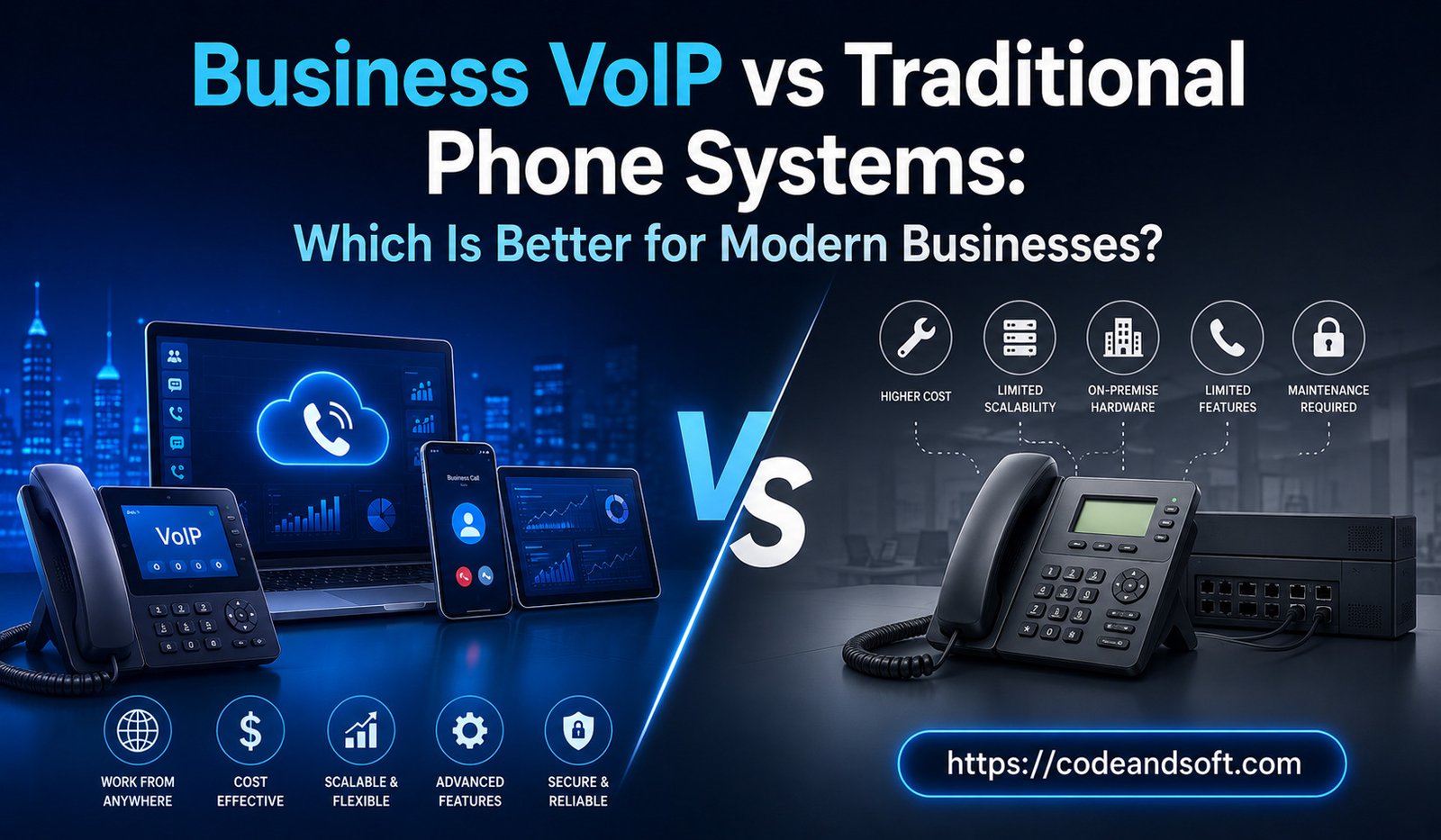
Business communication has changed dramatically as companies have adopted cloud technology, remote work, and digital collaboration tools. For decades, traditional phone systems were the standard choice for businesses that needed reliable voice communication. Today, however, Business VoIP has emerged as a flexible alternative that uses the internet to handle calls.
Choosing between VoIP and a traditional phone system is an important decision because a company’s phone infrastructure affects communication costs, employee productivity, customer service, and future scalability.
Traditional phone systems can still provide dependable calling, but they may require dedicated hardware and telephone infrastructure. Business VoIP, on the other hand, combines calling with modern features such as mobile access, call analytics, business messaging, video meetings, and CRM integrations.
So, which option is better?
The answer depends on the size of the business, available infrastructure, budget, communication requirements, and plans for future growth. This guide compares Business VoIP and traditional phone systems to help businesses understand their differences and choose the right solution.
What Is Business VoIP?
Business VoIP, or Voice over Internet Protocol, allows companies to make and receive phone calls through an internet connection rather than traditional telephone networks.
Voice is converted into digital information and transmitted through the internet.
Modern Business VoIP platforms often provide much more than voice calling. Depending on the provider, businesses may receive:
- Business phone numbers
- Call forwarding
- Auto attendants
- Call recording
- Voicemail
- Business texting
- Video conferencing
- Call analytics
- CRM integrations
- Mobile applications
- AI-powered call features
Because many VoIP systems are cloud-based, employees can access business communication tools from computers and mobile devices.
What Are Traditional Phone Systems?
Traditional business phone systems use conventional telephone networks and physical infrastructure to provide voice communication.
Common examples include:
- Landline systems
- Private Branch Exchange systems
- On-premises business phone systems
A traditional setup may require physical phone lines, dedicated equipment, desk phones, and technical maintenance.
Traditional systems have been used successfully by businesses for many years and can still be useful in environments where internet connectivity is limited or highly specialized.
Business VoIP vs Traditional Phone Systems
| Feature | Business VoIP | Traditional Phone System |
| Connection | Internet | Telephone network |
| Hardware | Usually limited | Often requires dedicated equipment |
| Scalability | Generally easy | Can require additional infrastructure |
| Remote Work | Strong support | More limited |
| Advanced Features | Usually extensive | Often more restricted |
| Maintenance | Mostly cloud-managed | Often requires on-site support |
| Integration | Strong integration options | More limited |
| Initial Setup | Often simpler | Can require physical installation |
| Mobility | High | Lower |
| Analytics | Common | Often limited |
1. Installation and Setup
Business VoIP
VoIP systems are generally easier to deploy because much of the infrastructure is hosted in the cloud.
Employees can often use:
- Computers
- Smartphones
- IP phones
- Tablets
Businesses can configure users and phone numbers through an online administration portal.
This makes VoIP particularly useful for companies that need to establish communication systems quickly.
Traditional Phone Systems
Traditional systems can require physical telephone lines, wiring, hardware, and on-site configuration.
Installation may become more complicated when a business has multiple offices or needs to expand its phone network.
Winner: Business VoIP
For most modern businesses, VoIP offers greater flexibility during setup.
2. Cost
Business VoIP Costs
VoIP typically uses subscription-based pricing. Depending on the provider, businesses may pay per user or according to selected features.
Potential costs include:
- Monthly subscriptions
- Premium features
- International calls
- Additional phone numbers
- Optional hardware
Businesses may save money because they do not need to maintain extensive traditional telephone infrastructure.
Traditional Phone System Costs
Traditional systems can involve:
- Phone lines
- Hardware
- Installation
- Maintenance
- Repairs
- Upgrades
Large organizations may need to invest significantly in physical infrastructure.
Winner: Business VoIP
VoIP often provides a more predictable and flexible cost structure, although businesses should compare the total cost of ownership rather than looking only at monthly subscription prices.
3. Scalability
Businesses rarely remain the same size forever. A growing company may need to add employees, departments, phone numbers, and locations.
Business VoIP
Adding users to a cloud-based VoIP system is generally straightforward.
Administrators can often create new accounts and assign numbers through the provider’s dashboard.
Traditional Systems
Traditional systems may require additional phone lines, hardware, ports, or configuration.
Expansion can therefore take more time and resources.
Winner: Business VoIP
VoIP is generally better suited to rapidly growing businesses.
4. Remote Work
Remote and hybrid work have become important parts of modern business operations.
Business VoIP
Employees can often use VoIP applications from their:
- Home offices
- Smartphones
- Laptops
- Other approved devices
Calls can remain connected to the company’s business number even when employees are working remotely.
Traditional Phone Systems
Traditional desk-phone systems are primarily designed around physical office locations.
Remote access can be possible, but it may require additional configuration or specialized solutions.
Winner: Business VoIP
VoIP is much more naturally suited to distributed teams.
5. Advanced Communication Features
Traditional phone systems primarily focus on voice communication.
Modern VoIP platforms can provide a much broader communication experience.
Features may include:
- Call queues
- Auto attendants
- Call recording
- Voicemail transcription
- Business SMS
- Video meetings
- Team messaging
- Call analytics
- CRM integration
- AI-powered assistance
These features can help businesses improve customer service and employee productivity.
Winner: Business VoIP
Modern VoIP systems provide significantly broader communication capabilities.
6. Reliability
Reliability is an important consideration for every business phone system.
Business VoIP
VoIP depends on internet connectivity. If a company’s internet connection is unstable, call quality can be affected.
Businesses can improve reliability by using:
- High-quality internet connections
- Backup connections
- Network monitoring
- Proper Quality of Service configurations
- Mobile failover options
Traditional Phone Systems
Traditional telephone systems have historically been valued for their reliability and independence from standard internet connectivity.
However, traditional infrastructure can also experience outages, hardware failures, and maintenance problems.
Winner: Depends on Infrastructure
Businesses with strong internet connectivity may find VoIP highly reliable, while organizations with limited connectivity may prefer traditional systems.
7. Call Quality
Business VoIP
VoIP call quality depends heavily on:
- Internet speed
- Network stability
- Latency
- Bandwidth
- Network configuration
With a properly configured network, VoIP can provide excellent voice quality.
Traditional Phone Systems
Traditional telephone systems are designed specifically for voice communication and do not depend on a company’s internet connection.
Winner: Traditional Systems in Poor-Connectivity Environments
If reliable internet access is unavailable, traditional phone systems may have an advantage.
8. Maintenance and Management
Business VoIP
Cloud-based VoIP providers typically manage much of the underlying infrastructure.
Businesses can manage users, settings, and call features through online dashboards.
Software updates and infrastructure maintenance are often handled by the provider.
Traditional Phone Systems
Businesses may need to maintain:
- Phone hardware
- Wiring
- On-premises equipment
- Telephone lines
Technical support may require on-site assistance.
Winner: Business VoIP
Cloud-based systems generally reduce the burden of maintaining physical phone infrastructure.
9. Business Mobility
Modern businesses often need employees to communicate while traveling or working outside the office.
VoIP applications allow employees to use business communication services through supported mobile devices.
For example, a sales representative can make business calls from a smartphone while still using the company’s phone number.
Traditional systems are more closely associated with physical office phones.
Winner: Business VoIP
VoIP provides greater mobility and flexibility.
10. Integration With Business Software
Modern businesses rely on multiple software platforms.
VoIP systems can often integrate with:
- CRM platforms
- Help desk applications
- Customer databases
- Collaboration tools
- Productivity software
These integrations can automatically connect call information with customer records.
For example, a sales employee may be able to access customer information when receiving a call.
Traditional phone systems generally offer fewer modern integration options, although some enterprise systems can support advanced integrations.
Winner: Business VoIP
VoIP is generally better suited to digitally connected workplaces.
11. Call Analytics
Business VoIP platforms often provide analytics dashboards that allow managers to monitor communication performance.
Businesses can track:
- Number of calls
- Missed calls
- Call duration
- Call volume
- Agent performance
- Response patterns
This information can help managers improve customer service and workforce planning.
Traditional phone systems may provide basic call information, but advanced analytics are usually less accessible.
Winner: Business VoIP
For businesses that depend on communication data, VoIP offers stronger analytics capabilities.
12. Security
Security is important regardless of which phone system a company chooses.
Business VoIP
VoIP systems should be protected against:
- Unauthorized account access
- Phishing
- Fraudulent calling
- Malware
- Weak passwords
Businesses should use strong authentication, access controls, network security, and provider security features.
Traditional Phone Systems
Traditional systems face a different set of risks, including physical access, equipment tampering, and telephone fraud.
Winner: Depends on Implementation
Neither option is automatically secure. Security depends on how the system is configured, maintained, and monitored.
Advantages of Business VoIP
Business VoIP offers several important benefits:
- Flexible pricing models
- Remote accessibility
- Easy scalability
- Advanced communication features
- Mobile support
- Business messaging
- Analytics
- Cloud management
- Software integrations
- AI capabilities
These advantages make VoIP particularly attractive to growing and digitally connected businesses.
Advantages of Traditional Phone Systems
Traditional phone systems still have strengths.
They can provide:
- Familiar technology
- Reliable voice communication
- Less dependence on internet connectivity
- Existing infrastructure compatibility
- Simple calling functionality
For businesses operating in locations with unreliable internet access, traditional systems may still be practical.
Which Businesses Should Choose VoIP?
Business VoIP may be the better choice for companies that:
- Have remote or hybrid employees
- Are expanding quickly
- Need advanced communication features
- Want CRM integrations
- Require business texting
- Need call analytics
- Operate across multiple locations
- Want flexible communication tools
Startups, professional services companies, e-commerce businesses, sales teams, and customer support organizations can particularly benefit from VoIP.
Which Businesses May Prefer Traditional Phone Systems?
Traditional systems may still make sense for businesses that:
- Have limited internet connectivity
- Already own extensive telephone infrastructure
- Need basic voice communication
- Operate in specialized environments
- Have minimal requirements for modern integrations
Replacing a working traditional system may not always make financial sense if a company has limited communication needs.
Business VoIP vs Traditional Phone Systems: Final Verdict
For most modern businesses, Business VoIP is the more flexible and future-ready option. It provides advanced features, supports remote work, integrates with business software, and can scale as companies grow.
Traditional phone systems remain useful in specific situations, particularly where internet connectivity is unreliable or existing infrastructure already meets business requirements.
The best choice ultimately depends on the organization’s communication needs, budget, infrastructure, and growth plans.
Conclusion
The comparison between Business VoIP and traditional phone systems is not simply about replacing old technology with new technology. It is about choosing a communication infrastructure that supports the way a business operates today and expects to operate in the future.
Traditional phone systems continue to provide dependable voice communication, but their physical infrastructure and limited flexibility can make expansion and remote work more challenging.
Business VoIP offers a broader set of capabilities, including cloud calling, mobile access, messaging, analytics, integrations, and AI-powered communication features.
For businesses focused on flexibility, scalability, and digital transformation, VoIP is generally the stronger long-term choice. However, companies should evaluate internet reliability, total costs, security requirements, existing infrastructure, and employee needs before making the switch.