
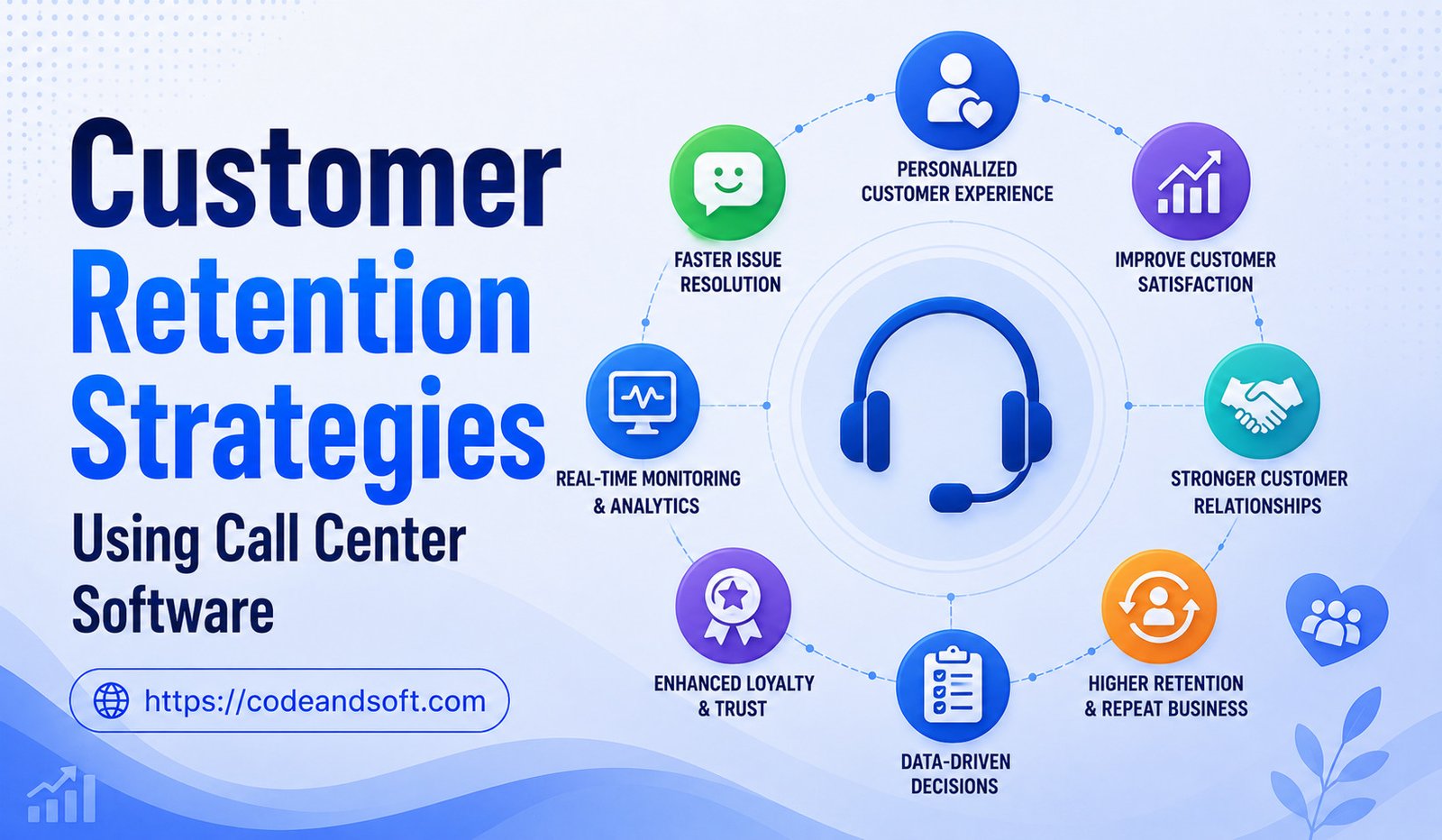

Introduction
Winning a new customer can require significant time, marketing effort, and investment. Keeping an existing customer, however, often depends on something much simpler: delivering a consistently positive experience.
Customer retention has therefore become an important priority for businesses across industries. Customers have more choices than ever, and a poor support experience can make it easy for them to switch to a competitor. A slow response, unresolved complaint, repeated explanation, or frustrating phone interaction can gradually weaken customer loyalty.
Call center software can help businesses address these challenges. Modern platforms are no longer limited to connecting phone calls. They can combine customer information, intelligent routing, automation, analytics, call recording, artificial intelligence, CRM integration, and agent-assistance features.
When these capabilities are used strategically, call center software can help companies understand customers, resolve problems faster, personalize conversations, identify dissatisfaction, and create stronger relationships.
This guide explores practical customer retention strategies that businesses can implement using modern call center software.
What Is Customer Retention?
Customer retention refers to a company’s ability to keep customers purchasing or using its products and services over time.
A strong retention strategy focuses on giving customers reasons to remain loyal.
These reasons can include:
- Reliable products or services
- Responsive customer support
- Personalized communication
- Quick problem resolution
- Convenient service
- Consistent experiences
- Strong relationships
Customer retention is closely connected to customer experience. When customers believe a company understands their needs and resolves problems effectively, they are more likely to continue the relationship.
How Call Center Software Supports Customer Retention
Call center software gives businesses tools for managing customer conversations more efficiently.
A modern platform can help teams:
- Identify customers
- Access interaction history
- Route calls intelligently
- Reduce waiting times
- Automate repetitive requests
- Track unresolved issues
- Monitor service quality
- Analyze customer conversations
- Identify potential dissatisfaction
These capabilities can turn customer support from a reactive function into a more proactive retention strategy.
1. Use Customer History to Personalize Calls
Customers do not want to repeatedly explain who they are or describe previous conversations.
Call center software integrated with a CRM can provide agents with information such as:
- Previous calls
- Past purchases
- Open support cases
- Account information
- Previous complaints
- Communication history
When an agent has this context before answering, the conversation can begin more naturally.
Instead of asking customers to repeat information, the representative can focus immediately on the current issue.
This can make customers feel recognized and reduce unnecessary frustration.
2. Improve First-Call Resolution
One of the most important retention strategies is solving problems during the first interaction whenever possible.
If customers need to contact a business repeatedly about the same issue, dissatisfaction can increase.
Call center software can support first-call resolution by giving agents access to:
- Customer records
- Knowledge bases
- Product information
- Previous conversations
- Internal documentation
- Real-time assistance
Intelligent routing can also direct customers to employees with the right expertise.
For example, a technical issue can be routed to a technical specialist instead of a general representative.
Faster resolution can create a better customer experience and reduce repeated contacts.
3. Reduce Customer Waiting Times
Long queues can negatively affect customer satisfaction.
Call center software can reduce unnecessary waiting through automatic call distribution, intelligent routing, callback options, and self-service.
A callback feature can be particularly useful.
Instead of requiring customers to remain on hold, the system can allow them to request a return call when an agent becomes available.
Reducing perceived waiting time can make customer service feel more convenient.
4. Use Intelligent Call Routing
Not every customer should be sent to the same queue.
Intelligent routing can consider factors such as:
- Customer type
- Agent availability
- Agent skills
- Language
- Department
- Previous interactions
- Call priority
A high-value customer with a complex technical problem, for example, may be routed to an experienced specialist.
Better routing can improve the likelihood that the customer’s problem is solved efficiently.
5. Create Personalized Customer Experiences
Personalization can play an important role in customer loyalty.
Call center software can use customer data to help agents understand the person behind the call.
For example, a representative may know whether the customer recently purchased a product, contacted support, or experienced a previous issue.
Agents can then adjust their conversation accordingly.
Personalization should not feel intrusive. Businesses should use only relevant information and follow applicable privacy requirements.
6. Identify At-Risk Customers
One of the biggest advantages of modern call center analytics is the ability to identify warning signs.
Customers who repeatedly complain, contact support frequently, or express dissatisfaction may be at greater risk of leaving.
Businesses can analyze:
- Call frequency
- Complaint history
- Sentiment
- Resolution time
- Repeat contacts
- Escalations
- Customer feedback
These signals can help support and customer success teams identify customers who may need additional attention.
Instead of waiting until a customer cancels, businesses can respond proactively.
7. Use Call Analytics to Understand Customer Sentiment
Customer conversations contain valuable information.
Call analytics can identify patterns in language, tone, and conversation outcomes.
Businesses can use this information to understand whether customers are:
- Satisfied
- Frustrated
- Confused
- Angry
- Interested
- At risk of leaving
Sentiment analysis should not be treated as a perfect measure of emotion, but it can provide useful signals when combined with other customer information.
Managers can use these insights to identify recurring problems and improve support processes.
8. Automate Simple Customer Requests
Not every customer interaction requires a human representative.
Call center software with IVR, chatbots, and AI voice assistants can handle routine tasks such as:
- Appointment confirmation
- Order status
- Business hours
- Basic account information
- Simple requests
- Frequently asked questions
Automation can reduce pressure on human agents.
This allows employees to dedicate more time to customers who need complex assistance.
However, businesses should always provide an easy path to human support when automation cannot solve the problem.
9. Follow Up After Problem Resolution
Customer retention does not have to end when a support ticket is closed.
Businesses can use call center software and CRM integrations to schedule follow-up interactions.
For example, after resolving a technical problem, a company could contact the customer later to confirm that everything is working correctly.
Follow-up communication demonstrates that the business cares about the outcome rather than simply closing the ticket.
It can also reveal whether the original solution actually worked.
10. Use Call Recording for Quality Improvement
Call recording can help managers review customer conversations and identify opportunities for improvement, subject to applicable laws and consent requirements.
Managers can examine:
- Communication quality
- Resolution effectiveness
- Agent behavior
- Customer concerns
- Policy compliance
- Common objections
The goal should be coaching and service improvement rather than simply finding mistakes.
Regular quality reviews can help support teams develop stronger communication skills.
11. Give Agents AI-Powered Assistance
Artificial intelligence can support customer service representatives during live conversations.
AI tools can:
- Retrieve information
- Suggest responses
- Summarize conversations
- Recommend knowledge articles
- Identify customer sentiment
- Generate post-call notes
This can reduce administrative work and help agents find information more quickly.
When agents spend less time searching through systems, they can focus more closely on the customer.
12. Build a Strong Self-Service Strategy
Many customers prefer solving simple problems themselves rather than calling support.
Businesses can use call center analytics to identify frequently asked questions and turn them into:
- Knowledge-base articles
- FAQs
- Tutorials
- Automated voice responses
- Help center content
Self-service can reduce customer effort while lowering the number of repetitive calls handled by agents.
The key is to make information easy to find and understand.
13. Use Customer Feedback to Improve Service
Customer feedback is one of the most valuable retention resources.
Call center platforms can integrate surveys into the customer journey.
Businesses can ask customers about:
- Satisfaction
- Resolution quality
- Agent performance
- Ease of getting help
- Overall experience
However, collecting feedback is only useful if businesses act on it.
Managers should review recurring complaints and identify process improvements.
14. Monitor Customer Effort
Customers are more likely to remain loyal when getting help is easy.
Customer effort can increase when people have to:
- Repeat information
- Wait too long
- Navigate complicated menus
- Contact multiple departments
- Explain the same issue repeatedly
Call center analytics can help identify these friction points.
Reducing unnecessary effort can improve the overall support experience.
15. Create Loyalty-Focused Service Workflows
Call center software can help businesses create specialized workflows for valuable or long-term customers.
For example, companies may create priority queues or dedicated support teams for specific customer segments.
These workflows should be designed carefully so that service remains fair and transparent.
The objective is to make important customers feel supported while maintaining a consistent customer experience.
16. Use Predictive Analytics for Retention
Advanced call center platforms can combine customer interaction data with predictive analytics.
Businesses can look for patterns associated with customer churn.
Potential indicators may include:
- Increasing complaint frequency
- Declining engagement
- Repeated service problems
- Negative feedback
- Longer resolution times
- Frequent escalations
Predictive models should be treated as decision-support tools rather than perfect predictions.
Human teams can review high-risk accounts and determine the appropriate response.
17. Improve Agent Training
Customer retention depends heavily on the people who communicate directly with customers.
Call center analytics can identify areas where agents need additional training.
For example, managers may discover that employees frequently struggle with:
- Product explanations
- Complaint handling
- Technical troubleshooting
- Upselling
- Communication
- Escalation procedures
Training can then focus on specific weaknesses rather than relying entirely on generic programs.
18. Connect Sales and Support Data
Customer retention improves when sales and support teams have a shared understanding of the customer.
Integrating call center software with CRM systems can help connect:
- Sales interactions
- Purchases
- Support requests
- Complaints
- Customer feedback
- Account information
This creates a more complete customer profile.
Sales teams can understand support history, while support representatives can understand the customer’s broader relationship with the company.
19. Track the Right Retention Metrics
Businesses should measure whether their call center strategy is actually improving retention.
Useful metrics include:
Customer Retention Rate
Measures the percentage of customers who remain with the company over a specific period.
Customer Churn Rate
Shows the percentage of customers who leave.
First Contact Resolution
Measures how often issues are solved during the initial interaction.
Customer Satisfaction
Indicates how customers feel about their service experience.
Net Promoter Score
Can provide insight into customers’ willingness to recommend the business.
Average Resolution Time
Shows how quickly support teams resolve issues.
Repeat Contact Rate
A high repeat-contact rate can indicate unresolved problems.
These metrics should be evaluated together rather than relying on one number.
20. Create a Proactive Customer Service Strategy
Traditional customer support often waits for customers to report problems.
Modern call center technology makes proactive service possible.
Businesses can identify potential issues and contact customers before they become serious problems.
For example, if a service disruption affects a group of customers, the company can notify them proactively rather than waiting for hundreds of calls.
Proactive communication can demonstrate reliability and transparency.
Final Thoughts
Customer retention is not achieved through one feature or a single customer service campaign. It is built through repeated positive interactions.
Call center software can provide the technology needed to make those interactions faster, more personalized, and more consistent.
Businesses can use CRM integration to understand customer history, intelligent routing to connect callers with the right agents, automation to handle simple requests, analytics to identify dissatisfaction, and AI to support employees.
The most effective strategy is to use technology to reduce customer effort rather than simply reduce the number of human interactions.
When customers can reach the right person quickly, receive relevant answers, avoid repeating information, and get their problems resolved effectively, they have stronger reasons to remain loyal.
Ultimately, call center software should support a broader retention strategy focused on trust, convenience, personalization, and continuous improvement. Businesses that combine useful technology with well-trained human teams can turn customer support into a competitive advantage and create relationships that last beyond individual transactions.