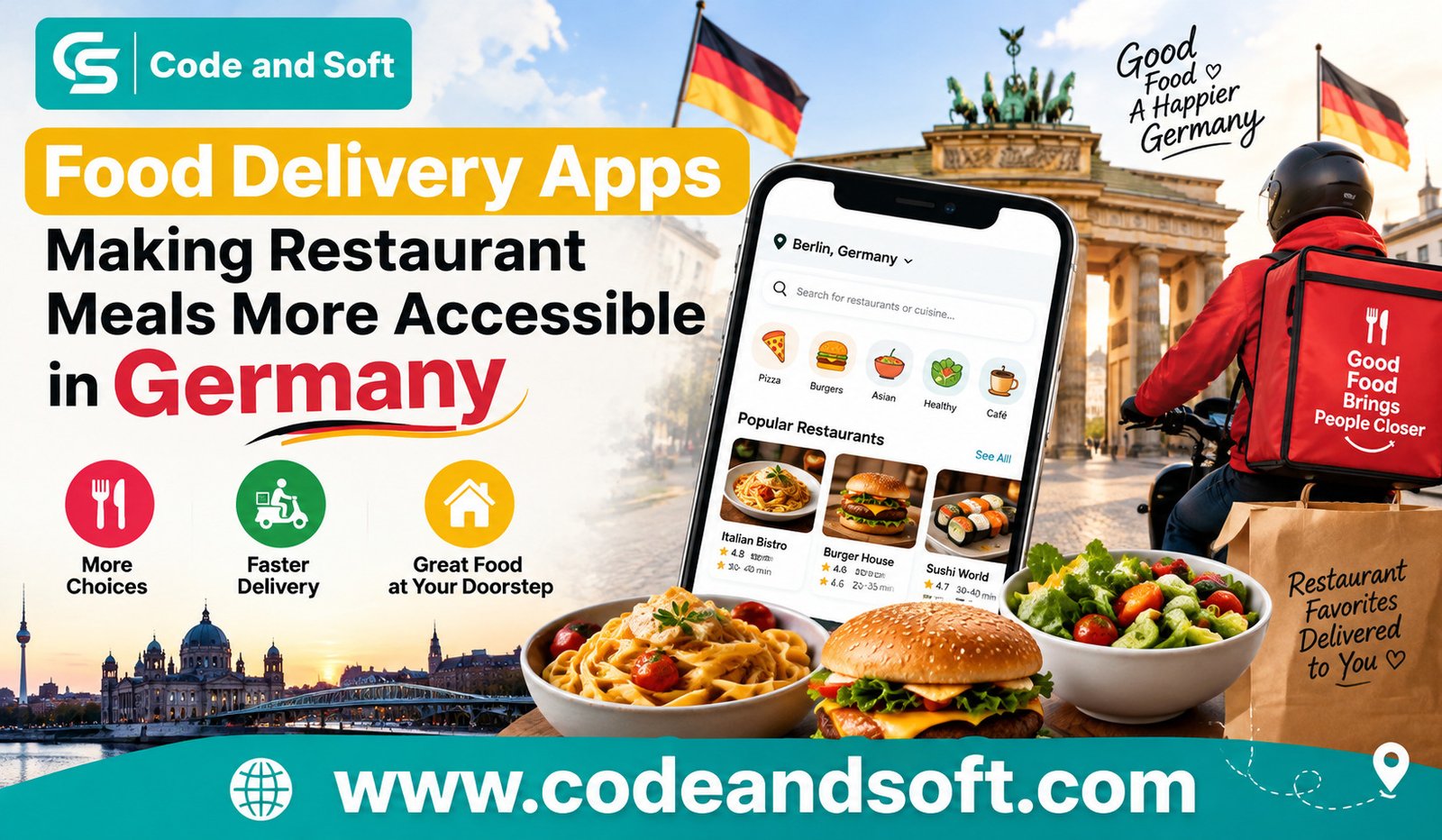
Getting your favorite restaurant meal in Germany no longer means finding a table, travelling across town, or waiting in a long queue. With Food Delivery Apps in Germany, you can browse local restaurants, compare dishes, place an order and have your meal brought directly to your doorstep.
Whether you live in a busy city, work from home, have a packed schedule or simply do not feel like cooking, food delivery has become a practical part of everyday life. Apps such as Lieferando, Wolt and Uber Eats connect you with restaurants through a few taps, while grocery-focused services such as Flink and Picnic make it easier to keep the ingredients for your next meal at home.
The result is a broader food ecosystem where convenience is not limited to traditional restaurant delivery.
Why Food Delivery Apps in Germany Are Becoming More Important
Think about a typical weekday. You finish work late, the refrigerator is almost empty and you do not have the time or energy to prepare dinner. Instead of travelling to a restaurant or supermarket, you can open a delivery app and explore dozens of options.
This is where Food Delivery Apps in Germany have changed the way you approach meals.
You can discover everything from German comfort food and Italian pizza to burgers, Asian dishes, vegetarian meals and international cuisines. In larger cities, your choices can be particularly extensive.
Lieferando, for example, allows you to search for restaurants and shops near your address, choose between delivery and collection, and track your order. Its current platform advertises more than 40,000 partners.
Wolt and Uber Eats add further competition, giving you more opportunities to compare restaurants, delivery times and offers.
The biggest advantage is simple: you get more choice without having to travel for it.
Lieferando: A Major Choice for Restaurant Delivery
If you are looking for a broad selection, Lieferando is one of the first platforms you are likely to encounter in Germany.
The service brings restaurants and other food-related businesses together in one platform. You can enter your address, search by cuisine or dish, read customer reviews and place an order for delivery or collection.
For you as a customer, the appeal is the variety. Instead of checking several individual restaurant websites, you can browse multiple options from one place.
You may also find useful payment flexibility. Lieferando supports online payment and, where offered by the restaurant, cash payment as well.
This makes Lieferando particularly useful when you want to compare several restaurants before deciding what to eat.
Wolt: Combining Food, Groceries and Convenience
Wolt has expanded beyond the traditional idea of restaurant delivery. Its German platform offers restaurants, groceries and other everyday products, allowing you to use one app for several types of purchases.
When you open Wolt, you can explore restaurants in your area and order meals directly to your home or workplace. The platform also provides grocery delivery through options such as Wolt Market and partner supermarkets.
This makes the app useful when your needs change from one day to another.
You might order sushi for dinner on Monday, groceries on Tuesday and a quick lunch at work on Wednesday. Instead of thinking about separate services, you can handle many of these needs through the same ecosystem.
For you, that means food delivery becomes less of an occasional luxury and more of an everyday convenience.
Uber Eats: Expanding Restaurant Access
Uber Eats is another major name among Food Delivery Apps in Germany.
The platform connects you with restaurants in numerous German cities and continues to expand its local restaurant network. Uber Eats announced additional German expansion in 2025, adding restaurants and extending availability into more regions.
One of the useful aspects of Uber Eats is its connection with the wider Uber ecosystem. If you already use Uber, you may find it convenient to access food delivery from the same account environment.
The platform also illustrates how the definition of food delivery is changing. Uber Eats has partnered with grocery-delivery businesses, including Flink, allowing users to access everyday grocery products through its app in participating locations.
So, you are not necessarily choosing between restaurant delivery and grocery delivery anymore. Increasingly, digital platforms are bringing both experiences closer together.
Flink: Useful When You Want to Prepare the Meal Yourself
At first glance, Flink might seem different from the restaurant-focused delivery services. It is primarily an online supermarket rather than a restaurant marketplace.
However, it still plays an important role in making food more accessible.
Suppose you want to cook pasta instead of ordering pasta from a restaurant. You can use Flink to order groceries such as pasta, vegetables, dairy products, snacks and other everyday essentials.
Flink currently promotes delivery of groceries within minutes and lists more than 100 cities across its German service area. Its assortment includes fresh produce, eggs, dairy products, baked goods and other daily essentials.
This gives you another way to solve the classic dinner problem.
Instead of asking, “Which restaurant should I order from?”, you can ask, “What can I quickly make at home?”
That flexibility is one reason grocery delivery and restaurant delivery increasingly overlap in the wider food-delivery market.
Picnic: Making the Weekly Food Shop Easier
Picnic takes a different approach to food accessibility.
Rather than focusing on instant restaurant meals, Picnic is designed around your regular grocery shopping. You can order fresh food, household products and ingredients through its app and have them delivered to your home.
Picnic says delivery is free when you meet its minimum order value, and its delivery model uses scheduled time windows rather than relying entirely on instant delivery.
This can be especially useful if you prefer planning your meals.
You can organize your weekly shopping, select ingredients for several dinners and avoid carrying heavy grocery bags home from a supermarket.
Picnic also provides recipes where ingredients can be added to your shopping basket, making it easier to move from meal inspiration to actual preparation.
So while Picnic does not replace a restaurant delivery service, it supports another side of convenient eating: having the right food available at home.
Gorillas: An Important Part of the Market’s Evolution
If you are researching Food Delivery Apps in Germany, you may also come across Gorillas.
Gorillas became well known for its ultra-fast grocery delivery model, particularly in major German cities. Customers could order supermarket products through an app and receive them quickly.
However, Gorillas is no longer a current German delivery option.
Getir acquired Gorillas in 2022, but Getir later decided to withdraw from Germany and other international markets. Operations in Germany ended in May 2024.
Why mention it today?
Because Gorillas helps explain how Germany’s food-delivery market has developed. The company was part of the rapid-growth “quick commerce” wave that promised groceries delivered within minutes. The subsequent consolidation showed that speed alone was not enough; delivery companies also needed sustainable economics and efficient operations.
Today, services such as Flink, Picnic, Wolt and other grocery-delivery options reflect a more mature market.
How These Apps Make Food More Accessible
The biggest change you experience is not simply faster delivery. It is greater accessibility.
You can use delivery apps when you are working late, studying, travelling, caring for children or simply staying at home. You can also compare different restaurants without physically visiting each location.
For people living in large German cities, this can open up a huge variety of cuisines.
You may want Turkish food one evening, Indian food the next and pizza after that. Instead of planning your journey around restaurants, the restaurants effectively become accessible through your phone.
Food delivery can also be helpful when weather conditions make travelling unpleasant. During heavy rain, cold evenings or busy periods, having a meal delivered can save you considerable time.
Restaurant Choice Is Becoming More Competitive
Another important benefit is competition.
When you have multiple Food Delivery Apps in Germany available in your area, you can compare restaurants, menus, delivery times and promotions.
You might find that your favorite restaurant is available on Lieferando but not Wolt. Another restaurant might offer delivery through Uber Eats. Grocery options may be available through Flink or Picnic.
This competition gives you more control.
Instead of being tied to a single platform, you can choose the service that works best for your particular order.
Of course, availability differs by city and even by address. A restaurant or grocery service that appears in Berlin may not necessarily be available in a smaller town. That means checking your exact delivery address remains important.
The Role of Technology in Modern Food Delivery
Behind the simple experience of tapping “Order” is a complicated digital system.
Delivery apps need to match your address with nearby restaurants, calculate delivery areas, estimate preparation times and connect the order with a courier.
Live tracking also changes your experience. Rather than wondering whether your food has left the restaurant, you can often follow the progress of your delivery.
This makes the process feel more transparent and predictable.
For restaurants, these platforms can also provide another way to reach customers. Wolt, for example, promotes its platform as a way for restaurants and shops to generate additional online sales while handling payments, delivery and support.
What You Should Consider Before Ordering
Although food delivery is convenient, you should still compare your options.
Start by checking the total price rather than focusing only on the menu price. Delivery charges, service fees, minimum order requirements and promotions can affect the final amount.
You should also check the estimated delivery time.
If you are ordering during a busy Friday evening, a restaurant that normally delivers quickly may take longer. Reading recent customer reviews can give you another indication of the experience.
Most importantly, check whether the service actually operates at your address.
The German delivery market changes quickly, and availability can vary from one neighborhood to another.
The Future of Food Delivery in Germany
The future of Food Delivery Apps in Germany is likely to be about more than simply delivering restaurant meals.
You are already seeing the boundaries between restaurants, supermarkets and delivery platforms becoming less distinct. Wolt offers restaurants and groceries, while Uber Eats has integrated grocery offerings such as Flink in its ecosystem.
At the same time, services such as Picnic demonstrate that scheduled grocery delivery can be an alternative to traditional supermarket shopping.
The market has also learned from the rapid expansion and later withdrawal of companies such as Gorillas. The focus is increasingly shifting from promises of extreme speed toward reliable service, useful selection and sustainable delivery models.
For you, that could mean more ways to decide how food reaches your table.
Final Thoughts
Food Delivery Apps in Germany are changing the way you access meals and groceries. Lieferando gives you a broad restaurant marketplace, Wolt combines food with groceries and everyday delivery, while Uber Eats continues expanding its restaurant network.
Flink provides a quick way to stock your kitchen, and Picnic focuses on planned grocery shopping and convenient home delivery. Gorillas, although no longer operating in Germany, remains an important example of how quickly the market has evolved.
The real benefit is choice.
You can order a restaurant meal when you want convenience, buy groceries when you prefer cooking, or plan your weekly food shopping when you want to save time. With these services becoming increasingly integrated into everyday routines, getting food from a restaurant, supermarket or online store to your home is becoming easier and more flexible than ever.