
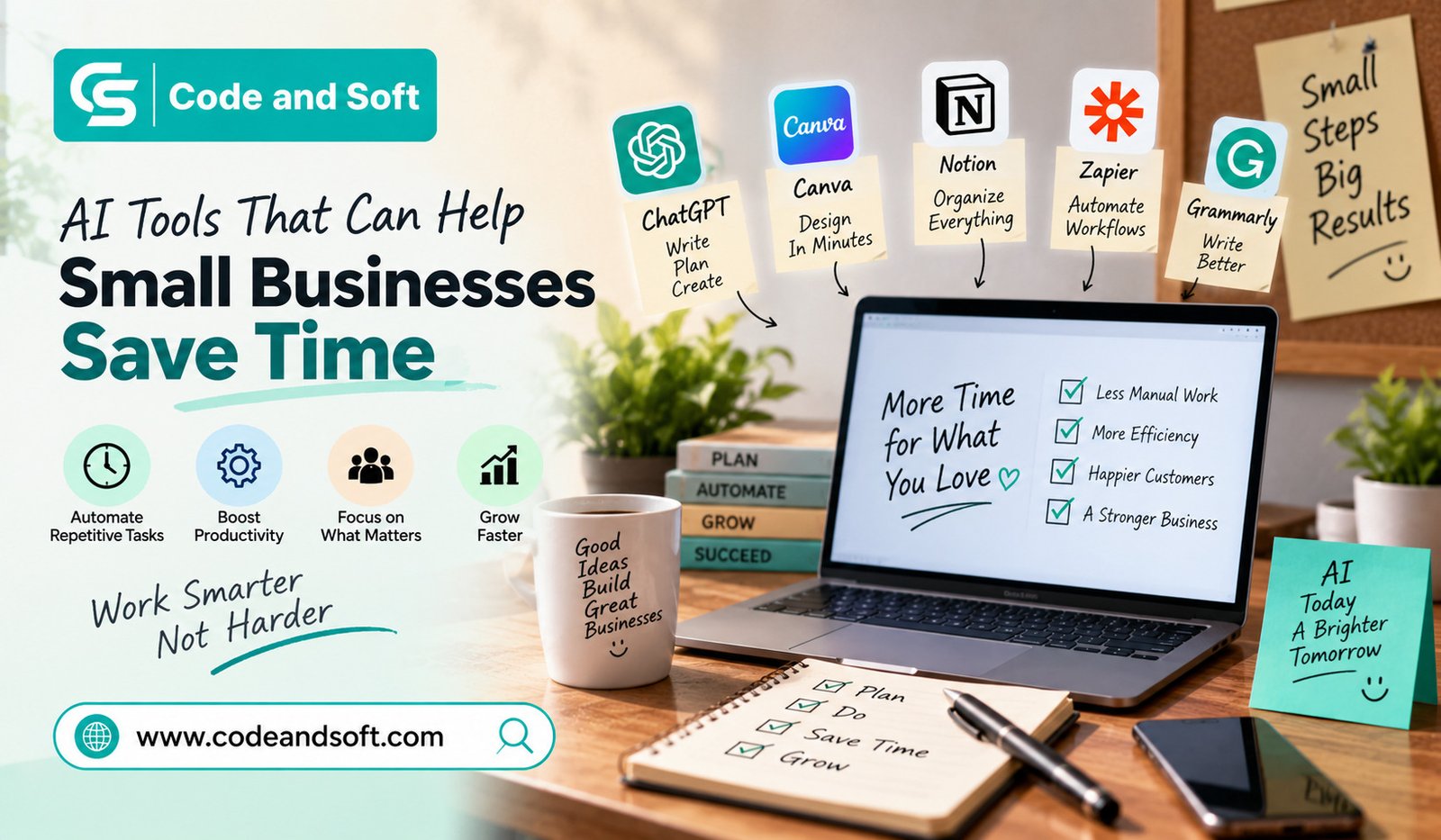

Running a small business can feel like you are doing five jobs at once. One minute, you are replying to a customer email, and the next, you are creating a social media post, checking an invoice, scheduling a meeting, or trying to finish an important report. When everything depends on you or a small team, even simple tasks can quickly eat up your day.
This is where AI tools can make a real difference.
You do not need a huge team or a complicated technology setup to benefit from artificial intelligence. Today, you can use AI for writing, customer service, marketing, meetings, data analysis, scheduling, and many other everyday tasks. The goal is not to replace the work you do. Instead, you can let AI handle repetitive tasks while you spend more time on decisions, customers, and growing your business.
If you are looking for practical ways to save time, here are some ways AI Tools Help Small Businesses work more efficiently.
1. AI Writing Tools for Faster Content Creation
Creating content is important for almost every business, but it can also be surprisingly time-consuming. You may need blog posts, product descriptions, emails, advertisements, social media captions, or website copy on a regular basis.
AI writing tools can help you create a first draft in much less time. You can provide a topic, explain your audience, and tell the tool what kind of tone you want. It can then generate ideas or draft content that you can review and edit.
For example, if you run an online store, you can use AI to create initial product descriptions for dozens of products. If you manage a local service business, AI can help you come up with social media ideas or email newsletter topics.
You should still review everything before publishing it. Your experience and brand voice are what make the final content feel authentic.
2. AI Tools for Email Management
Email can quietly consume a large part of your working day. Customer questions, supplier messages, appointment requests, invoices, and internal communication can quickly fill your inbox.
AI-powered email features can help you summarize long messages, draft replies, identify important information, and organize your communication.
Instead of spending several minutes reading a lengthy email thread, you can use AI to get the key points first. You can then decide how you want to respond.
AI can also help you write professional replies when you are short on time. You provide the basic information, review the suggested response, and make any necessary changes before sending it.
This can be especially useful when you receive similar questions repeatedly.
3. AI Customer Service Assistants
Your customers expect quick answers, but you may not always have someone available to respond immediately.
AI-powered chatbots and customer service assistants can answer common questions about your products, services, business hours, shipping, returns, appointments, and other basic information.
This means your customers can get help without waiting for you to manually answer every question.
For a small business, this can save a significant amount of time. You can allow AI to handle routine questions while you or your team focus on more complicated customer issues.
The key is to make sure the chatbot knows when to hand a conversation over to a real person. Customers should always have a way to reach human support when their problem requires personal attention.
4. AI Meeting and Note-Taking Tools
Meetings are useful, but taking notes during every meeting can be frustrating. You may find yourself trying to listen to the conversation while also writing down everything that was discussed.
AI meeting assistants can help by transcribing conversations, summarizing important points, and identifying action items.
After a meeting, instead of going through pages of notes, you can quickly review the summary and see what needs to happen next.
This can be particularly helpful if you regularly meet with employees, clients, suppliers, or business partners.
You can spend more time participating in the discussion and less time worrying about capturing every sentence.
5. AI Tools for Social Media
Maintaining an active social media presence takes consistency. Unfortunately, coming up with new content every day can become another job on your already busy schedule.
AI can help you generate post ideas, captions, content calendars, promotional messages, and variations of existing content.
For instance, you can take one blog post and ask AI to turn its key points into several social media posts. You can then customize each post for the platform you use.
AI can also help you brainstorm seasonal campaigns, promotional ideas, and questions that encourage your followers to engage.
However, you should add your own photos, experiences, opinions, and brand personality. This prevents your social media content from feeling generic.
6. AI for Scheduling and Task Management
Managing your own schedule while keeping track of meetings, deadlines, and tasks can become difficult as your business grows.
AI-powered productivity tools can help you prioritize tasks, organize schedules, set reminders, and identify potential conflicts.
Imagine starting your day with a long list of tasks and not knowing where to begin. An AI assistant can help organize those tasks according to urgency and importance.
You still make the final decisions, but you do not have to spend as much time figuring out what needs your attention first.
For small business owners, this can make the workday feel considerably more manageable.
7. AI-Powered Data Analysis
You probably already have useful business information hidden in spreadsheets, sales reports, customer records, or accounting data. The problem is finding the time to analyze it.
AI tools can help you identify patterns and summarize information in a more understandable way.
For example, you might use AI to examine sales data and find which products are performing best. You could also analyze customer feedback to identify common complaints or frequently requested features.
This does not mean you should blindly follow an AI-generated recommendation. Instead, use AI as a starting point for understanding your data.
You can combine those insights with your own knowledge of your customers and industry before making business decisions.
8. AI for Marketing Ideas and Research
Marketing requires constant experimentation. You need to understand your customers, develop new campaigns, test different messages, and keep an eye on competitors.
AI can help speed up the research and brainstorming stage.
You can ask AI to generate customer personas, campaign ideas, headline variations, promotional concepts, or questions to use in customer surveys.
You can also use AI to organize customer feedback and identify repeated themes.
For a small business with limited marketing resources, having an AI assistant available for brainstorming can make it easier to keep your marketing efforts moving.
9. AI Tools for Administrative Work
Administrative work may not directly generate revenue, but it takes up a lot of time.
Creating documents, organizing information, preparing reports, categorizing expenses, and processing routine paperwork can become repetitive.
Depending on the software you already use, AI features can help automate or speed up some of these tasks.
For example, you might use AI to summarize documents, extract important information from files, create basic reports, or organize unstructured information.
The more repetitive the task, the more likely it is that AI can help you reduce the amount of manual work involved.
10. AI Can Help You Work Smarter, Not Just Faster
The biggest advantage of AI for a small business is not simply completing tasks quickly. It is giving you more time to focus on work that actually requires your experience.
Think about how much of your day is spent copying information, writing similar emails, creating basic documents, answering repetitive questions, or searching through data.
These tasks may be necessary, but they do not always require your full attention.
When you use AI appropriately, you can delegate some of this routine workload to technology. That gives you more time to speak with customers, develop products, improve your services, train your team, and think about your next business move.
How to Choose the Right AI Tools for Your Business
You do not need to start using ten different AI platforms at once. In fact, doing so can make your workflow more complicated.
Start by identifying the tasks that take up the most time. Ask yourself:
- Which tasks do you repeat every day?
- Which tasks require a lot of manual work?
- Where do you regularly fall behind?
- Which tasks do you dislike doing?
- What work could be partially automated?
Once you identify these areas, choose an AI tool that solves a specific problem.
You should also consider ease of use, pricing, integration with your existing software, security, and the quality of its results.
Most importantly, test the tool before making it an important part of your workflow.
Final Thoughts
AI is no longer something reserved for large technology companies. You can use it in a small business to reduce repetitive work, organize information, communicate with customers, and speed up everyday tasks.
The real benefit comes from using AI strategically. You do not need to automate everything. Start with one or two time-consuming tasks and see how much time you can realistically save.
Whether you need help writing content, managing emails, taking meeting notes, supporting customers, analyzing data, or organizing your schedule, there is likely an AI solution that can make the process easier.
Ultimately, AI Tools Help Small Businesses by giving you something incredibly valuable: more time. And when you have more time to focus on your customers, your team, and your business goals, you can spend less of your day on repetitive work and more of it building something that lasts.