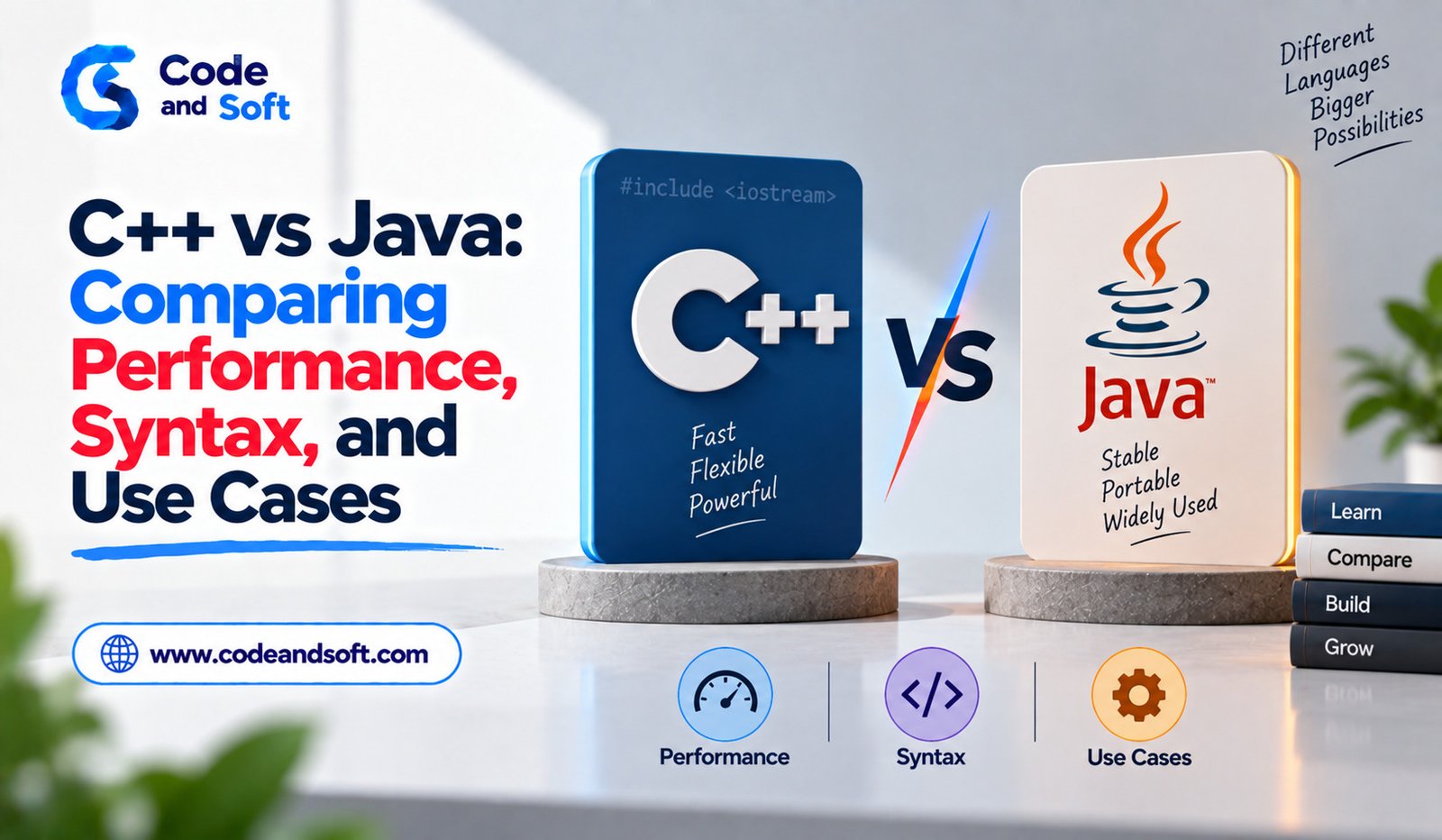
C++ and Java are two of the most established programming languages in modern software development. Both are widely known, support object-oriented programming and can be used to build large and complex applications. However, they approach programming in different ways.
For students and new developers, choosing between C++ and Java can be confusing. One language provides extensive control over memory and system resources, while the other focuses strongly on portability, managed memory and a consistent runtime environment.
The comparison between C++ and Java becomes especially interesting when looking at performance, syntax, memory management and practical use cases. Understanding these differences can help developers choose the language that better matches their project and learning goals.
C++ and Java: A Basic Overview
C++ evolved from the C programming language and was designed to support both low-level and high-level programming. It is commonly associated with performance-intensive software, systems programming, game development and applications that require detailed control over hardware resources.
Java was designed around the idea of portability. Java source code is compiled into bytecode that runs through the Java Virtual Machine, commonly called the JVM. This approach allows Java applications to run across different platforms when a suitable JVM is available.
Both languages support classes, objects, inheritance, polymorphism and other object-oriented programming concepts. However, their design philosophies are noticeably different.
Comparing C++ and Java Performance
Performance is one of the most common reasons developers compare C++ and Java.
C++ is generally compiled into native machine code for a particular target platform. Developers can also control memory allocation, data structures and other implementation details. This makes C++ particularly useful when an application needs highly optimized execution.
Java takes a different approach. Java applications typically run inside the JVM, which manages many runtime responsibilities. Modern JVM implementations use techniques such as Just-In-Time compilation to optimize frequently executed code during execution.
As a result, Java can achieve strong performance and is capable of handling demanding applications. However, C++ can provide greater control when developers need to optimize specific parts of a program or interact closely with hardware.
Performance should not be judged by language alone. Algorithms, application architecture, compiler or runtime optimizations, hardware and programming practices can all have a major impact.
Differences in Syntax
C++ and Java share several familiar programming concepts, so developers moving between them may recognize structures such as variables, loops, conditions, functions and classes.
A simple C++ statement might look like:
int age = 25;
Java uses a very similar syntax:
int age = 25;
Conditional statements and loops also look relatively familiar in both languages.
However, the differences become more visible when developers work with memory, classes, headers, pointers and object management.
C++ offers pointers and direct memory-related operations, while Java intentionally hides much of this complexity from normal application development.
C++ can therefore feel more flexible but also more complicated. Java often provides a more structured environment that reduces the number of low-level decisions beginners need to make.
Memory Management
Memory management is one of the biggest differences between C++ and Java.
In C++, developers can manually allocate and release dynamic memory. Modern C++ also provides smart pointers and other techniques that make resource management safer.
This level of control is valuable when performance and resource usage are critical. However, incorrect memory management can result in serious problems such as memory leaks, invalid memory access and dangling pointers.
Java uses automatic garbage collection. Developers generally create objects without manually releasing their memory. The JVM identifies objects that are no longer needed and can reclaim their memory.
This reduces a major category of programming errors, although garbage collection itself can influence application behavior and performance.
Therefore, C++ gives developers more direct control, while Java provides more automatic memory management.
Object-Oriented Programming
Both C++ and Java support object-oriented programming.
Developers can create classes that combine data and behavior. They can also use inheritance and polymorphism to design relationships between different types of objects.
C++ provides multiple programming styles. Developers can combine procedural programming, object-oriented programming and generic programming depending on their needs.
Java is more strongly centered around object-oriented application development, although modern Java also includes features that support functional programming concepts.
For beginners learning software design, both languages can provide a strong introduction to classes, objects, abstraction and polymorphism.
C++ for High-Performance Applications
C++ is particularly valuable when software needs high performance or close interaction with system resources.
Game engines and graphics-heavy applications are major examples. Games need to process graphics, physics, audio, artificial intelligence and user input while maintaining responsive performance.
C++ is also used in systems software, embedded applications, scientific computing, financial technology and other performance-sensitive areas.
Its ability to work close to hardware while still providing sophisticated abstractions makes it a versatile choice for demanding applications.
Java for Enterprise Software
Java has a strong presence in enterprise software.
Large organizations use Java for backend systems, business applications, APIs, financial platforms and other applications that need reliability and scalability.
The Java ecosystem provides a large collection of frameworks, libraries and development tools. This makes it possible for teams to build complex applications without implementing every component themselves.
Java’s portability is another major advantage. Applications can be deployed across different environments without requiring developers to completely rewrite the core program.
Java and Web Backend Development
Java is also widely associated with backend development.
Developers can use Java-based frameworks to build APIs, web services and large server-side applications. These applications may communicate with databases, mobile applications, web interfaces and other services.
Java’s mature ecosystem is particularly useful for organizations that need structured development practices and long-term application maintenance.
C++ can also be used for backend and server applications, especially where performance is a major priority, but Java is often a more common choice for conventional enterprise application development.
C++ in Game and System Development
C++ has a strong reputation in game development because of its performance and control.
Game developers often need to optimize CPU usage, memory consumption and graphics-related operations. C++ gives them detailed control over these areas.
The language is also useful for system-level software where developers need to interact closely with operating systems, hardware or specialized devices.
This makes C++ particularly attractive for developers interested in understanding how software works closer to the machine.
Learning Curve
The learning experience can also differ significantly.
C++ has many powerful features, but that flexibility can create a steep learning curve. Beginners eventually need to understand concepts such as pointers, references, memory management, templates and object lifetimes.
Java hides many low-level details and provides automatic memory management. This can make it easier for beginners to focus initially on programming logic and application design.
However, Java also becomes complex when developers move into advanced frameworks, concurrency, architecture and large-scale application development.
Neither language is automatically easy or difficult. The learning experience depends heavily on the learner’s background and goals.
Which Language Should Beginners Learn?
The better choice depends on what the learner wants to accomplish.
C++ can be an excellent choice for students interested in computer science fundamentals, game development, systems programming, embedded development or high-performance computing. It can also teach valuable concepts about memory and how software interacts with hardware.
Java may be a strong option for learners interested in enterprise applications, backend development, Android-related programming concepts, large-scale software systems and object-oriented application development.
Students who learn one language can also benefit from learning the other later because many fundamental programming concepts transfer between them.
C++ vs Java for Career Development
Both languages can provide valuable career opportunities.
C++ remains relevant in industries where performance and resource control are important. Java continues to be widely used in enterprise and backend environments.
Instead of choosing a language only because of its popularity, developers should consider the types of applications they want to build.
Understanding programming fundamentals, algorithms, data structures, debugging and software design is often more important than knowing one particular language.
Final Thoughts
C++ and Java solve many similar programming problems but approach them from different directions.
C++ emphasizes performance, flexibility and direct control over system resources. Java emphasizes portability, managed memory and a consistent runtime environment.
C++ can be particularly suitable for games, systems software, embedded applications and other performance-sensitive projects. Java is especially useful for enterprise software, backend services and large applications that benefit from its mature ecosystem and platform-independent approach.
For beginners, the best choice depends on their goals. Those who want to understand memory, hardware interaction and high-performance programming may find C++ especially valuable. Those who want to focus on application development, enterprise systems and backend programming may prefer Java.
Ultimately, both languages remain important because they teach strong programming concepts and continue to power different categories of real-world software. Learning either one thoroughly can provide a solid foundation for becoming a capable software developer.