

Introduction
Phone calls remain an important customer service channel, but customers now also expect support through email, live chat, social media, messaging apps, websites, and other digital platforms.
This shift has created two commonly used terms: call center and contact center.
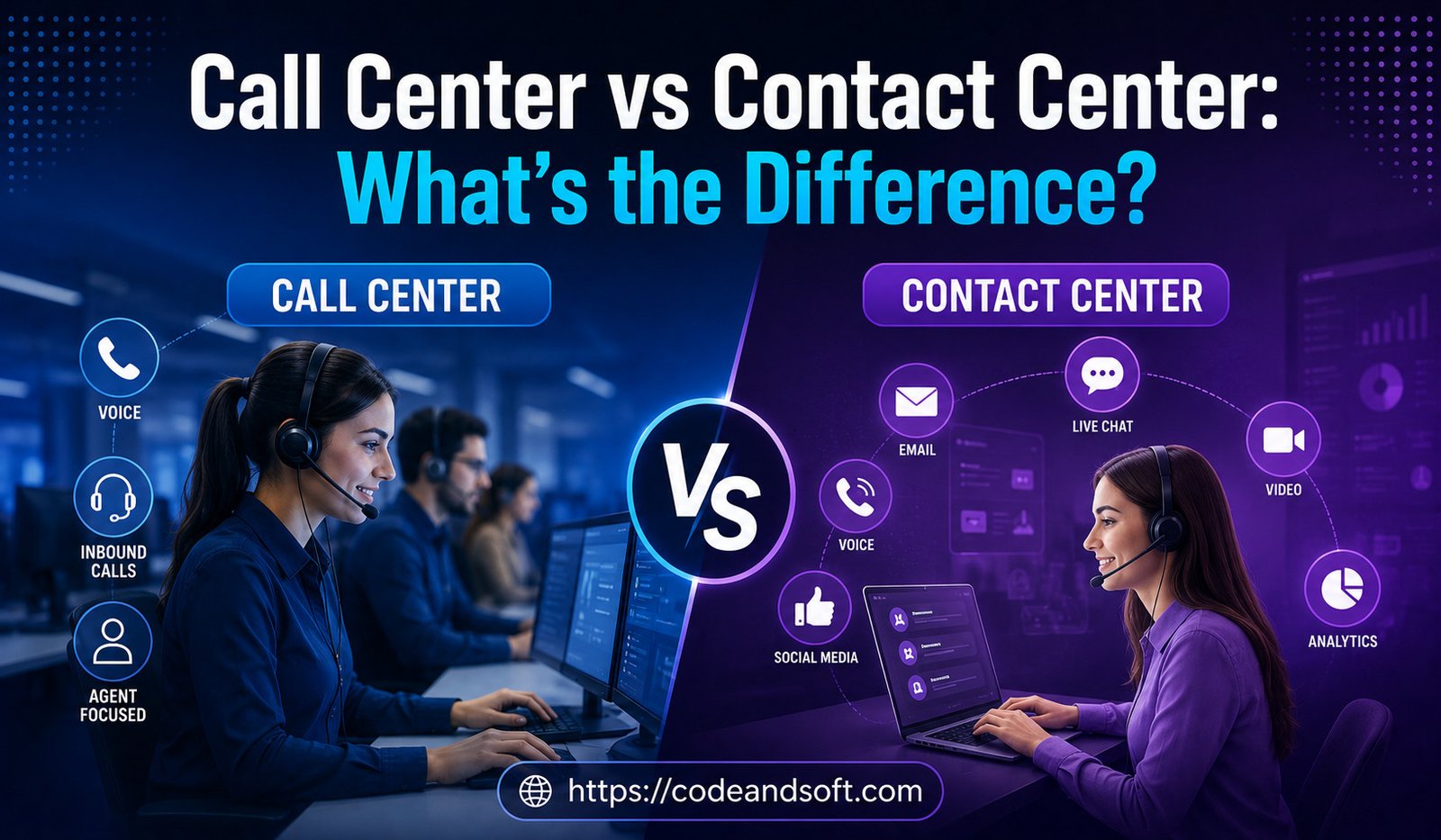
A call center traditionally focuses on handling voice conversations, while a contact center manages customer interactions across multiple communication channels.
Understanding the difference can help businesses choose the right customer service technology, organize their support teams, and create better customer experiences.
What Is a Call Center?
A call center is a centralized operation designed primarily to manage telephone conversations between a business and its customers.
Call centers can handle both inbound and outbound calls.
Inbound Call Centers
Inbound call centers receive calls from customers.
Common examples include:
- Technical support
- Billing assistance
- Product questions
- Appointment scheduling
- Order support
- Complaint handling
The goal is usually to resolve customer issues as efficiently as possible.
Outbound Call Centers
Outbound call centers initiate calls to customers or prospects.
Typical activities include:
- Telemarketing
- Sales calls
- Customer surveys
- Appointment reminders
- Payment follow-ups
- Customer retention campaigns
Some organizations operate both inbound and outbound call center teams.
What Is a Contact Center?
A contact center is a broader customer communication operation that manages interactions through multiple channels.
In addition to voice calls, a contact center may support:
- Live chat
- SMS
- Social media
- Messaging applications
- Website forms
- Video communication
The main difference is that a contact center is designed around the overall customer journey rather than focusing primarily on telephone conversations.
For example, a customer might start a conversation through live chat, continue it by email, and eventually speak with an agent by phone.
A modern contact center aims to make that journey as seamless as possible.
Call Center vs Contact Center: The Main Difference
The simplest distinction is:
A call center primarily manages voice calls, while a contact center manages customer interactions across multiple channels.
A call center might focus on improving call waiting times, agent productivity, and telephone support.
A contact center looks at the broader customer experience across voice and digital communication.
This difference is becoming increasingly important as customers move between channels during a single support journey.
Key Differences Between Call Centers and Contact Centers
1. Communication Channels
The most obvious difference is the number of channels supported.
Call centers primarily use telephone communication.
Contact centers can combine:
- Voice
- Chat
- SMS
- Social media
- Messaging
- Web-based communication
A contact center therefore provides a broader communication environment.
2. Customer Experience
Call centers often focus on individual calls.
Contact centers can track customer interactions across multiple channels.
For example, an agent may be able to see that a customer previously:
- Sent an email
- Used live chat
- Received a support response
- Called the business
This broader context can help agents understand the customer’s situation without asking them to repeat everything.
3. Technology
Traditional call centers generally rely on technologies such as:
- Phone systems
- Interactive voice response
- Automatic call distribution
- Call recording
- Call monitoring
Contact centers use these technologies while adding tools for digital communication.
They may also include:
- Omnichannel routing
- Customer profiles
- Digital messaging
- CRM integration
- Conversation analytics
- AI-powered assistance
- Workforce management
4. Customer Data
Call centers may primarily collect information from telephone conversations.
Contact centers can combine information from several customer interactions.
This creates a more complete view of customer activity.
5. Agent Skills
Call center agents primarily need strong telephone communication skills.
Contact center employees may need to handle multiple communication formats.
An agent might respond to a chat conversation, write an email, and handle a phone call during the same workday.
This can require additional training and broader digital communication skills.
How Call Center Technology Works
Modern call centers often use cloud-based software instead of traditional telephone infrastructure.
Important technologies include:
Automatic Call Distribution
Automatic call distribution routes incoming calls to appropriate agents.
Calls may be distributed according to:
- Agent availability
- Department
- Skills
- Customer priority
- Language
- Call type
Interactive Voice Response
IVR allows callers to interact with automated menus.
For example:
“Press 1 for Sales.”
“Press 2 for Support.”
“Press 3 for Billing.”
IVR can help customers reach the appropriate department without requiring a receptionist to manually route every call.
Call Queues
Call queues allow customers to wait for available agents.
Businesses can monitor queue length, waiting time, and abandoned calls.
Call Recording
Recorded calls can be used for training, quality assurance, and service improvement, subject to applicable privacy and consent requirements.
How Contact Center Technology Works
Contact centers combine voice technology with digital communication systems.
A modern contact center may provide a centralized interface where agents can manage multiple channels.
For example, an agent may see:
- Customer profile
- Previous phone calls
- Email history
- Chat conversations
- Open support tickets
- Previous purchases
This information can help create a more personalized customer experience.
What Is Omnichannel Communication?
Omnichannel communication is one of the most important concepts associated with contact centers.
It means customers can communicate through different channels while maintaining continuity.
For example, a customer could:
- Ask a question through chat
- Receive an email response
- Send additional information through messaging
- Call customer support
In an omnichannel environment, relevant information can remain connected across those interactions.
This is different from simply offering multiple communication channels.
A company may provide email, phone, and chat but keep each channel completely separate. That is more accurately described as multichannel communication.
Benefits of a Call Center
Call centers continue to provide important advantages.
Focused Phone Support
Businesses can concentrate resources on customers who prefer voice communication.
Easier Management
A phone-focused operation can be simpler to organize than a complex omnichannel environment.
Faster Voice Conversations
Some problems can be resolved faster through a conversation than through a long email exchange.
Useful for High-Volume Calling
Call centers are effective for organizations handling large numbers of inbound or outbound calls.
Specialized Agent Training
Agents can focus specifically on telephone communication and customer service skills.
Benefits of a Contact Center
Contact centers provide broader capabilities.
More Communication Choices
Customers can select their preferred communication channel.
Better Customer Context
Agents can potentially access information from previous interactions.
Improved Personalization
Customer history can help agents provide more relevant responses.
Greater Flexibility
Businesses can support customers through both traditional and digital channels.
Better Analytics
Contact center platforms can analyze customer activity across multiple channels.
Call Center vs Contact Center Comparison
| Feature | Call Center | Contact Center |
| Primary focus | Phone calls | Multiple communication channels |
| Voice support | Yes | Yes |
| Limited or separate | Usually integrated | |
| Live chat | Usually separate | Commonly integrated |
| SMS | Limited | Commonly supported |
| Social media | Usually separate | Can be integrated |
| CRM integration | Common | Common |
| Omnichannel support | Limited | Core capability |
| Customer journey tracking | More limited | Broader |
| AI capabilities | Increasingly available | Increasingly integrated |
| Complexity | Generally simpler | Generally more complex |
Which One Is Better for Small Businesses?
There is no universal answer.
A small company that mainly receives phone calls may not need a sophisticated contact center.
For example, a local service company may primarily need:
- Business phone numbers
- Call forwarding
- Voicemail
- Call queues
- IVR
- Basic reporting
In this situation, a call center solution may be sufficient.
However, a growing online business that receives questions through phone, email, chat, and social media may benefit more from contact center software.
Which One Is Better for Large Businesses?
Large businesses often benefit from contact center technology because they may have customers using multiple communication channels.
Large organizations can also require:
- Advanced routing
- Workforce management
- Quality monitoring
- Customer journey analytics
- CRM integration
- AI tools
- Omnichannel communication
- Supervisor dashboards
However, a large company that relies almost exclusively on telephone communication may still operate effectively with a call center platform.
The right choice depends on business requirements rather than company size alone.
When Should a Business Move From a Call Center to a Contact Center?
Common indicators that an upgrade could be necessary include:
- Customers repeatedly ask for chat support
- Email and phone systems are disconnected
- Agents cannot easily view customer history
- Customers have to repeat information
- Digital support volume is increasing
- Managers need cross-channel analytics
- Remote teams require centralized communication tools
Moving to a contact center can help businesses create a more connected support operation.
The Role of AI in Modern Call and Contact Centers
AI-powered tools can support:
- Call transcription
- Automatic summaries
- Intelligent routing
- Chatbots
- AI voice agents
- Agent assistance
- Sentiment analysis
- Conversation analytics
- Predictive forecasting
In a call center, AI might summarize a phone conversation.
In a contact center, AI can analyze information across multiple customer interactions.
The goal is generally to reduce repetitive work while giving employees better information.
Call Center vs Contact Center: Cost Considerations
Call center systems can be less expensive when businesses only need voice communication.
Contact centers can require additional investment because they support multiple channels and more advanced capabilities.
Costs can include:
- User licenses
- Phone services
- Digital messaging
- CRM integrations
- AI features
- Analytics
- Implementation
- Training
- Support
Businesses should calculate total cost rather than comparing only monthly subscription prices.
A more expensive contact center can provide better value if it eliminates multiple disconnected communication systems.
Security Considerations
Both call centers and contact centers can handle sensitive customer information.
Businesses should consider:
- User authentication
- Access permissions
- Data encryption
- Call recording controls
- Transcript protection
- Secure integrations
- Fraud prevention
- Data retention policies
The more communication channels a business manages, the more important centralized security and access controls become.
How to Choose Between a Call Center and Contact Center
Start by evaluating your customers.
Ask:
How Do Customers Contact Us?
If almost everyone calls, a call center may be sufficient.
If customers regularly use email, chat, SMS, social media, and voice, consider a contact center.
Do Agents Need Customer History?
If agents need information from multiple conversations, contact center technology may provide greater value.
Do You Need Omnichannel Support?
If maintaining communication across multiple channels is important, a contact center is usually the better fit.
How Complex Is Your Operation?
A simple support operation may not require advanced contact center technology.
A large customer service team may need more sophisticated tools.
What Are Your Future Plans?
Think beyond current requirements.
If digital customer communication is expected to grow rapidly, choosing a scalable contact center platform may prevent another major technology migration later.
Can a Business Use Both?
Yes.
Some businesses use traditional call center functions alongside digital contact center channels.
A company may maintain a strong phone support operation while gradually adding:
- Live chat
- Email integration
- SMS
- Social messaging
- AI assistance
This allows organizations to expand communication capabilities without changing everything at once.
Final Thoughts
The difference between a call center and a contact center primarily comes down to the scope of communication.
A call center focuses primarily on telephone interactions, while a contact center manages customer conversations across multiple channels.
Call centers can be a practical choice for businesses that mainly depend on voice support. Contact centers are better suited to organizations that want connected communication across voice, email, chat, messaging, social media, and other digital channels.
Neither approach is automatically better. The right option depends on how your customers communicate, how your agents work, the complexity of your operations, and your future growth plans.
As customer expectations continue to evolve, businesses should focus on creating convenient and connected experiences rather than simply choosing the platform with the largest feature list.
For organizations that primarily need reliable phone support, a modern call center system may provide everything required. For businesses managing increasingly complex customer journeys across multiple channels, contact center software can provide the broader infrastructure needed to deliver consistent and personalized support.