
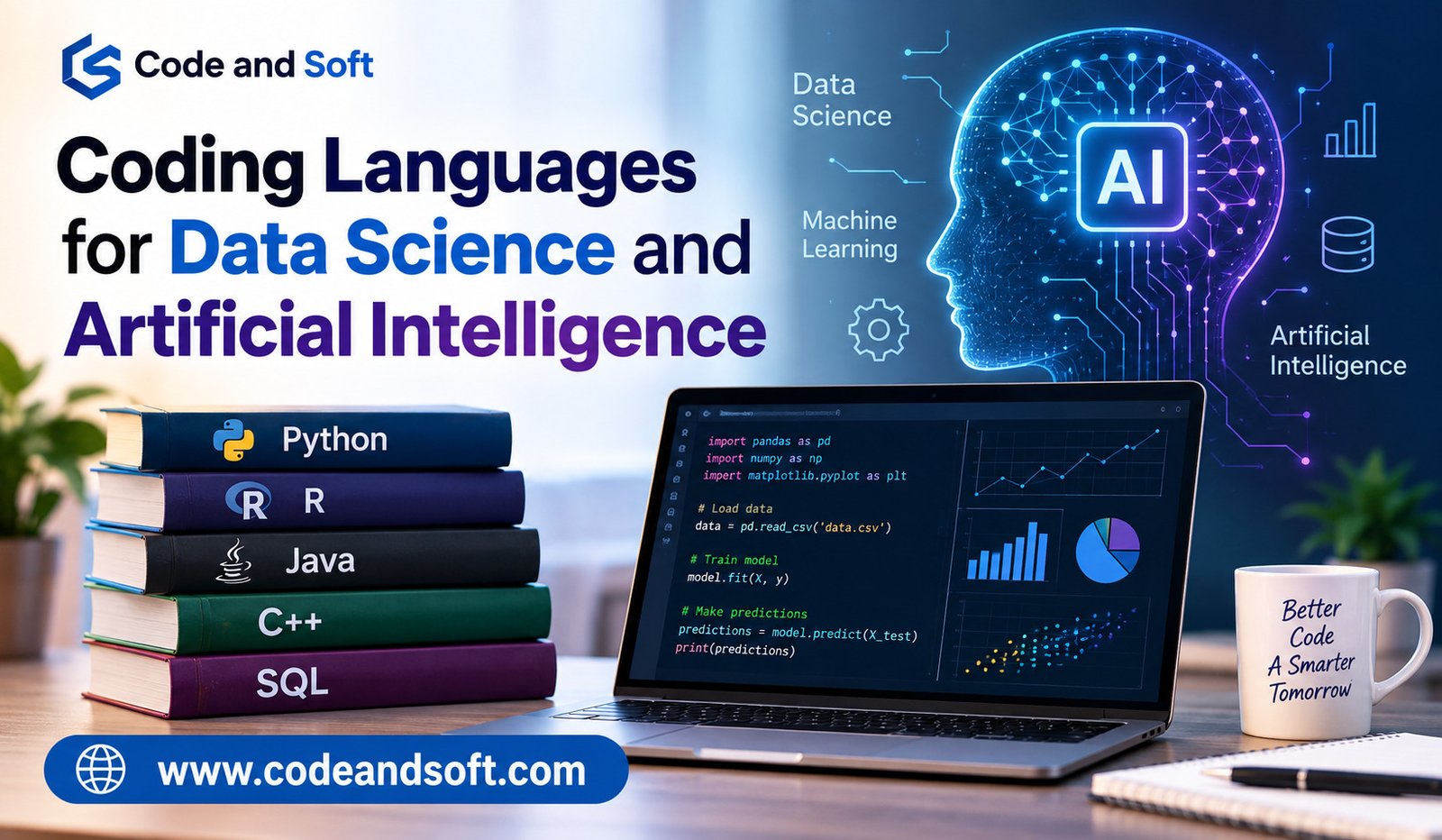

Data science and artificial intelligence have become important parts of modern technology. Businesses use data to understand customers, improve products, reduce costs, and make better decisions. Artificial intelligence is also being used in areas such as healthcare, banking, education, shopping, entertainment, and software development.
Behind many of these systems are programming languages. A programming language gives developers a way to work with data, create computer programs, build prediction systems, and develop applications that can perform tasks automatically. However, choosing the right language can be confusing, especially for beginners. There are many options, and each language has its own strengths.
The good news is that you do not need to learn every programming language to start working in data science or artificial intelligence. Some languages are much more useful than others for these fields. Understanding what each language does best can help you choose a good starting point.
Python
Python is one of the most popular programming languages for data science and artificial intelligence. It is especially friendly to beginners because its code is usually easy to read and understand. The language uses simple commands and does not require developers to write large amounts of code for basic tasks.
Python is widely used for working with data. Developers can use it to open files, clean information, compare numbers, create charts, and find useful patterns in large collections of data. It is also commonly used to create artificial intelligence applications.
Another reason Python is so popular is the large number of ready-made tools available for it. These tools help developers perform common tasks without having to build everything from the beginning. For someone learning data science or artificial intelligence, this can make the learning process much easier.
Python is also used in many other areas of software development. Learning it can therefore be useful even if your career later moves beyond data science or artificial intelligence.
R
R is another important programming language for data science. It was created with statistics and data analysis in mind, which makes it useful for people who work with numbers and research.
R is often used to study large amounts of information and create charts that make results easier to understand. Researchers, statisticians, universities, and businesses use R when they need to examine data carefully.
For example, a company may have information about thousands of customers. An R program can help the company study customer behavior and understand how different groups respond to a product.
R can be a good choice for people who are especially interested in statistics and research. However, Python is generally a more common starting point for beginners who want to work across both data science and artificial intelligence.
SQL
SQL is different from languages such as Python and R because it is mainly used to work with information stored in databases. Databases are used by websites, applications, banks, businesses, hospitals, and many other organizations to store information.
Data scientists often need to find specific information from these databases before they can study it. SQL makes this possible. It allows users to search for records, select certain information, combine related information, and make changes when necessary.
Imagine a shopping website with millions of customer orders. A data scientist may want to find how many products were sold in a particular month or which products were most popular. SQL can help retrieve the information needed for that analysis.
Learning SQL is therefore highly useful for anyone planning to work with data. It is often used together with Python or R rather than as a replacement for them.
Java
Java has been used in software development for many years and remains important in large applications. Although it is not usually the first language beginners choose for data science, it can still be useful in artificial intelligence and data-related projects.
Java is known for being suitable for large software systems. Many businesses use it for applications that need to handle large numbers of users and transactions.
Some artificial intelligence and data tools support Java, allowing developers to build intelligent features into existing applications. Java can also be useful when a data science project needs to become part of a larger business application.
For a beginner focused mainly on data science, Python is usually easier to start with. However, Java can become valuable for developers who want to connect artificial intelligence features with large software systems.
C++
C++ is known for its speed and is used when software needs to perform tasks very quickly. This makes it useful in some areas of artificial intelligence where performance is important.
Artificial intelligence systems can sometimes involve large amounts of calculations. When speed is critical, C++ can provide strong performance. It is also used in areas such as robotics, computer games, image processing, and other software where quick responses matter.
C++ is more difficult for beginners than Python because it gives developers greater control over how computer resources are used. That control can be helpful for experienced developers, but beginners may find the language harder to understand.
Someone starting with data science does not normally need C++ immediately. It becomes more useful when working on performance-heavy artificial intelligence systems or specialized software.
JavaScript
JavaScript is best known for creating interactive websites, but it can also be used for artificial intelligence and data-related applications.
One advantage of JavaScript is that it runs directly in web browsers. This means developers can create websites that perform certain intelligent tasks without requiring users to install a separate program.
For example, a website can use JavaScript to process information, display charts, or provide features that respond to user actions. JavaScript can also be used with tools that allow artificial intelligence programs to run in web applications.
JavaScript is a useful choice for web developers who want to add data or artificial intelligence features to websites. However, Python remains a more common choice for people who are starting specifically with data science and artificial intelligence.
Julia
Julia is a newer programming language designed for technical and scientific work. It combines features that make it suitable for mathematical calculations while also aiming to provide good speed.
Julia is used in areas such as scientific research, data analysis, engineering, and artificial intelligence. It can be useful when a project involves large calculations and requires good performance.
Although Julia has a growing community, it is not as widely used as Python or R. This means beginners may find fewer learning resources and fewer job opportunities compared with the more established languages.
Still, Julia is worth knowing about, especially for people interested in scientific computing and research.
MATLAB
MATLAB is widely used in engineering, mathematics, research, and education. It provides an environment for working with numbers, creating charts, testing ideas, and solving mathematical problems.
It is commonly found in universities and research organizations. Engineers can use MATLAB to test models and study complex systems before turning their ideas into finished products.
MATLAB can also be used in areas connected to artificial intelligence and data analysis. Its clear environment can make certain mathematical tasks easier to understand.
However, MATLAB is usually less common in general software development than Python. For someone who wants broad career options in data science and artificial intelligence, Python may provide a more useful starting point.
Which Coding Language Should Beginners Learn?
For most beginners, Python is the strongest starting point. It has simple-looking code, a large learning community, and many tools for data science and artificial intelligence.
A beginner can start by learning basic Python commands and gradually move toward working with data. After becoming comfortable with Python, learning SQL can be a smart next step because many real-world data jobs involve information stored in databases.
People who are especially interested in statistics and research may also want to learn R. Those who want to build websites with artificial intelligence features can benefit from JavaScript. Developers interested in robotics, high-speed software, or specialized systems may eventually need C++.
The important thing is not to rush into learning several languages at the same time. Trying to learn everything can make the process confusing. It is better to become comfortable with one language and then add another when you have a clear reason to use it.
Why Python Is Often the Best Starting Point
Python has become a popular choice because it covers many parts of data science and artificial intelligence. A learner can use the same language to work with data, create charts, build prediction programs, test ideas, and develop useful applications.
Another advantage is the amount of educational material available. Beginners can find courses, tutorials, examples, and community discussions covering almost every basic Python topic.
Python also allows learners to move gradually. You can start with simple programs and slowly work toward more advanced projects. This makes it easier to build confidence instead of trying to understand everything at once.
The language is also used by companies of different sizes. This means learning Python can be useful when looking for internships, entry-level jobs, freelance work, or future opportunities in technology.
The Importance of Learning More Than One Language
Although one language may be enough to get started, learning another language can make a developer more flexible.
For example, Python can be used to study data and create an artificial intelligence program, while SQL can be used to get the required information from a database. JavaScript may then be used to display the results on a website.
This shows why programming languages are often used together. Each language can handle a different part of a project.
The goal should not be to collect as many languages as possible. Instead, focus on understanding how to use the right language for the task. A developer who knows one language well and understands how to solve real problems can often be more effective than someone who knows many languages only at a basic level.
Final Thoughts
Choosing a programming language for data science and artificial intelligence depends on what you want to build and where you want to work. Python is generally the best starting point for beginners because it is easy to read and widely used in both fields.
R is useful for statistics and research, while SQL is important for working with databases. Java and C++ can be valuable for large or performance-focused software. JavaScript is helpful for web-based applications, while Julia and MATLAB have strong uses in scientific and engineering work.
You do not need to master all of these languages. Start with one, practice regularly, and work on small projects that solve real problems. Once you understand the basics, learning another language becomes much easier.
For most people entering data science or artificial intelligence today, learning Python first and then adding SQL is a practical path. From there, you can choose other languages based on your interests, career goals, and the kind of applications you want to create.