
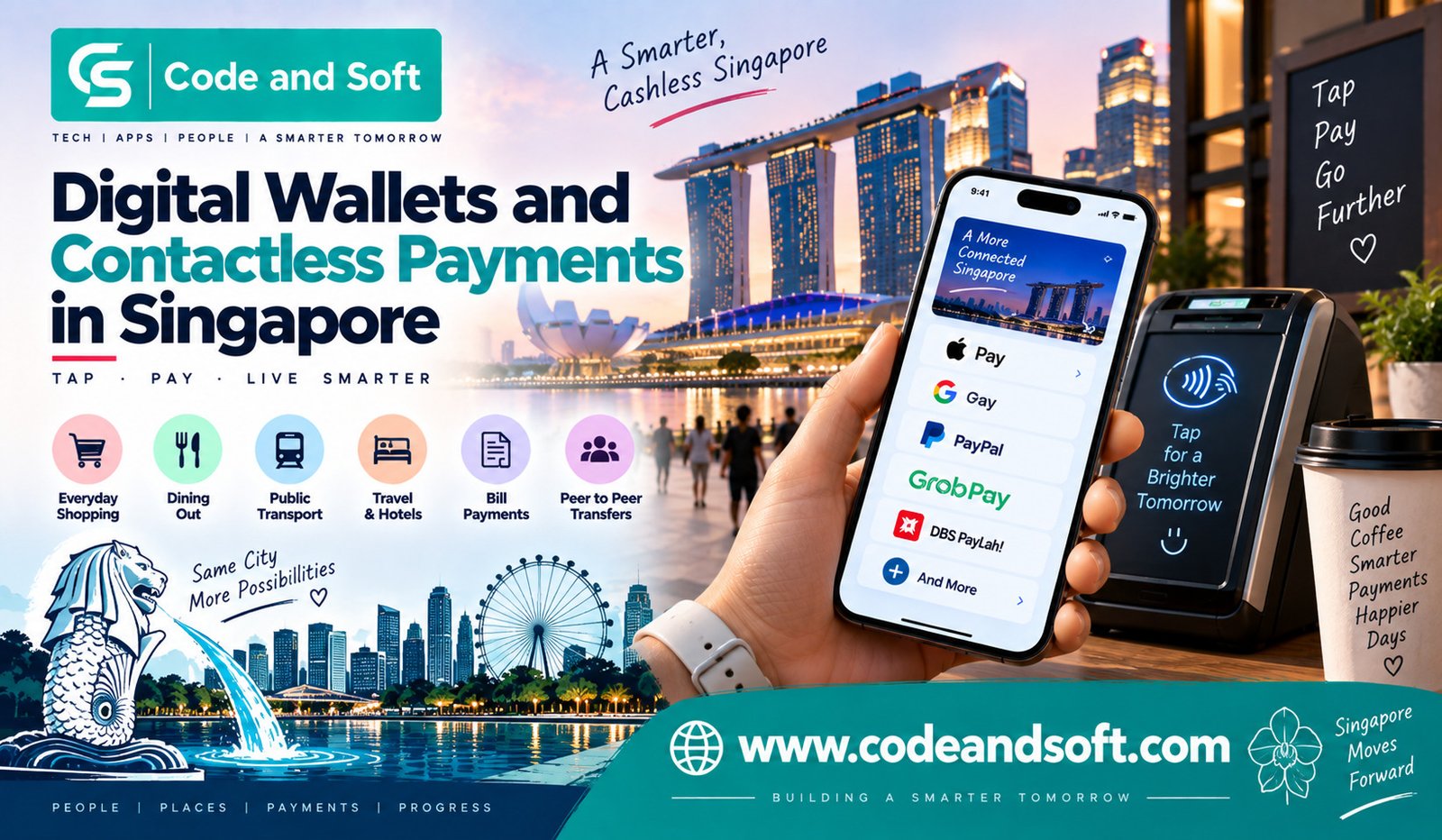

Imagine walking into a café in Singapore, ordering your favourite drink, and paying without taking out your wallet. You simply hold your phone near the payment terminal, approve the transaction, and you are done. At another shop, you might scan a QR code instead. No coins, no notes, and sometimes not even a physical card.
That is the everyday reality of digital wallets use in Singapore.
Singapore has developed one of the most convenient digital payment environments in the region. With high smartphone and banking penetration, contactless cards, QR payments and mobile wallets have become part of normal shopping, dining, commuting and online spending. According to PwC Singapore, digital payment adoption reached 92% in 2025, with tap-to-pay, PayNow, FAST and SGQR playing important roles in the country’s payment ecosystem.
For you as a consumer, this means paying digitally is no longer something reserved for large shopping malls or online stores. You can encounter digital payment options in everyday situations, from buying lunch to paying a bill or splitting expenses with friends.
What Are Digital Wallets?
A digital wallet is essentially a payment tool on your smartphone, smartwatch or another connected device. Instead of carrying your physical card everywhere, you can add supported cards or money to a wallet and use your device to make payments.
Some wallets work mainly through NFC contactless technology. You hold your phone or smartwatch close to a compatible terminal, and the payment is processed within seconds.
Others use QR codes. You open the relevant app, scan the merchant’s QR code and confirm the amount before completing the transaction.
Singapore’s SGQR system also makes QR payments easier because participating payment schemes can be represented through a single QR code at the merchant’s counter.
The important thing for you is that you do not necessarily have to use one payment method everywhere. Depending on your phone, bank, preferred apps and the merchant, you can choose from several options.
Why Digital Wallets Are Becoming So Popular in Singapore
One of the biggest advantages is convenience.
Think about how often you use your smartphone throughout the day. You probably already carry it when you leave home, travel to work, meet friends or go shopping. Turning that same device into a payment tool removes another item from your daily routine.
Speed is another major reason.
When you use contactless payment, you do not have to insert a card, wait for a machine to read it or handle cash. You simply tap, authenticate when required and continue with your day.
Digital wallets can also make online shopping easier. Once your payment details are securely stored, you may not have to repeatedly enter your card number, expiry date and other information.
Security is another important factor. Modern digital wallets can use tokenisation, authentication and device security features rather than simply exposing your actual card details during every transaction.
Of course, digital payments are not completely risk-free. You still need to protect your phone, passwords, PINs and authentication methods and remain alert to scams.
DBS PayLah! for Everyday Payments
If you use DBS or POSB services, DBS PayLah! can be particularly useful in your everyday payment routine.
PayLah! is designed around Singapore’s local payment environment and supports functions such as peer-to-peer payments and QR-based transactions. Instead of carrying cash when you meet friends, for example, you can use your phone to send or receive money.
This can be especially convenient when splitting restaurant bills, paying someone back for a purchase or making payments at participating merchants.
The appeal of PayLah! is that it feels closely connected to the way many people already manage their finances in Singapore. Rather than treating payments as a separate activity, you can handle them directly from your mobile device.
GrabPay: More Than Paying for a Ride
You may already use Grab to book rides or order food, so using GrabPay can feel like a natural extension of the same ecosystem.
GrabPay Wallet lets you make payments within Grab’s services and at participating merchants. You can also use QR payments at participating physical locations. Grab says users can earn GrabRewards points when spending through GrabPay Wallet, which can then be used toward eligible rewards and services.
This creates an interesting advantage: your payment activity can become connected with other things you already do.
For example, you might order lunch through GrabFood, book a ride later in the day and use GrabPay at a participating merchant. Instead of moving between several unrelated services, you can manage parts of your spending within one ecosystem.
Grab is also pushing contactless acceptance from the merchant side. In 2026, Grab announced Tap to Pay on iPhone for Singapore merchants, allowing participating businesses to accept contactless cards and digital wallets using an iPhone and the Grab Merchant app without additional payment hardware.
Apple Pay for Simple Tap-to-Pay Transactions
If you use an iPhone or Apple Watch, Apple Pay offers one of the simplest ways to make contactless payments.
You add an eligible card to your Apple Wallet and can then use your device at supported contactless terminals. Instead of pulling your physical card out of your wallet, you authenticate on your device and tap.
The experience is particularly useful when you are moving quickly through a shop, café or other location where contactless payments are supported.
The underlying technology is important here. Contactless mobile wallets use NFC, allowing your device to communicate with a compatible payment terminal over a very short distance.
For you, the result is simple: hold, authenticate and go.
Google Pay for Android Users
If you use an Android phone, Google Pay, through Google’s supported wallet/payment experience, provides another route to contactless payments.
Google states that contactless payments with Google Wallet require an NFC-enabled Android device, while card availability depends on the participating bank and card issuer.
That means you should check whether your particular card and bank are supported before relying on your phone as your primary payment method.
Once everything is set up correctly, however, the process can be remarkably straightforward. You can use your phone at compatible contactless terminals without needing to reach for the physical card.
For people who already use Android devices throughout the day, this can make everyday payments feel like a natural part of the smartphone experience.
ShopeePay for Online and Offline Spending
If you regularly shop through Shopee, ShopeePay can also be useful.
The biggest attraction is the connection between your online shopping habits and payments. Rather than treating shopping and payment as completely separate experiences, ShopeePay brings them together within the Shopee ecosystem.
Depending on current promotions and merchant availability, you may also encounter ShopeePay as a payment option outside the main shopping platform.
This is one of the broader trends you can see across Singapore’s wallet market: payment apps increasingly compete by combining payments with shopping, rewards, transfers and other services.
And More: Samsung Pay, PayNow and QR Payments
The digital wallet landscape does not stop with the five names above.
You may also encounter Samsung Pay, especially if you use a compatible Samsung device. There are also QR-based payment options connected to PayNow and other participating services.
PayNow is particularly important in Singapore because it allows you to transfer money almost instantly using identifiers such as mobile numbers, NRIC/FIN-linked details where applicable, or virtual payment addresses, depending on the service.
Then there is SGQR.
When you see an SGQR code at a merchant, you may have several ways to complete the payment depending on the apps and accounts you use. This helps reduce the need for merchants to display a different physical QR code for every payment provider.
For you, the experience can be as simple as opening the app you prefer, scanning the code and confirming the transaction.
Contactless Payments Are Changing Your Daily Routine
The biggest change is not necessarily the technology itself. It is the way payments disappear into your daily routine.
You may tap your phone when buying breakfast, scan a QR code at lunch, use a wallet when shopping online and transfer money to a friend through a banking app later that evening.
You do not have to think about each transaction as a major financial activity. Payments become another function of the smartphone you already carry.
This is one reason Singapore’s digital payment environment has developed so quickly. The country combines widespread smartphone use, strong banking infrastructure, real-time payment networks and a regulatory framework for payment services. PwC describes tap-to-pay and mobile wallets as everyday parts of Singapore’s payment landscape, alongside PayNow, FAST and SGQR.
What You Should Consider Before Going Fully Digital
While the convenience is attractive, you should not assume that every wallet works everywhere.
Before leaving your physical cards at home, check whether your preferred card is supported by your wallet and whether the places you visit accept your chosen payment method. Google, for example, notes that individual banks decide whether their cards can be used for mobile payments.
You should also keep your phone protected with a strong passcode and biometric authentication where available.
Most importantly, stay cautious about suspicious QR codes, unexpected payment requests and messages asking you to reveal passwords or authentication codes. A convenient payment system is only as safe as the habits you use with it.
Keeping a backup payment method can also be sensible. Your phone battery can run out, an app can experience an issue, or a particular merchant may not support your preferred wallet.
The Future of Digital Wallets in Singapore
The direction is clear: payments are becoming more integrated, mobile and almost invisible.
Instead of thinking about whether you should carry cash, you are increasingly thinking about which phone, card, wallet or app is most convenient for a particular situation.
Digital wallets are also becoming more connected to loyalty programmes, shopping platforms, transportation, financial services and cross-border payments. Singapore’s payment ecosystem is already highly digital, while newer developments are continuing to connect domestic payment systems with international networks.
For you, that means the next stage of digital payments may not feel like a dramatic technological revolution. It may simply mean fewer moments when you need to stop and think about how to pay.
Final Thoughts
The Digital Wallets Use In Singapore is ultimately about convenience becoming part of everyday life.
Whether you prefer DBS PayLah!, GrabPay, Apple Pay, Google Pay, ShopeePay, Samsung Pay or PayNow-linked services, you have a wide range of ways to pay without relying entirely on cash or physical cards.
You can tap your phone at a terminal, scan a QR code at a merchant, send money to a friend or complete an online purchase in just a few steps.
The real advantage is choice. You can choose the wallet that fits your phone, bank, shopping habits and lifestyle.
As Singapore continues moving toward a more connected digital economy, your smartphone is becoming much more than a communication device. It is increasingly becoming your everyday wallet, payment card and financial companion — all in one.