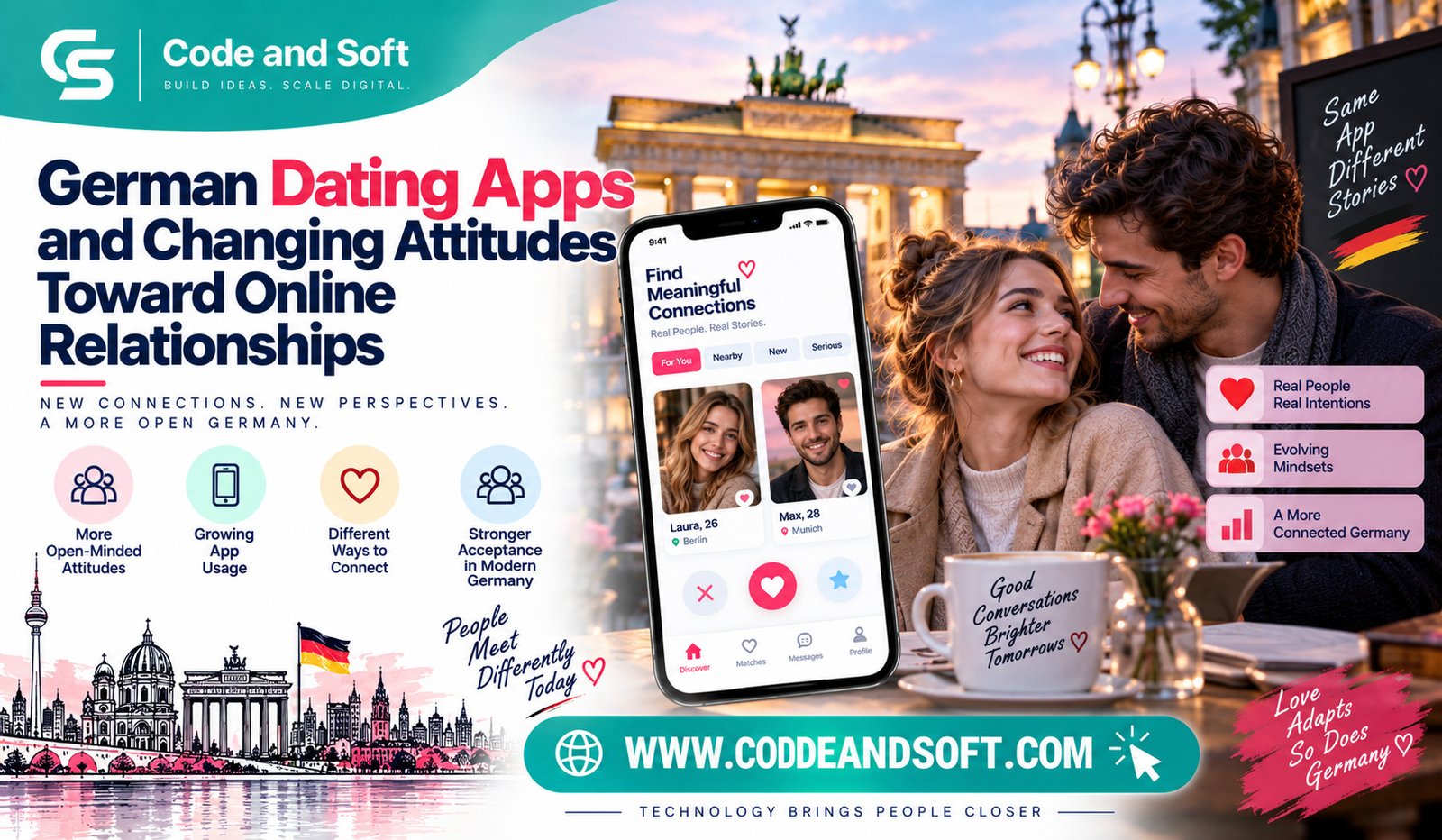
Germany has one of the busiest online dating markets in Europe. Bitkom Research found that 53 percent of German internet users have already been active on a dating platform, and around 12.6 million people in the country use dating apps or sites on a regular basis. German dating apps now range from quick swipe tools to slow, question-heavy matchmaking sites, and that range says a lot about how attitudes toward online relationships have changed. This article looks at seven platforms shaping that market: Tinder, Bumble, and Hinge, along with Lovoo, Parship, ElitePartner, LoveScout24, C-Date, and Finya.
Tinder, Bumble, and Hinge: The US Apps in the German Market
Tinder, Bumble, and Hinge all operate in Germany, and Tinder still leads among younger singles in large cities. The app works the same way it does in the United States, built around quick swiping and a broad, mostly casual user base.
Bumble and Hinge have smaller followings in Germany than Tinder does, but both keep gaining ground, especially in cities such as Berlin, Munich, and Hamburg. Their pricing runs close to what German users pay for homegrown apps, with Tinder Gold priced at roughly 20 euros a month and Bumble Boost close to 23 euros.
German users tend to write longer, more detailed profiles than users on these apps in other countries. Direct, specific messages tend to perform better here than generic opening lines, which fits a broader pattern of German dating culture valuing straightforwardness over small talk.
Lovoo: Germany’s Own Radar-Based App
Lovoo was founded in Dresden and built specifically for German-speaking users. It combines familiar swipe matching with a location feature called Radar, which shows other users nearby in real time, along with suggested spots for a first meeting, such as cafes or cinemas.
The app also includes live video streaming, where members host or join broadcasts, turning Lovoo into something closer to a social entertainment platform than a pure dating tool. An icebreaker feature lets users message someone before a mutual match happens, giving people a way to take the first step instead of waiting on a like.
Lovoo mainly attracts users between 18 and 35, and it works best in areas with a high density of members, since the Radar feature depends on nearby activity. In smaller towns, the pool of nearby users can feel thin.
Parship: Personality-Based Matching for Serious Relationships
Parship launched in Hamburg in 2001 and built its identity around a scientific approach to matchmaking rather than swiping. New members complete a personality test, originally developed with input from a psychology professor at the University of Hamburg, that scores more than 130 personal traits.
The app uses those results to suggest a curated list of potential partners instead of an open, scrollable feed. Parship belongs to the ParshipMeet Group, which also owns ElitePartner and Lovoo, giving the company a presence across both the casual and serious ends of German online dating.
Parship draws an older, education-heavy audience focused on long-term relationships. Surveys of its own membership report that a majority hold a university degree, and manual profile checks are meant to keep the platform feeling more like a matchmaking service than a browsing app.
ElitePartner: Matchmaking for Academic and Established Singles
ElitePartner launched in 2004 and targets singles aged 30 and older who want a partner with a similar educational or professional background. Like its sister platform Parship, it opens with a personality test built by psychologists, covering values, life goals, and relationship expectations.
The platform reviews new applications by hand, rejecting profiles that do not fit its intended audience. This manual check, combined with the personality assessment, is meant to keep the community focused on people who want a serious relationship rather than casual dating.
ElitePartner and Parship share much of the same backend technology and company structure, but they market to slightly different groups. ElitePartner leans more heavily toward academics and professionals, while Parship casts a somewhat wider net among serious daters.
LoveScout24: A Broad Mix of Flings and Long-Term Search
LoveScout24, formerly known as FriendScout24, is one of the largest general dating platforms in Germany, with millions of members spanning both casual and long-term intentions. It is run by Scout24, the same Munich-based company behind AutoScout24 and ImmoScout24.
The platform offers detailed profiles, a search-based system, and a Tinder-like shuffle feature for browsing random profiles. Premium tiers unlock features such as unlimited messaging, advanced filters, and higher visibility for a user’s profile.
LoveScout24 also runs a separate portal for gay and bisexual users and hosts in-person single events alongside its app and website. Its broad mix of relationship goals makes it a middle ground between fast swipe apps and slower, matchmaking-style platforms like Parship.
C-Date: Casual Dating Without Commitment
C-Date has operated since 2008 and focuses entirely on casual dating rather than long-term relationships. The platform reports around 3.7 million members in Germany, making it the country’s leading site built specifically around no-strings-attached connections.
Registration is free for everyone, and C-Date offers full premium access to women at no cost, which shifts the gender balance closer to even compared with many casual dating platforms. Roughly half of its German members are women, a notably higher share than most dating apps report.
Because every member signs up for the same general purpose, C-Date avoids some of the mismatched expectations that can show up on broader apps like Tinder or Lovoo, where casual and serious users mix in the same pool.
Finya: Free Dating Built Around a Personality Test
Finya has been running for close to two decades and remains completely free, supported by advertising rather than subscriptions. It has attracted more than a million users and several awards for a German-only, no-cost dating platform.
After signing up, members can take an optional personality test aimed at improving match suggestions. Users can also search for potential partners on their own, rather than relying only on automatic recommendations, which gives Finya a hybrid feel between a matchmaking site and an open search platform.
Finya’s German-only interface and lack of any paid tier make it stand out in a market where most platforms eventually ask users to pay for full access.
Key Takeaways
- Tinder, Bumble, and Hinge: US apps with a strong presence in German cities, led by Tinder among younger users.
- Lovoo: A German-made app built around the Radar proximity feature and live video.
- Parship: A personality-test platform focused on serious, long-term relationships.
- ElitePartner: A sister platform to Parship aimed at academic and professional singles.
- LoveScout24: A large, general-purpose platform covering both flings and long-term search.
- C-Date: Germany’s leading casual dating platform, free for all users to join.
- Finya: A free, ad-supported site with an optional personality test.
Frequently Asked Questions
Which dating app is most popular among young people in Germany?
Tinder remains the most widely used app among younger singles in large German cities.
What makes Parship and ElitePartner different from swipe-based apps?
Both platforms open with a psychologist-designed personality test and suggest a curated list of matches instead of an open feed.
Is C-Date free to use in Germany?
Registration is free for everyone, and women can access full premium features at no cost.
Does Finya charge for a subscription?
No, Finya is completely free and supported by advertising rather than paid memberships.
What does Lovoo’s Radar feature actually do?
Radar shows other Lovoo users nearby in real time, along with suggested nearby spots for a first meeting.
Conclusion
German dating apps now cover a wide range of intentions, from Tinder’s fast swiping to Parship’s personality-based matchmaking and C-Date’s dedicated casual dating focus. With more than half of German internet users having tried a dating platform, online relationships have moved well past the early stigma that once surrounded them. The variety of apps on offer today, each built around a different idea of what a good match looks like, reflects how normal online dating has become across Germany.