
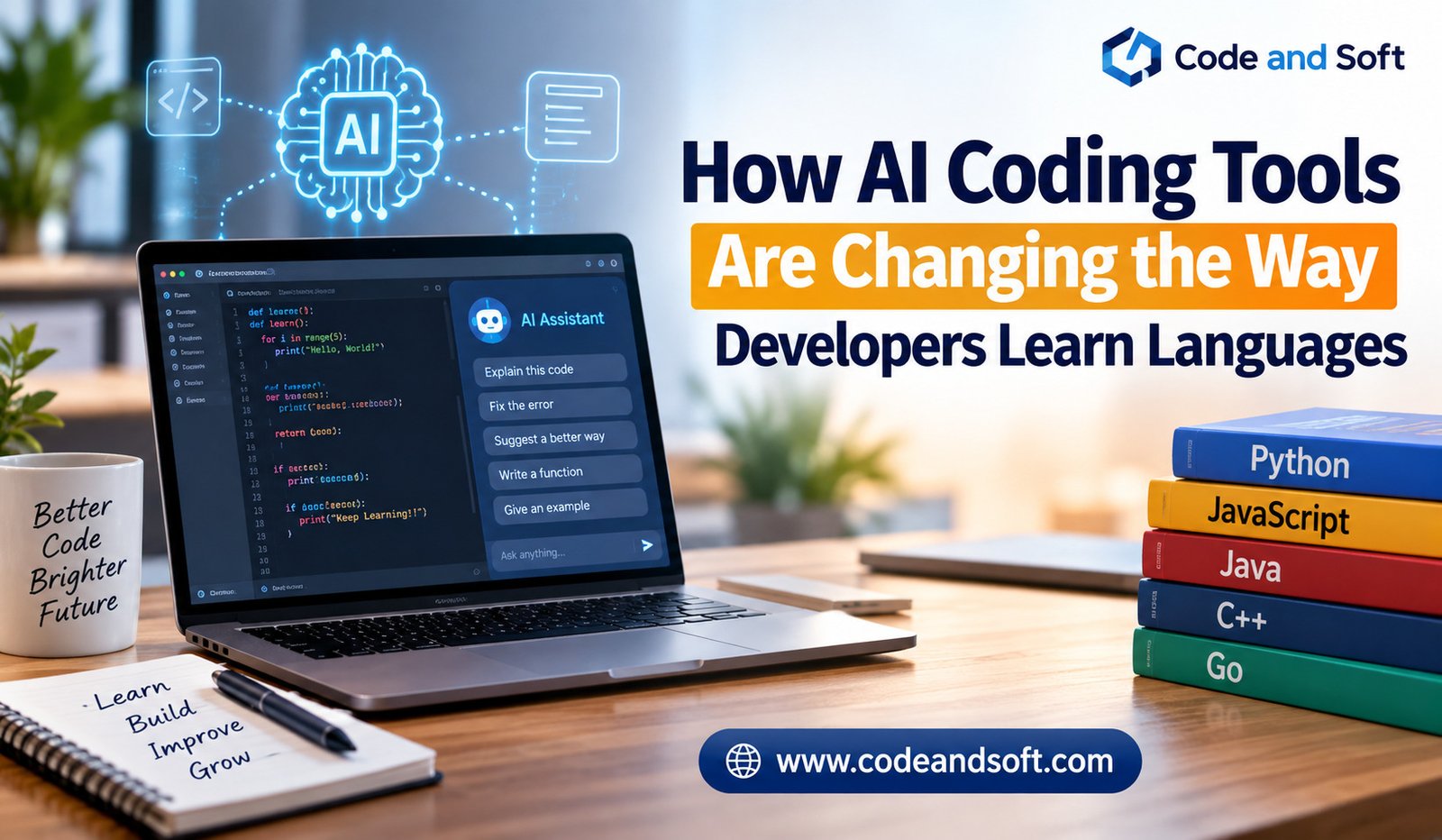

Learning a programming language has never been completely easy. Developers have traditionally spent hours reading tutorials, studying examples, writing small programs, fixing errors, and searching online when they get stuck. This process still matters, but artificial intelligence is changing how people move through it.
AI coding tools can now explain code, suggest solutions, create examples, find mistakes, and answer questions while a developer is working. Instead of stopping every few minutes to search for an answer, learners can ask an AI tool directly and continue practicing.
This does not mean that developers no longer need to study programming languages. In fact, learning the basics may be more important than ever. The difference is that AI is changing where people spend their time and how they understand difficult ideas.
For beginners, this can make programming feel less confusing. For experienced developers, it can make learning a new language much faster. At the same time, depending too heavily on AI can create problems if learners accept answers without understanding them.
Learning Programming Is Becoming More Interactive
In the past, learning a language often followed a fixed path. A person would read about variables, functions, conditions, loops, and other basic ideas before moving toward larger projects. If something was unclear, they had to find another explanation or ask someone for help.
AI coding tools make this process more interactive. A learner can write a piece of code and immediately ask why it works or why it fails. The tool can explain the answer in simpler language and provide another example.
For example, someone learning JavaScript might write a function and not understand why a particular result appears. Instead of searching through several pages of documentation, the learner can ask an AI tool to explain the function step by step.
This creates a more conversational learning experience. The student is not simply reading information. They are asking questions based on their own work.
That can be especially useful because programming problems are often easier to understand when they are connected to something the learner has already written.
AI Makes It Easier to Start With a New Language
Learning a second or third programming language is often easier than learning the first one because developers already understand many basic programming ideas.
However, every language has its own way of doing things. The syntax can be different, the rules can vary, and common tasks may require different approaches.
AI coding tools can help developers make these connections.
A developer who already knows Python, for example, can ask an AI tool to explain how a similar task works in Java. Instead of learning everything from the beginning, the developer can compare familiar ideas with new ones.
This can reduce the fear that often comes with starting a new language. Developers can experiment with small pieces of code and ask questions whenever something looks unfamiliar.
The result is a learning process that can feel more practical and less like memorizing a large textbook.
Developers Can Learn Through Their Own Projects
One of the biggest changes brought by AI coding tools is that people can learn while building something useful.
A beginner may want to create a simple website, mobile application, or small program. Previously, the learner might have needed to study a large amount of material before starting the project.
AI allows learners to begin with a small idea and learn along the way.
Suppose someone wants to create a simple weather application. They may not know how to connect different parts of the program or how to display information on a page. An AI coding tool can help explain each part and show possible ways to approach the task.
The learner can then change the code, test it, and see what happens.
This approach can make programming more interesting because every new lesson has a clear purpose. Instead of learning a feature only because it appears in a course, the developer learns it because the current project needs it.
Instant Explanations Can Reduce Frustration
Getting stuck is a normal part of learning programming. A small mistake can sometimes prevent an entire program from working.
For new developers, this can be frustrating. They may see an error message without knowing what it means. Searching for the exact problem online can also be difficult because beginners may not know the right words to use.
AI tools can explain errors in plain language.
A learner can provide the code and ask what went wrong. The AI can point out the problem and explain why the code produced that result.
This does not remove the need to practice debugging. Instead, it gives learners another way to understand mistakes.
Over time, repeated explanations can help developers recognize common problems themselves. An error that once looked confusing may eventually become familiar.
AI Can Help Developers Compare Languages
Programming languages often solve similar problems in different ways. Understanding these differences can help developers choose the right language for a particular task.
AI coding tools make language comparisons easier.
A developer can ask how the same small program would be written in Python, JavaScript, Java, C#, or another language. Seeing the differences side by side can help learners understand how each language approaches the same problem.
This is useful because learning a language is not only about remembering its rules. Developers also need to understand how those rules fit together.
For example, one language may use a particular style for handling data, while another may provide a different approach. An AI explanation can help a learner understand not only what changes but also why the code looks different.
This can make learning multiple languages more natural.
The Role of Practice Is Changing
AI can write code quickly, but developers still need to practice writing and understanding code themselves.
This is one of the most important points for learners.
If someone asks an AI tool to write every program and simply copies the answer, they may finish projects without actually learning the language. The code may work, but the developer may not know how to change it when something goes wrong.
A better approach is to use AI as a learning partner.
A learner can first attempt a problem independently. If they get stuck, they can ask for a hint instead of a complete solution. After receiving an explanation, they can try again.
This keeps the learner involved in the process.
The goal should not be to avoid difficult thinking. The goal should be to use AI to make difficult thinking easier to understand.
AI Can Adapt to Different Learning Styles
Not everyone learns programming in the same way.
Some people understand an idea quickly when they see an example. Others prefer explanations. Some want to solve several small exercises before moving forward.
Traditional courses often provide the same material to everyone. AI tools can provide more flexible support.
A developer can ask for a simple explanation, a detailed explanation, another example, or a version designed for someone with no previous programming experience.
If the first explanation is confusing, the learner can ask the tool to explain it differently.
This ability can make learning more comfortable for people who struggle with traditional teaching methods.
Experienced Developers Are Learning Faster Too
AI coding tools are not only useful for beginners.
Experienced developers frequently need to learn new languages because of changing projects, new technologies, or career opportunities. They may not have time to complete a long course before becoming productive.
AI can help them quickly understand the basics of an unfamiliar language.
A developer can ask about common syntax, typical project structures, important language features, or differences from a language they already know.
This allows experienced programmers to spend more time building and less time searching for basic information.
However, experienced developers also need to verify AI-generated answers. An AI tool can produce code that looks correct but has an error or does not follow the best approach for a particular situation.
Experience remains valuable because it helps developers judge whether an answer actually makes sense.
The Risk of Learning Without Understanding
The biggest concern with AI-assisted programming is that it can make learning appear easier than it really is.
A developer can ask an AI tool to solve a problem and receive working code within seconds. That feels productive, but copying the answer does not automatically create understanding.
This is especially risky for beginners.
If learners regularly skip the process of thinking through a problem, they may struggle when AI is unavailable or when a problem is too unusual for the tool to solve correctly.
They may also find it difficult to explain their own code.
For this reason, developers should treat AI-generated code as something to study rather than something to blindly accept.
Reading the answer, changing it, testing it, and explaining it in their own words can turn an AI response into a genuine learning experience.
Understanding the Basics Still Matters
AI has changed programming, but the basic ideas behind programming have not disappeared.
Developers still need to understand how programs make decisions, how data is stored, how functions work, how different parts of an application communicate, and how to find problems in their code.
These skills help developers use AI more effectively.
Someone who understands programming can look at an AI-generated answer and quickly notice when something seems wrong. Someone without those skills may accept incorrect code simply because it looks professional.
The stronger a developer’s foundation, the more useful AI becomes.
AI should therefore support learning rather than replace it.
The Way Developers Search for Answers Is Changing
Search engines and programming websites have been important learning tools for many years. Developers have traditionally searched for error messages, examples, explanations, and solutions.
AI does not completely replace these resources, but it changes the process.
Instead of searching for a perfect answer, developers can describe the problem in their own words and ask follow-up questions. They can continue the conversation until they understand the issue.
This can be especially helpful when a developer does not know the technical term for what they are trying to solve.
Still, reliable documentation and trusted technical resources remain important. AI answers should not always be treated as final authority, particularly when a developer is working with important software.
AI Is Turning Programming Into a More Guided Experience
The biggest change may be the shift from learning alone to learning with continuous assistance.
A developer can write code, receive feedback, ask a question, try another approach, and continue building without leaving the development environment.
This creates a smoother learning process.
Instead of spending most of the time searching for information, developers can spend more time experimenting. Instead of being blocked by a small mistake for hours, they can receive an explanation and keep going.
That does not make programming effortless. Developers still need patience, practice, curiosity, and careful thinking.
What changes is the amount of support available during the learning process.
What the Future of Language Learning May Look Like
As AI coding tools become more capable, programming education is likely to become even more personalized.
Developers may use AI to create practice exercises based on their current skill level. They may receive explanations based on mistakes they repeatedly make. They may also use AI to move between programming languages more easily.
This could make it possible for learners to spend less time memorizing syntax and more time understanding how software works.
At the same time, human teaching will continue to matter. Teachers, mentors, classmates, and experienced developers provide perspectives that AI cannot always replace. Learning also involves communication, teamwork, creativity, and making decisions about what should be built.
AI is best viewed as another tool in that larger learning process.
Conclusion
AI coding tools are changing how developers learn programming languages by making education more interactive, practical, and accessible. Developers can ask questions while coding, receive explanations for mistakes, compare different languages, and learn new skills while working on real projects.
For beginners, this can reduce frustration and make difficult concepts easier to approach. For experienced developers, AI can shorten the time needed to become familiar with a new language.
But faster answers do not always mean deeper learning. Developers still need to understand the basics, practice solving problems, review generated code, and learn from their mistakes.
The most effective developers will not be those who simply ask AI to write everything for them. They will be the ones who know how to use AI to improve their own understanding.
AI is changing the way programming is learned, but curiosity and practice remain at the center of becoming a good developer.