
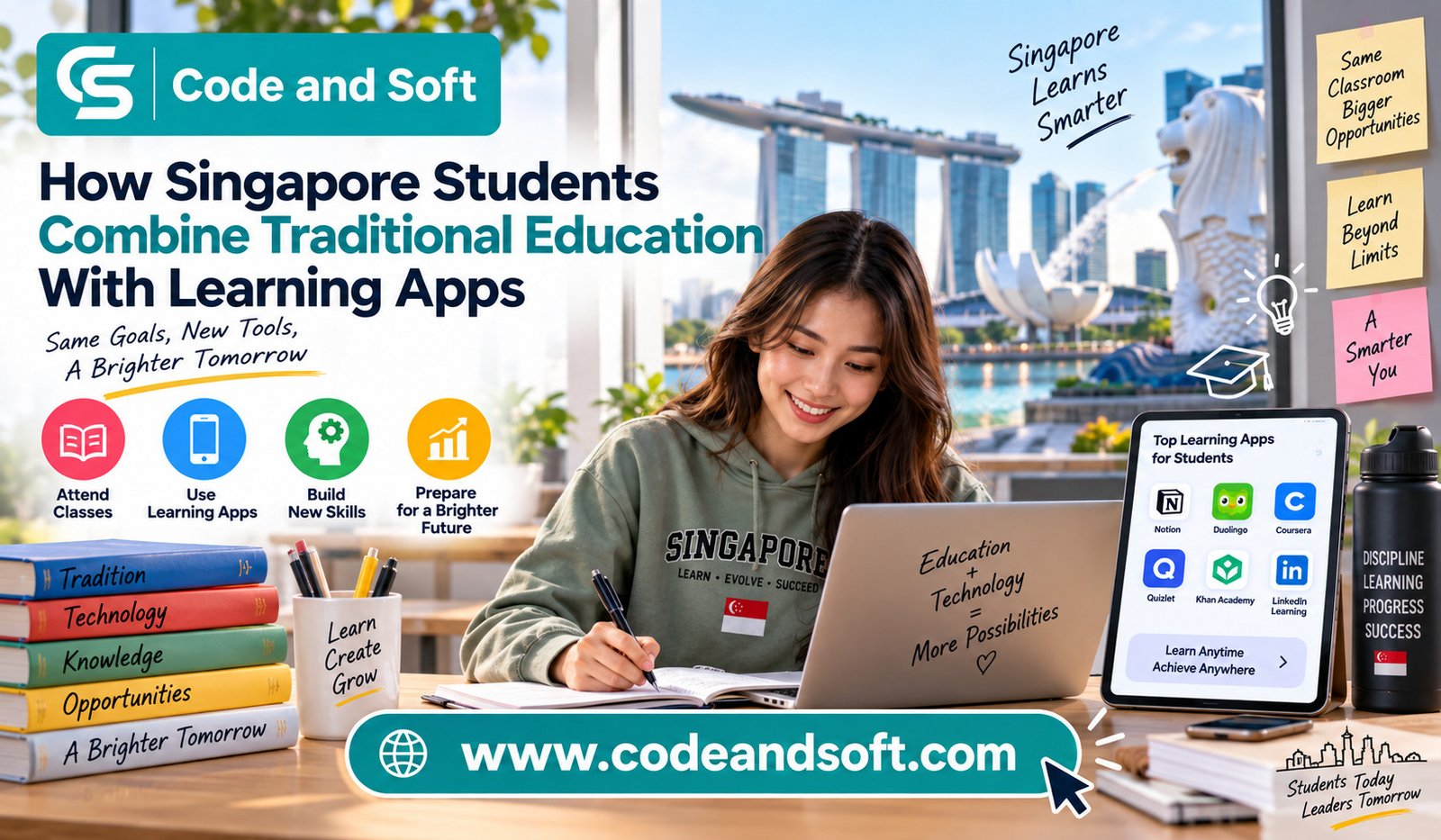

Education in Singapore is often associated with high academic standards, structured classrooms, tuition, examinations, and strong parental involvement. But the way you study today can look very different from the way students studied a decade ago. Alongside textbooks, school lessons, worksheets, and face-to-face teaching, you now have access to a growing range of digital learning tools.
For many students, the goal is not to replace traditional education with technology. Instead, you can use both together. Your teacher may explain a difficult mathematics concept in class, while an app gives you extra questions to practise later. You might revise vocabulary from your school materials and then use a language-learning app to strengthen your skills.
This combination has made Learning Apps For Singapore Students an increasingly useful part of everyday study routines. From Singapore’s Student Learning Space to platforms such as KooBits, Geniebook, Duolingo, and Quizlet, these apps can give you more flexibility over when, where, and how you revise.
Why Traditional Education Still Matters
Before looking at learning apps, it is important to understand why traditional education remains central to your academic journey.
A classroom gives you something that an app cannot completely reproduce: direct interaction with a teacher and classmates. Your teacher can notice when you are confused, explain an idea differently, answer questions immediately, and provide feedback based on your individual progress.
School also gives your learning a structure. You follow a curriculum, attend lessons, complete assignments, participate in activities, and prepare for assessments according to a planned schedule.
Textbooks and printed worksheets have their own advantages too. When you work through a chapter on paper, you may find it easier to concentrate without notifications or other digital distractions.
Rather than moving away from these traditional methods, you can use learning apps as an additional layer of support.
Student Learning Space: A Digital Extension of School
One of the most important digital education platforms available to Singapore students is Student Learning Space (SLS).
SLS provides a common online learning environment connected to Singapore’s education system. Your teachers can use it to share learning materials, activities, assignments, and resources.
Imagine that you have just completed a science lesson at school. Instead of relying only on your notes, you can revisit digital learning activities through SLS. If your teacher has assigned an activity for revision, you can complete it after school and reinforce what you learned earlier.
This creates a useful connection between classroom teaching and independent study.
The biggest advantage is continuity. Your learning does not necessarily stop when the school bell rings. You can revisit selected materials and work through activities at your own pace, depending on what your teacher provides.
KooBits Makes Mathematics More Interactive
Mathematics is one area where regular practice can make a noticeable difference. You may understand a concept during a lesson but struggle when you encounter a slightly different question later.
This is where KooBits can become useful.
KooBits is designed around mathematics learning and practice, using interactive activities and problem-solving exercises. Instead of simply reading another explanation in a textbook, you can get additional opportunities to work with mathematical concepts.
For example, after learning a particular topic in school, you could use KooBits to practise related questions. If you make mistakes, those errors can show you which areas need more attention.
The important point is balance. You do not have to abandon your school textbook or classroom exercises. You can use an app for additional practice once you have learned the underlying concept from your teacher.
That approach can make your revision more targeted rather than simply increasing the amount of work you do.
Geniebook Helps You Focus on Your Weak Areas
Another platform you may encounter is Geniebook, which uses technology to support personalised learning, particularly in subjects such as mathematics, science, and English.
One advantage of a personalised platform is that your practice does not always have to look identical to someone else’s. If you are comfortable with one topic but consistently struggle with another, targeted exercises can help you spend more time where you actually need it.
Consider a typical revision session. You might complete your school’s assigned worksheet first. Once you identify that fractions or algebra is causing problems, you can use additional digital practice to work through similar questions.
This can be more productive than randomly completing dozens of exercises.
However, you should still pay attention to your teacher’s feedback and school requirements. An app can help you practise, but your teacher understands the curriculum, assessment expectations, and your progress in a broader context.
Duolingo Brings Language Practice Into Your Daily Routine
Language learning is another area where apps can fit naturally into your schedule.
Duolingo is particularly useful for short, regular practice sessions. You can work on vocabulary, sentence structures, pronunciation, and basic language skills through bite-sized activities.
Suppose you are studying a language at school. You may have limited classroom time for speaking and vocabulary practice. Spending a few minutes with an app can give you another opportunity to interact with the language.
The strength of this approach is consistency.
You do not necessarily need an hour-long study session every day. A short practice session while travelling, during a break, or after finishing your homework can help you maintain contact with the language.
At the same time, classroom learning remains important because your teacher can provide cultural context, detailed explanations, writing feedback, and opportunities for real conversation.
The app works best as a supplement rather than your entire language education.
Quizlet Turns Revision Into Active Recall
When you are preparing for tests, memorising information can become one of the most time-consuming parts of studying. This is where Quizlet can be helpful.
You can create or use digital flashcards to review vocabulary, definitions, concepts, formulas, and other information.
For instance, after completing a biology chapter, you could create flashcards for important terms. Instead of repeatedly reading the same textbook page, you can test yourself and see which concepts you remember.
This matters because active recall is generally more useful for revision than simply looking over notes repeatedly.
You can also use Quizlet for language vocabulary, history terms, scientific definitions, or business concepts. The format makes it relatively easy to fit revision into short periods of free time.
Still, flashcards should not become your only study method. Understanding a concept is different from remembering its definition. Your textbook, teacher’s explanations, written practice, and exam-style questions all continue to have a role.
More Apps You Can Add to Your Study Routine
The world of educational technology extends well beyond these five platforms.
Depending on your age, subjects, and learning preferences, you may also explore tools such as Google Classroom, Microsoft Teams, Khan Academy, Coursera, educational YouTube channels, and various school-provided digital resources.
Each tool serves a different purpose.
Some platforms are better for structured courses. Others are designed for quizzes, videos, flashcards, coding, languages, or specific academic subjects.
The trick is not to collect as many apps as possible.
If you have ten learning apps but rarely use any of them consistently, they are not helping much. Two or three well-chosen tools that fit naturally into your existing study routine can be far more valuable.
How You Can Combine Apps With Classroom Learning
The most effective approach is to give traditional education and technology different jobs.
1. Learn the concept in class
Start with your teacher’s explanation. Pay attention, take notes, ask questions, and make sure you understand the basic idea.
2. Review the material digitally
After class, use platforms such as SLS or another relevant learning app to revisit the topic.
3. Practise your weak areas
If you discover that you are struggling with a particular topic, use tools such as KooBits or Geniebook for additional practice.
4. Test your memory
Use Quizlet or similar flashcard tools to check whether you can recall important information without looking at your notes.
5. Keep skills fresh
For languages, short sessions with Duolingo can help you practise regularly between formal lessons.
6. Return to traditional resources
When you need deeper understanding, go back to your textbook, class notes, worksheets, and teacher feedback.
This creates a study cycle rather than forcing you to choose between paper and screen.
Why This Combination Can Work So Well
One major advantage of combining traditional education with apps is flexibility.
You might understand something during school hours but forget parts of it several days later. Instead of waiting for the next lesson, you can revisit the topic digitally.
Apps can also make revision less intimidating. A large textbook chapter may feel overwhelming, while a ten-minute quiz can seem much more manageable.
Another benefit is immediate feedback. When you answer a digital question, you may find out quickly whether you were correct. That can help you identify mistakes before they become habits.
However, technology also comes with distractions. Notifications, games, social media, and entertainment are always competing for your attention. You therefore need to treat learning apps as study tools, not simply another source of screen time.
Creating a Balanced Study Routine
You do not need to spend your entire evening switching between apps.
A balanced routine could look something like this:
After school: Review your classroom notes and complete assigned homework.
Early evening: Spend 20–30 minutes practising a difficult subject with an appropriate learning platform.
Later: Use Quizlet for a short recall session or Duolingo for language practice.
Before an examination: Combine textbook revision, teacher-provided worksheets, past questions, and targeted app-based practice.
This approach keeps technology in its proper place.
You remain responsible for your learning, while apps provide extra opportunities to practise, review, and test yourself.
The Future of Learning in Singapore
Education is unlikely to become entirely digital or entirely traditional. Instead, you are likely to see the two approaches continue to overlap.
Teachers remain important for guidance, explanation, encouragement, and human interaction. Textbooks remain useful for detailed study. At the same time, digital platforms can make practice more flexible and personalised.
For you as a student, this means the question is not whether you should choose school or apps. The better question is how you can use both intelligently.
Learning Apps For Singapore Students can give you convenient ways to revise mathematics, practise languages, memorise important information, and revisit lessons. Platforms such as Student Learning Space, KooBits, Geniebook, Duolingo, and Quizlet each offer different forms of support.
When you combine those tools with classroom teaching, textbooks, assignments, and teacher feedback, you can build a study routine that is both structured and flexible.
Ultimately, technology works best when it supports good learning habits rather than replacing them. Your teacher can explain the lesson, your textbook can provide depth, and your learning apps can give you additional practice whenever you need it. Together, these tools can make your education more adaptable to the way you actually learn.


