
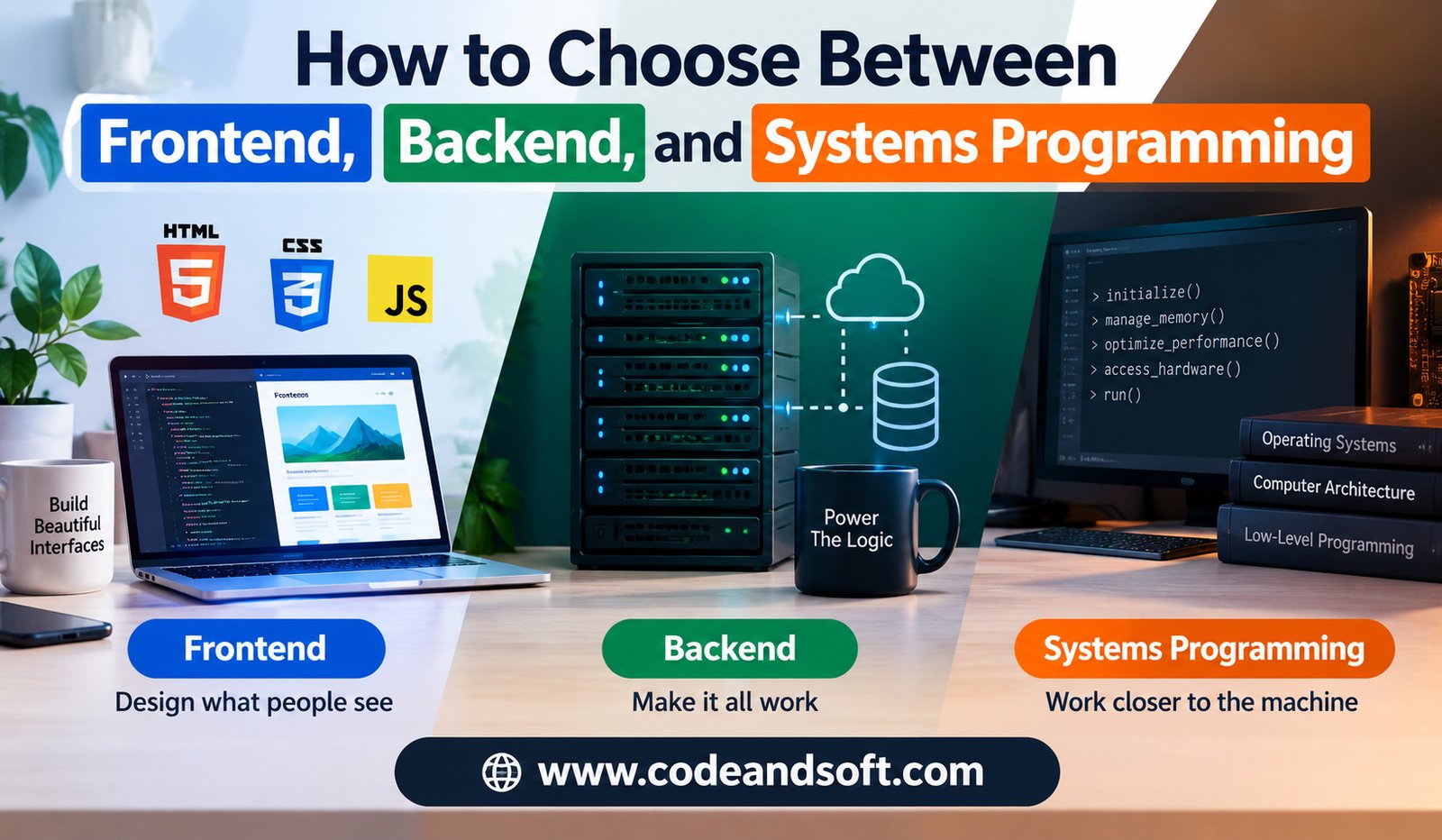

Choosing a programming path can feel confusing, especially when you are just starting your software development journey. You may hear people talk about frontend development, backend development, and systems programming, but it is not always clear what these areas actually involve or which one would suit you best.
Each path has its own type of work, programming languages, challenges, and career opportunities. None of them is automatically better than the others. The right choice depends on what you enjoy building, how you like to solve problems, and what kind of work you want to do every day.
Understanding the differences between these three areas can make your decision much easier. Instead of choosing based only on what seems popular, you can think about the kind of software you would genuinely enjoy creating.
What Is Frontend Programming?
Frontend programming focuses on the part of an application that people see and use. When you open a website and click a button, fill out a form, move through a menu, or read information on a page, you are interacting with the frontend.
Frontend developers turn designs and ideas into working websites and applications. They make sure pages look good, respond properly to user actions, and work across different screen sizes.
For example, imagine an online shopping website. The product pictures, search box, shopping cart button, menus, product details, and checkout screens are all parts of the frontend. The frontend is responsible for presenting these things clearly and making them easy to use.
HTML, CSS, and JavaScript are the basic technologies used in frontend development. As developers become more experienced, they may also work with tools and libraries built around JavaScript, such as React, Vue, or Angular.
Frontend programming can be a good choice if you enjoy seeing the direct result of your work. You can write some code and quickly see a button change, a page become interactive, or an entire screen come together.
Who Usually Enjoys Frontend Development?
Frontend development can suit people who enjoy visual work and user interaction. You do not need to be a professional designer, but having an interest in how websites look and feel can be helpful.
You may enjoy frontend work if you like creating things that people can immediately see. It can also be rewarding if you enjoy improving small details. A change in spacing, color, button placement, or page behavior can make a website much easier to use.
At the same time, frontend development is not only about appearance. Developers need to think carefully about how pages behave. They have to handle different screen sizes, user actions, errors, and accessibility.
If you enjoy combining creativity with programming, frontend may be a strong starting point.
What Is Backend Programming?
Backend programming deals with the parts of an application that usually work behind the scenes. Users may not see the backend directly, but it is responsible for much of what happens when they use an application.
Consider the same online shopping website. When you create an account, place an order, make a payment, or check your previous purchases, the backend handles much of the work involved.
The backend can receive information from the frontend, process it, store information, and send results back. It may also communicate with databases and other services.
Backend developers commonly work with languages such as Python, Java, JavaScript, C#, PHP, Go, Ruby, and others. The choice of language depends on the company, project, and type of software being developed.
Backend programming can feel very different from frontend development because much of the work is not immediately visible. You may spend hours working on how information is stored or how an application handles a particular situation.
Who Usually Enjoys Backend Development?
Backend development can be a good fit if you enjoy solving logical problems and thinking about how things work behind the scenes.
You might enjoy creating the rules that control an application. For example, an application may need to determine whether a customer has enough money to complete a purchase, whether a user is allowed to access certain information, or how an order should be processed.
Backend developers also spend a lot of time thinking about reliability. If thousands or millions of people use an application, the software needs to handle their requests correctly.
If you enjoy working with data, business rules, and the hidden workings of applications, backend programming may be more interesting to you than frontend work.
What Is Systems Programming?
Systems programming is different from both frontend and backend development. It focuses on software that works closely with the computer itself.
Systems programmers may work on operating systems, device software, computer networks, databases, programming tools, game engines, and other software where performance and control are especially important.
Languages such as C, C++, and Rust are commonly associated with systems programming. These languages allow developers to work more closely with computer memory and other parts of the machine.
For example, when an application needs to use computer memory efficiently or communicate closely with hardware, systems programming may be involved.
This type of programming often requires a deeper understanding of how computers work. You may need to understand memory, files, processes, computer hardware, and how programs communicate with the operating system.
Who Usually Enjoys Systems Programming?
Systems programming can suit people who are curious about what happens inside a computer.
If you have ever wondered what happens when a program starts, how memory is used, how an operating system manages applications, or how hardware communicates with software, you may find systems programming interesting.
It can be more difficult at the beginning because you need to understand more about the computer itself. Mistakes can also be harder to find because the problem may not appear as an obvious visual error.
However, systems programming can be very satisfying for people who enjoy detailed technical problems and want to understand software at a deeper level.
Frontend vs Backend vs Systems Programming
The biggest difference between these three areas is the part of the computer or application they focus on.
Frontend development is closest to the user. It is concerned with what people see and how they interact with software.
Backend development sits behind the frontend. It handles information, application rules, user accounts, requests, and many other tasks that make an application work.
Systems programming goes deeper into the computer. It deals more directly with the operating system, memory, hardware, and software that needs strong control over computer resources.
These areas can also overlap. A large software product may have frontend developers creating the user interface, backend developers handling application data, and systems programmers building the software that supports the underlying technology.
Think About What You Enjoy
One of the easiest ways to choose a programming path is to think about the type of problems you naturally enjoy solving.
If you like creating websites and watching your work appear on the screen, frontend development could be a good fit.
If you prefer thinking about how information moves through an application and how different parts work together, backend development may be more suitable.
If you want to understand how computers work at a deeper level and enjoy difficult technical challenges, systems programming could be worth exploring.
You do not need to make this decision permanently. Many developers change their focus as they gain experience.
Consider How You Like to Learn
Your learning style can also influence your choice.
Frontend development often gives beginners quick visual feedback. You can change some code and immediately see the result in a browser. This can make early learning enjoyable.
Backend development may require more patience because the results are often less visible. You may spend time learning about databases, application logic, and how different parts of a program communicate.
Systems programming usually requires more patience still. Before creating advanced software, you may need to learn how memory, operating systems, files, and computer hardware work.
None of these learning paths is wrong. The important thing is finding an area that keeps you interested enough to continue learning.
Think About Your Career Goals
Career goals can also help you decide.
Frontend skills are useful for websites, web applications, mobile applications, and many products that require a strong user experience.
Backend skills are useful across many industries because almost every major application needs software that can process information and manage data.
Systems programming is especially valuable in areas such as operating systems, hardware-related software, cloud infrastructure, networking, databases, gaming technology, and other performance-focused fields.
The demand for each skill can change over time, so it is better not to choose a path only because you hear that it is currently popular. Strong programming skills, problem-solving ability, and the willingness to keep learning can remain useful even as technologies change.
You Can Try All Three
You do not have to decide immediately.
A simple way to explore your options is to build a small project in each area. For frontend development, you could create a personal website or a simple task application.
For backend development, you could create a small service that stores user information or manages tasks.
For systems programming, you could write a basic command-line program in C, C++, or Rust and learn how it works with files and memory.
The purpose is not to become an expert in every area. Instead, pay attention to which project makes you want to keep working after the basic task is finished.
That feeling can tell you more than a career guide ever could.
Do You Need to Know Everything?
No. A common mistake beginners make is believing they must learn frontend, backend, and systems programming before they can become good developers.
You do not need to master everything.
It is usually better to choose one area and develop strong basic skills first. Once you understand programming well, moving into another area becomes easier.
For example, a frontend developer who later learns backend programming can eventually work across an entire web application. A backend developer who learns systems programming may develop a stronger understanding of how software runs on computers.
Your first choice does not lock you into one career forever.
Which Path Is Best for Beginners?
There is no single best path for every beginner.
Frontend development can be an attractive starting point because the results are easy to see. It can help beginners understand basic programming concepts while creating useful websites.
Backend development can be a strong choice for people who already enjoy logic, data, and problem-solving.
Systems programming may be better for learners who are especially interested in computers and do not mind spending more time understanding difficult concepts before seeing major results.
If you are completely unsure, starting with basic programming concepts and a little frontend development can give you a comfortable introduction. After that, you can explore backend and systems programming before deciding where you want to go deeper.
Final Thoughts
Choosing between frontend, backend, and systems programming is really about choosing the type of problems you want to spend your time solving.
Frontend development is about creating the part of software people interact with. Backend development focuses on the work happening behind the screen. Systems programming goes deeper and deals closely with the computer, operating system, and hardware.
There is no need to rush your decision. Try small projects, learn the basics, and notice which type of programming keeps your attention.
The best programming path is not necessarily the one that looks most impressive or popular. It is the one that makes you curious enough to keep learning. Once you find that area, building your skills becomes much easier because you are learning something you genuinely want to understand.
Frequently Asked Questions
Is frontend development easier than backend development?
Frontend development can feel easier at first because beginners can see their results quickly. However, advanced frontend work can become quite complex. Backend development also has its own challenges, especially when working with large amounts of information and complicated application rules.
Can I learn frontend and backend together?
Yes, but beginners may find it easier to focus on one area first. Once you understand basic programming, you can gradually learn the other side and eventually become comfortable working with both.
Is systems programming difficult for beginners?
It can be more challenging because it often requires an understanding of memory, operating systems, and how computers work internally. Starting with basic programming before moving into systems programming can make the learning process easier.
Which programming path has the best career opportunities?
All three can lead to strong careers. Frontend, backend, and systems developers are needed for different types of software. Your skills, experience, projects, and ability to solve problems often matter more than simply choosing one category.
Can I change my programming path later?
Absolutely. Many developers move between frontend, backend, and systems programming during their careers. Learning one area also gives you programming knowledge that can make it easier to learn another area later.