Learning your first programming language can feel challenging because there are many new terms, symbols, and concepts to understand. Java is one of the languages that can provide a strong foundation for students and new developers because it teaches important programming principles while being widely used in software development.
Java is used for many types of applications, including backend systems, enterprise software, Android-related development, financial platforms, desktop applications, and other technology products. More importantly for beginners, learning Java introduces concepts such as variables, conditions, loops, methods, classes, objects, and exception handling.
Understanding these fundamentals can make it easier to approach other programming languages later.
What Is Java?
Java is a general-purpose programming language designed around the idea of writing software that can run across different computing environments with the help of the Java platform.
One of its well-known characteristics is object-oriented programming. Instead of organizing an entire program as a collection of unrelated instructions, developers can organize code into classes and objects that represent data and behavior.
Java also has a large ecosystem of development tools, libraries, frameworks, and learning resources, making it a practical language for students who want to explore software development.
Why Should Students Learn Java?
Java can be useful for students because it encourages structured programming habits.
Beginners learn how to declare variables, create methods, organize classes, handle errors, and think about how different parts of a program interact.
These concepts are useful beyond Java. Once students understand programming fundamentals, moving toward languages such as C#, Kotlin, JavaScript, Python, or TypeScript can become easier because many underlying ideas are transferable.
Java is also commonly encountered in academic programming courses, coding exercises, technical interviews, and professional software development.
Understanding the Basic Structure of a Java Program
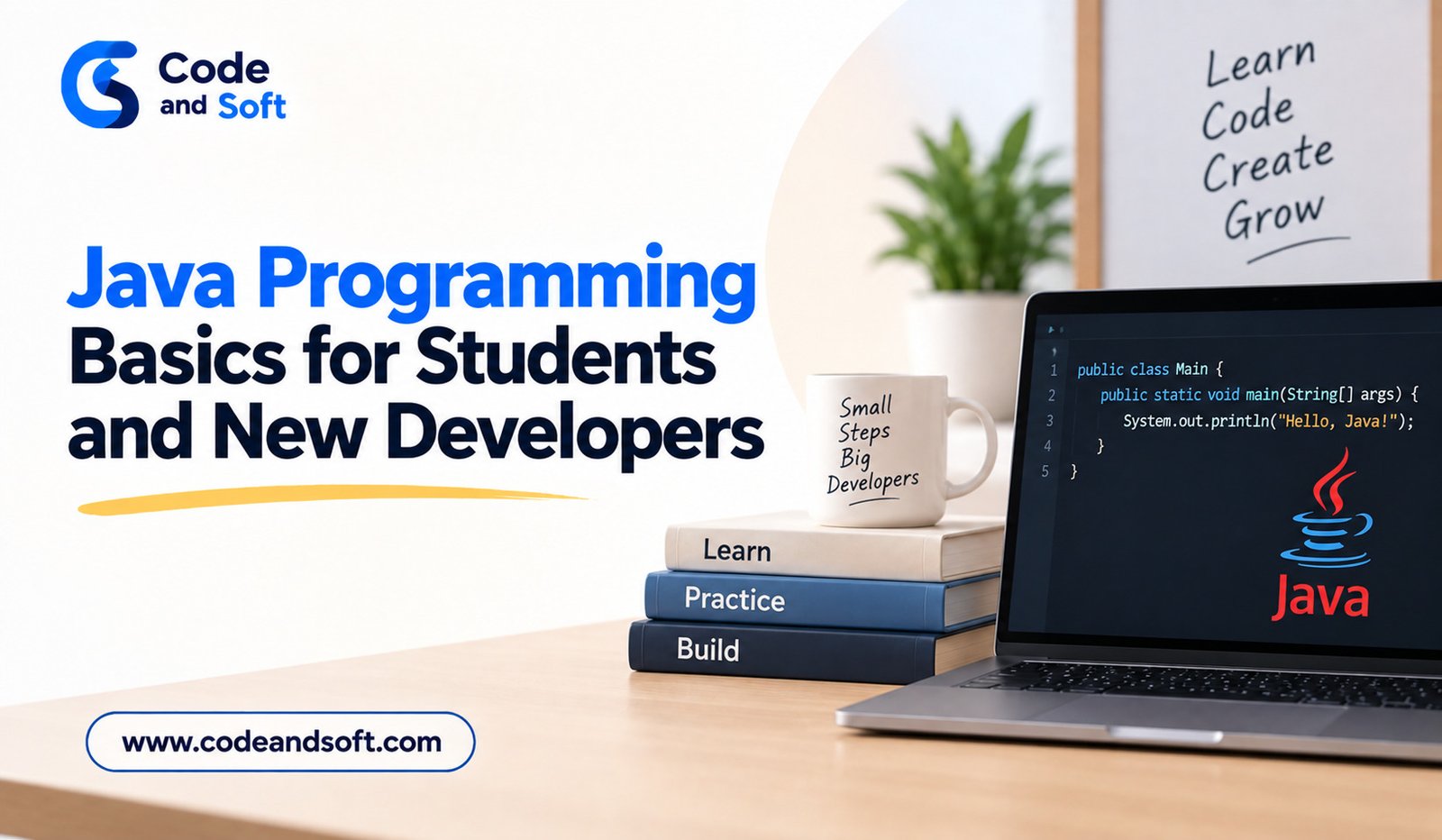
A beginner’s first Java program is often a simple program that prints text.
For example:
public class Main {
public static void main(String[] args) {
System.out.println(“Hello, Java!”);
}
}
Although this example is small, it introduces several important concepts.
class defines a class, while main represents the method from which a basic Java application begins execution. System.out.println() displays information in the console.
Students do not need to memorize every keyword immediately. It is more useful to understand what each part does and gradually become familiar with the syntax.
Variables and Data Types
Variables allow programs to store information.
Java requires developers to specify the type of data a variable is expected to contain.
For example:
int age = 20;
double price = 499.99;
boolean enrolled = true;
String name = “Priya”;
Here, int is used for whole numbers, double can represent decimal values, boolean stores true or false values, and String represents text.
Understanding data types is one of the first important steps in Java programming because different types can be used for different kinds of information.
Operators in Java
Operators allow developers to perform calculations and comparisons.
Arithmetic operators include addition, subtraction, multiplication, and division.
For example:
int total = 20 + 10;
int difference = 50 – 15;
int product = 5 * 4;
Java also provides comparison operators that can be used to determine relationships between values.
These operators become particularly important when writing conditions and controlling how a program behaves.
Conditional Statements
Programs often need to make decisions.
For example, a student grading program might display different messages depending on a student’s score.
An if statement can be used for this purpose:
if (score >= 40) {
System.out.println(“Pass”);
} else {
System.out.println(“Needs improvement”);
}
Conditional statements allow programs to respond differently depending on the information they receive.
Students should become comfortable with if, else if, and else because decision-making is a fundamental part of programming.
Loops for Repeated Tasks
Programs frequently need to repeat an operation.
Java provides several loop structures, including for, while, and do-while.
A simple for loop might look like this:
for (int i = 1; i <= 5; i++) {
System.out.println(i);
}
This example prints numbers from one through five.
Loops are useful for processing lists, repeating calculations, displaying data, and performing many other tasks.
Understanding loops also teaches students how programs can perform repetitive operations without requiring the same instruction to be written repeatedly.
Arrays and Collections
An array allows developers to store multiple values of the same general type.
For example:
int[] marks = {78, 85, 91, 67};
The program can then access individual values using their positions.
As students progress, they can learn Java’s collection framework, including structures such as lists, sets, and maps.
Collections are important in real applications because programs frequently need to store and organize groups of information.
Methods Make Code Reusable
Methods allow developers to organize functionality into separate blocks of code.
For example:
static int addNumbers(int a, int b) {
return a + b;
}
The method can then be called whenever the program needs to perform the same operation.
Methods improve organization and reduce unnecessary repetition.
Students should learn how to define methods, pass parameters, return values, and understand the difference between methods that return information and those that simply perform an action.
Understanding Classes and Objects
Object-oriented programming is one of Java’s most important concepts.
A class can be thought of as a blueprint for creating objects.
For example:
class Student {
String name;
int age;
}
An object can then be created from the class:
Student student = new Student();
The object can contain information represented by the class.
As students continue learning, they will encounter concepts such as constructors, methods, encapsulation, inheritance, and polymorphism.
These concepts form an important part of Java’s object-oriented programming model.
Exception Handling
Programs do not always behave exactly as expected.
Users may enter invalid information, files may be unavailable, or an operation may fail.
Java provides exception handling mechanisms that allow developers to respond to certain problems.
A basic example uses try and catch:
try {
int result = 10 / 0;
} catch (ArithmeticException e) {
System.out.println(“An arithmetic error occurred.”);
}
Learning exception handling helps students understand that good programs should not simply assume everything will work correctly.
Input and Output
Beginner programs often need to receive information from users.
Java provides classes and APIs that can be used to read input from sources such as the console.
For example, students can use Scanner to read keyboard input.
This allows them to build interactive programs such as calculators, simple quiz applications, and student record systems.
Projects that accept input are useful because they combine several concepts, including variables, conditions, methods, and error handling.
Java Development Tools
Students can write Java using different development environments.
Popular choices include dedicated Java IDEs and code editors that provide features such as syntax highlighting, debugging, code completion, and project management.
The important thing is not which editor a beginner chooses. Students should become comfortable creating a project, compiling or running code, reading error messages, and using debugging tools.
Learning how to understand errors is just as important as learning how to write code.
Common Mistakes Beginners Should Avoid
New Java developers sometimes try to memorize large amounts of syntax without understanding the underlying concepts.
A better approach is to learn one concept and immediately practice it.
Another common mistake is avoiding errors instead of learning from them. Compilation messages and runtime errors can provide useful clues about what needs to be fixed.
Beginners should also avoid creating overly complicated projects too early. A small calculator, student grade tracker, quiz application, or simple inventory program can teach many important concepts.
A Practical Java Learning Path
A structured learning path can make Java easier to approach.
Begin with variables, data types, operators, conditions, and loops. Then learn arrays, methods, and basic input and output.
After becoming comfortable with these concepts, move into classes, objects, constructors, encapsulation, inheritance, and polymorphism.
Next, explore collections, exception handling, file operations, and other parts of the Java ecosystem.
Once the fundamentals are strong, students can begin exploring frameworks and tools used in professional Java development.
Build Projects to Improve Your Skills
Reading tutorials is useful, but writing programs is where programming knowledge becomes practical.
Students can start with a calculator and then build a number guessing game, quiz application, student management system, expense tracker, or simple inventory program.
Each project should introduce a new challenge.
For example, a student management application can combine classes, objects, arrays or collections, methods, conditions, and input handling.
Projects also create useful material for a portfolio and can give students something practical to discuss during interviews or academic evaluations.
Final Thoughts
Java programming basics provide students and new developers with a strong foundation in software development.
Variables teach developers how to store information, conditions introduce decision-making, loops handle repetition, methods encourage reusable code, and classes introduce object-oriented programming.
The best way to learn Java is to combine theory with regular practice. Start with simple programs, understand why the code works, learn from errors, and gradually move toward larger projects.
Once the fundamentals become comfortable, Java developers can explore advanced programming concepts, frameworks, databases, APIs, and professional software development practices. The early learning stage may require patience, but a strong foundation can make the rest of the journey much easier.