

Introduction
The manufacturing industry has always depended on accurate information, efficient processes, and timely decisions. However, modern manufacturing operations have become more complex due to increasing customer expectations, global competition, supply chain challenges, and the need for faster production cycles.
Manufacturers generate enormous amounts of data from machines, production lines, inventory systems, quality checks, suppliers, and customer orders. Managing and analyzing this information manually can be difficult and time-consuming.
This is where manufacturing business intelligence software plays a crucial role. These advanced analytics solutions help manufacturers collect, analyze, and visualize operational data to improve production efficiency, reduce costs, and make smarter decisions.
By using real-time dashboards, predictive analytics, automated reporting, and data-driven insights, manufacturing companies can identify production problems, optimize resources, improve quality, and increase profitability.
This article explains how manufacturing business intelligence software works, its key features, benefits, applications, and how it helps companies build more efficient production processes.
What Is Manufacturing Business Intelligence Software?
Manufacturing Business Intelligence (BI) software is a specialized analytics solution designed to help manufacturers analyze production-related data and improve operational performance.
Unlike traditional reporting methods, manufacturing BI tools collect information from multiple systems and convert it into meaningful insights.
These systems can analyze data from:
- Manufacturing equipment
- Production management systems
- Enterprise resource planning (ERP) software
- Inventory platforms
- Supply chain systems
- Quality management systems
- Customer order databases
Manufacturers can use this information to monitor production performance, identify inefficiencies, and make faster decisions.
For example, a factory manager can use a BI dashboard to track machine performance, production output, downtime, and quality issues in real time.
Why Manufacturing Businesses Need Business Intelligence Software
Manufacturing operations involve many interconnected processes. A small issue in one area can affect the entire production cycle.
Business intelligence software helps manufacturers overcome challenges such as:
- Unexpected equipment failures
- Production delays
- Rising operational costs
- Inventory problems
- Quality issues
- Inefficient resource usage
By providing accurate and timely insights, BI software allows manufacturers to take proactive actions instead of reacting to problems after they occur.
How Manufacturing BI Software Improves Production Efficiency
1. Real-Time Production Monitoring
One of the biggest advantages of manufacturing BI software is real-time visibility into production activities.
Traditional reporting methods often provide information after production problems have already occurred. Real-time BI dashboards allow managers to monitor operations continuously.
Manufacturers can track:
- Production output
- Machine performance
- Production speed
- Employee productivity
- Downtime levels
If production efficiency decreases, managers can immediately investigate the issue and take corrective action.
Real-time monitoring helps factories maintain consistent performance and reduce operational disruptions.
2. Predictive Maintenance for Equipment
Machine downtime is one of the biggest challenges in manufacturing. Unexpected equipment failures can stop production and create significant financial losses.
Manufacturing BI software uses predictive analytics to identify potential equipment problems before failures happen.
The system analyzes:
- Machine performance data
- Operating conditions
- Maintenance history
- Sensor information
Predictive maintenance helps manufacturers:
- Reduce equipment downtime
- Extend machine lifespan
- Lower repair costs
- Improve production reliability
Instead of repairing machines after failure, companies can schedule maintenance at the right time.
3. Improved Production Planning
Effective production planning is essential for meeting customer demands and avoiding resource waste.
Manufacturing BI tools analyze historical production data and current market demand to improve planning decisions.
Businesses can optimize:
- Production schedules
- Workforce allocation
- Material requirements
- Machine usage
Better planning helps manufacturers increase output while reducing unnecessary expenses.
4. Better Inventory Management
Inventory management is a major challenge for manufacturing companies. Too much inventory increases storage costs, while insufficient inventory can delay production.
BI software provides insights into:
- Raw material availability
- Inventory movement
- Stock levels
- Supplier performance
Manufacturers can identify demand patterns and maintain optimal inventory levels.
This reduces waste and ensures materials are available when needed.
5. Quality Control Improvement
Product quality directly affects customer satisfaction and brand reputation.
Manufacturing BI software helps companies monitor quality metrics and identify factors causing defects.
Businesses can analyze:
- Defect rates
- Production errors
- Quality inspection results
- Customer complaints
By identifying quality issues early, manufacturers can reduce waste and improve product reliability.
6. Reduces Manufacturing Costs
Cost reduction is one of the primary goals of every manufacturing organization.
BI software helps identify areas where companies can save money.
Manufacturers can analyze:
- Energy consumption
- Labor costs
- Material usage
- Production efficiency
- Equipment performance
These insights help businesses reduce unnecessary expenses and improve profitability.
7. Improves Supply Chain Management
Modern manufacturing depends on efficient supply chains. Delays from suppliers or logistics problems can affect production schedules.
Manufacturing BI tools provide visibility into supply chain performance.
Companies can monitor:
- Supplier reliability
- Delivery times
- Material availability
- Transportation costs
Better supply chain insights help manufacturers avoid disruptions and maintain smooth operations.
8. Enhances Workforce Productivity
Employees play a critical role in manufacturing efficiency.
BI software helps managers analyze workforce performance and identify improvement opportunities.
Companies can track:
- Production targets
- Employee performance
- Work schedules
- Labor efficiency
These insights help organizations improve workforce planning and productivity.
Key Features of Manufacturing Business Intelligence Software
Production Dashboards
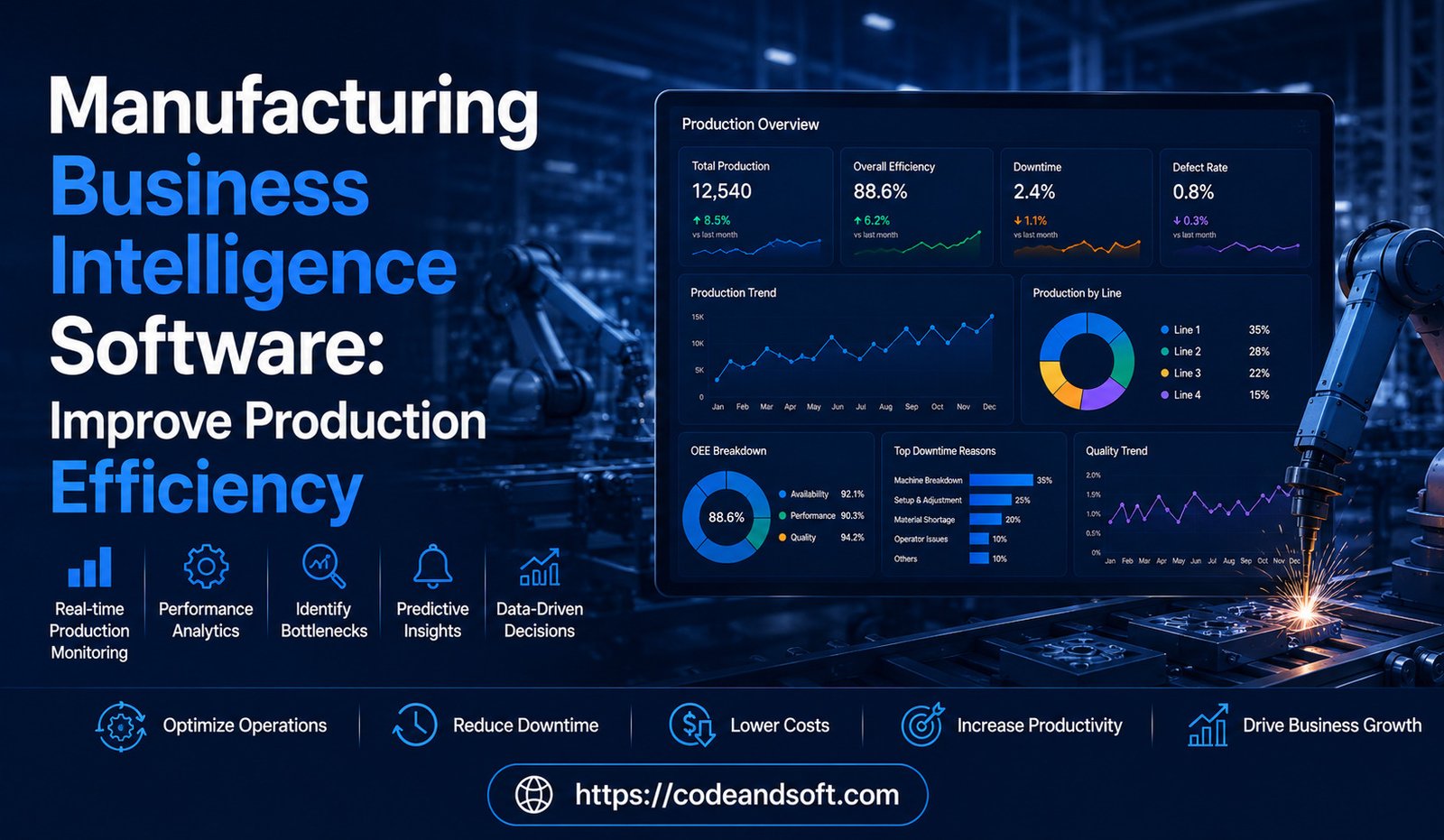
Manufacturing dashboards provide a visual overview of production performance.
They display important metrics such as:
- Production volume
- Machine efficiency
- Downtime
- Quality rates
Data Integration
BI software connects different manufacturing systems to provide a complete view of operations.
Common integrations include:
- ERP systems
- Manufacturing execution systems (MES)
- IoT devices
- Inventory platforms
Predictive Analytics
Predictive analytics uses historical and real-time data to forecast future events.
Manufacturers can predict:
- Equipment failures
- Demand changes
- Production challenges
Automated Reporting
Automated reports save time by eliminating manual data collection.
Managers can receive updated reports about production performance without preparing them manually.
Data Visualization
Charts and graphs make complex manufacturing data easier to understand.
Visual dashboards help decision-makers identify problems quickly.
Popular Manufacturing Business Intelligence Software Solutions
Microsoft Power BI
Microsoft Power BI is widely used in manufacturing because of its strong analytics, reporting, and visualization capabilities.
Manufacturers can create dashboards for production monitoring, inventory analysis, and operational performance.
Tableau
Tableau provides advanced data visualization tools that help manufacturers explore production data and identify trends.
It is useful for organizations that need detailed analytics and interactive reporting.
Qlik Sense
Qlik Sense provides self-service analytics and data discovery features that allow manufacturing teams to explore information independently.
SAP Analytics Cloud
SAP Analytics Cloud is designed for enterprises requiring advanced analytics integrated with business systems.
It supports planning, reporting, and predictive analytics.
Oracle Analytics Cloud
Oracle Analytics Cloud provides enterprise-level analytics solutions for companies managing complex manufacturing operations.
Applications of Manufacturing BI Software
Production Performance Analysis
Manufacturers use BI tools to measure production efficiency and identify improvement areas.
Important metrics include:
- Overall equipment effectiveness (OEE)
- Production cycle time
- Machine utilization
Demand Forecasting
Companies analyze customer trends to predict future demand and adjust production accordingly.
Energy Management
BI software helps manufacturers monitor energy consumption and identify opportunities to reduce costs.
Safety Monitoring
Manufacturing organizations can analyze workplace data to improve safety standards and reduce risks.
Benefits of Manufacturing Business Intelligence Software
Increased Efficiency
BI tools identify production problems and help companies optimize processes.
Faster Decision-Making
Managers receive real-time insights that support quicker decisions.
Reduced Downtime
Predictive analytics helps prevent unexpected equipment failures.
Improved Product Quality
Data analysis helps manufacturers reduce defects and improve standards.
Better Resource Management
Companies can optimize materials, labor, and equipment usage.
Competitive Advantage
Manufacturers using data-driven strategies can respond faster to market changes.
Challenges of Implementing Manufacturing BI Software
Although manufacturing BI provides many advantages, companies may face some challenges.
Data Integration Issues
Manufacturers often use multiple systems, and connecting them can require technical planning.
Implementation Costs
Advanced BI solutions may require investment in software, infrastructure, and training.
Employee Training
Workers and managers need proper training to use BI tools effectively.
Data Security
Manufacturing data must be protected from unauthorized access and cyber threats.
How to Successfully Implement Manufacturing BI Software
Identify Business Goals
Companies should define what they want to improve, such as production efficiency, quality, or cost reduction.
Choose the Right BI Solution
The selected software should match business size, industry requirements, and technology infrastructure.
Ensure Data Quality
Accurate data is essential for reliable insights.
Train Employees
Employees should understand how to use dashboards and analytics tools.
Start With Key Areas
Companies can begin with specific departments and expand BI usage gradually.
Conclusion
Manufacturing business intelligence software is transforming how companies manage production operations. By turning complex manufacturing data into actionable insights, BI tools help organizations improve efficiency, reduce costs, maintain quality, and make smarter decisions.
From real-time production monitoring and predictive maintenance to supply chain optimization and inventory management, manufacturing BI software provides valuable support across every stage of production.
As manufacturing becomes more digital and connected, businesses that adopt advanced BI solutions will be better prepared to handle challenges, improve productivity, and achieve long-term growth.