
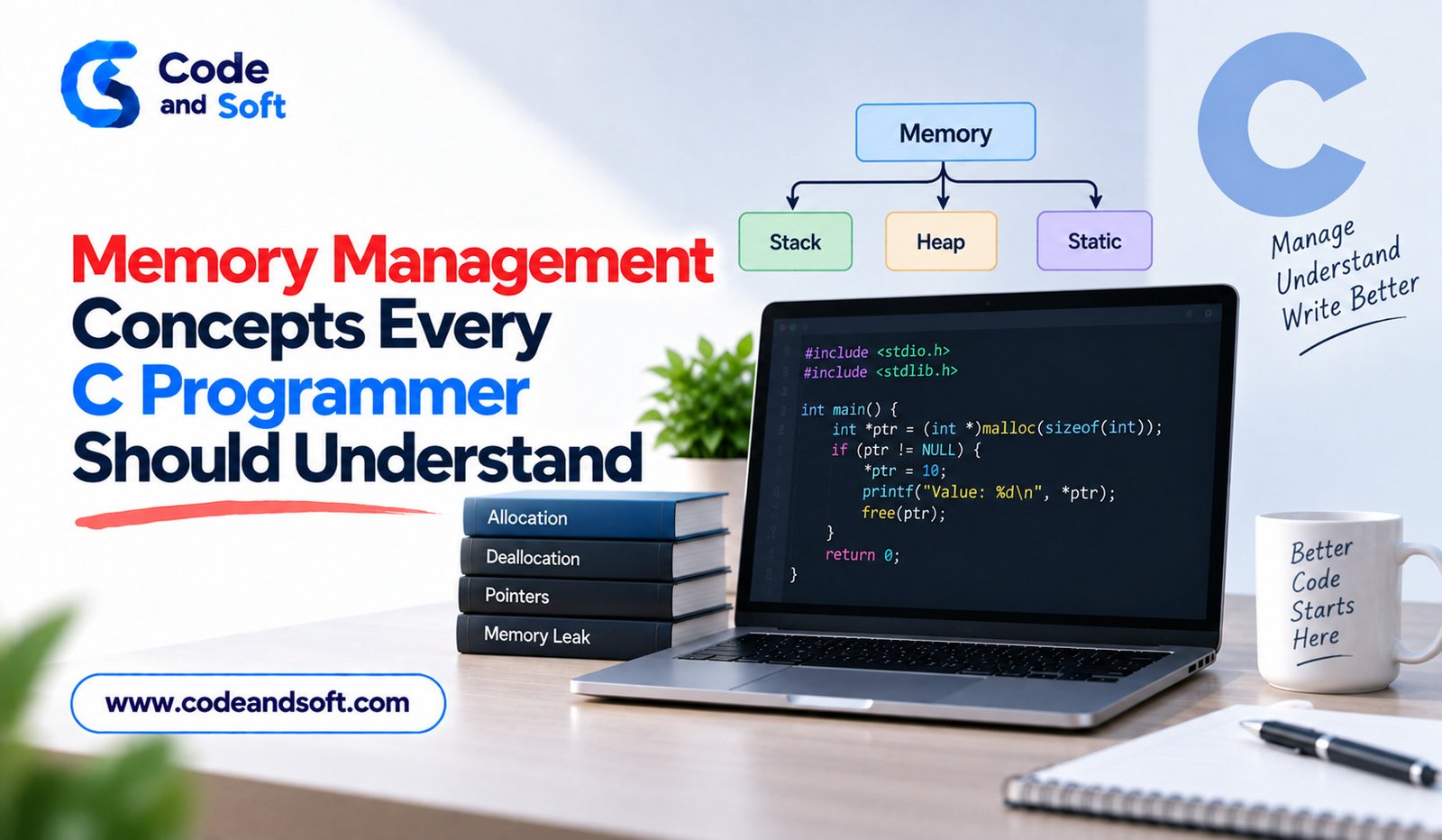
Memory management is one of the most important topics every C programmer should understand. Unlike languages that automatically manage most memory-related tasks, C gives developers considerable control over how memory is allocated, used and released.
This control is one reason C remains useful for system programming, embedded software and performance-sensitive applications. However, it also means programmers are responsible for avoiding problems such as memory leaks, invalid access and dangling pointers.
For beginners, memory management can seem complicated because it involves concepts such as stack memory, heap memory, pointers, dynamic allocation and object lifetime. Once these ideas are understood individually, however, they become much easier to connect.
Why Memory Management Matters in C
Every running program needs memory to store instructions, variables, temporary values and dynamically created data.
When a C program starts, the operating system provides it with a memory environment. Different parts of that memory serve different purposes. Variables created inside functions, dynamically allocated objects and program instructions do not necessarily use memory in the same way.
Good memory management ensures that a program uses available resources correctly. Poor memory management can cause crashes, unpredictable behavior, performance problems or memory leaks.
The important lesson is that memory is a limited resource. A programmer must understand how data is created, accessed and eventually removed when it is no longer needed.
Understanding Stack Memory
The stack is commonly used for local variables and information associated with function calls.
Consider a simple function:
void calculate()
{
int number = 50;
}
The local variable number has a limited lifetime associated with the function’s execution. When the function finishes, its local storage is no longer available for normal use.
The stack is convenient because the lifetime of local variables is largely managed automatically by the program’s execution structure.
However, programmers still need to understand stack limitations. Creating extremely large local objects or using excessive recursion can consume significant stack space and potentially cause a stack overflow.
Understanding Heap Memory
The heap is used for dynamic memory allocation.
Unlike a typical local variable, dynamically allocated memory remains available until the program explicitly releases it or the process ends.
For example:
int *number = malloc(sizeof(int));
Here, memory is requested dynamically, and the returned address is stored in the pointer number.
When the program no longer needs that memory, it should release it:
free(number);
The heap is useful when the required amount of memory is not known when the program is written.
Static and Global Memory
C programs can also contain global and static variables. These variables have storage that exists for the lifetime of the program.
For example:
int total = 0;
A global variable can be accessed from different parts of a program depending on its declaration and scope.
A variable declared with the static keyword can also have a lifetime that extends throughout program execution, although its visibility depends on where it is declared.
Understanding the difference between automatic local storage and longer-lived storage helps programmers reason about how long data remains available.
Pointers and Memory Addresses
Pointers are central to memory management in C.
A pointer stores the address of another object. For example:
int value = 25;
int *ptr = &value;
The variable value stores the number 25, while ptr stores the address associated with value.
Dereferencing the pointer allows the program to access the value:
printf(“%d”, *ptr);
Pointers become especially important when working with dynamically allocated memory because functions such as malloc() return an address rather than an ordinary integer or character value.
Dynamic Memory Allocation
Dynamic memory allocation allows a program to request memory while it is running.
The most commonly used functions include malloc(), calloc(), realloc() and free().
malloc() requests a specified amount of memory without automatically initializing the allocated bytes.
int *numbers = malloc(5 * sizeof(int));
If allocation succeeds, numbers points to enough memory for five integers.
calloc() can be used when memory for multiple elements is needed and zero-initialized storage is desired.
realloc() can resize a previously allocated memory block, while free() releases memory that is no longer required.
These functions provide flexibility but also make programmers responsible for managing the resulting memory carefully.
Checking Whether Allocation Succeeded
Dynamic memory allocation can fail. A program should not assume that every request will succeed.
For example:
int *data = malloc(100 * sizeof(int));
if (data == NULL)
{
printf(“Memory allocation failed”);
}
Checking the returned pointer is an important programming practice.
If an allocation fails and the program immediately attempts to use the returned pointer as though it were valid memory, the program can behave unpredictably.
Proper error handling is therefore an important part of memory management.
Memory Leaks
A memory leak occurs when dynamically allocated memory is no longer needed but the program loses the ability to release it.
For example:
int *data = malloc(100 * sizeof(int));
data = NULL;
In this example, the allocated memory is no longer accessible through data. Because its address has been lost, the program cannot properly release that block.
Repeated leaks can cause a program’s memory usage to increase over time.
The solution is to release dynamically allocated memory when it is no longer required:
free(data);
Developers should think about the entire lifetime of dynamically allocated memory, from allocation to release.
Dangling Pointers
A dangling pointer occurs when a pointer continues to refer to memory that is no longer valid.
For example:
int *ptr = malloc(sizeof(int));
free(ptr);
After free(ptr), the memory previously referenced by ptr is no longer available for use. The pointer itself may still contain an address, but that does not make the memory valid.
Using such a pointer can produce undefined behavior.
One common practice is to assign NULL after releasing memory when the pointer will remain in scope:
free(ptr);
ptr = NULL;
This does not solve every ownership problem, but it can help prevent accidental reuse through that pointer.
Buffer Overflows
A buffer overflow happens when a program writes beyond the boundaries of an allocated memory area.
Consider an array:
int values[5];
Valid indexes range from 0 through 4. Writing to values[5] goes beyond the array’s boundaries.
Such mistakes can corrupt nearby memory and cause crashes or unpredictable program behavior. In security-sensitive software, memory boundary errors can also create serious vulnerabilities.
C programmers should therefore carefully track array sizes, pointer ranges and allocated memory capacities.
Use-After-Free Errors
Another serious memory problem occurs when a program attempts to access memory after it has been released.
For example:
int *value = malloc(sizeof(int));
*value = 50;
free(value);
printf(“%d”, *value);
The final access is invalid because the allocated memory has already been released.
This type of mistake is known as a use-after-free error. It can produce unpredictable results and should be avoided by carefully managing object lifetimes.
Memory Ownership
A useful concept for C programmers is ownership.
When a program allocates memory, developers should know which part of the program is responsible for eventually releasing it.
This becomes particularly important in larger applications where pointers are passed between functions.
Without a clear understanding of ownership, it becomes easier to accidentally free memory too early, forget to free it or release the same memory more than once.
Good design can make ownership responsibilities clear and reduce memory-related bugs.
Memory Management and Structures
Structures are often combined with dynamic memory allocation.
For example, a program may dynamically create a structure representing a user, product or other object:
struct Product *item = malloc(sizeof(struct Product));
If the structure contains pointers to additional dynamically allocated memory, the programmer must also consider those nested allocations.
Releasing the outer structure does not automatically release memory referenced by its internal pointers.
This is an important concept when building linked lists, trees and other dynamic data structures.
Best Practices for C Memory Management
Good memory management begins with simple habits. Programmers should allocate only the memory they need, check allocation results and release dynamically allocated memory when it is no longer required.
They should also avoid accessing arrays outside their valid boundaries and should be careful when passing pointers between functions.
Keeping ownership rules clear can make larger programs easier to maintain.
Testing and debugging tools can also help identify memory leaks and invalid memory operations during development.
Final Thoughts
Memory management is a fundamental part of C programming because the language gives developers significant control over system resources. Understanding stack memory, heap allocation, pointers, static storage and dynamic memory provides a strong foundation for writing reliable C programs.
Concepts such as memory leaks, dangling pointers, buffer overflows and use-after-free errors show why that control must be used carefully.
The best way to learn C memory management is through practical programming. Start with simple variables and pointers, then move to dynamic allocation, arrays, structures and data structures. As these concepts become familiar, developers can write programs that use memory more efficiently and avoid many common programming errors.
For anyone learning C, mastering memory management is not just another topic to complete. It is a core skill that helps explain how programs actually use computer memory.