
Learning to code can feel difficult when you are seeing strange symbols, unfamiliar words, and long lines of code for the first time. Python makes this process easier because its code is close to normal English and does not require a lot of complicated writing to get started. This is one reason Python has become a popular choice for people who are learning programming for the first time.
If you are completely new to coding, you do not need to learn everything about Python at once. A better approach is to understand a small part of the language, practice it, and then use what you have learned to create something simple. As your confidence grows, you can move from basic commands to useful small projects.
This practical path can make learning Python more enjoyable. Instead of spending weeks reading about code without making anything, you can slowly turn your knowledge into working programs.
Why Python Is a Good Choice for Beginners
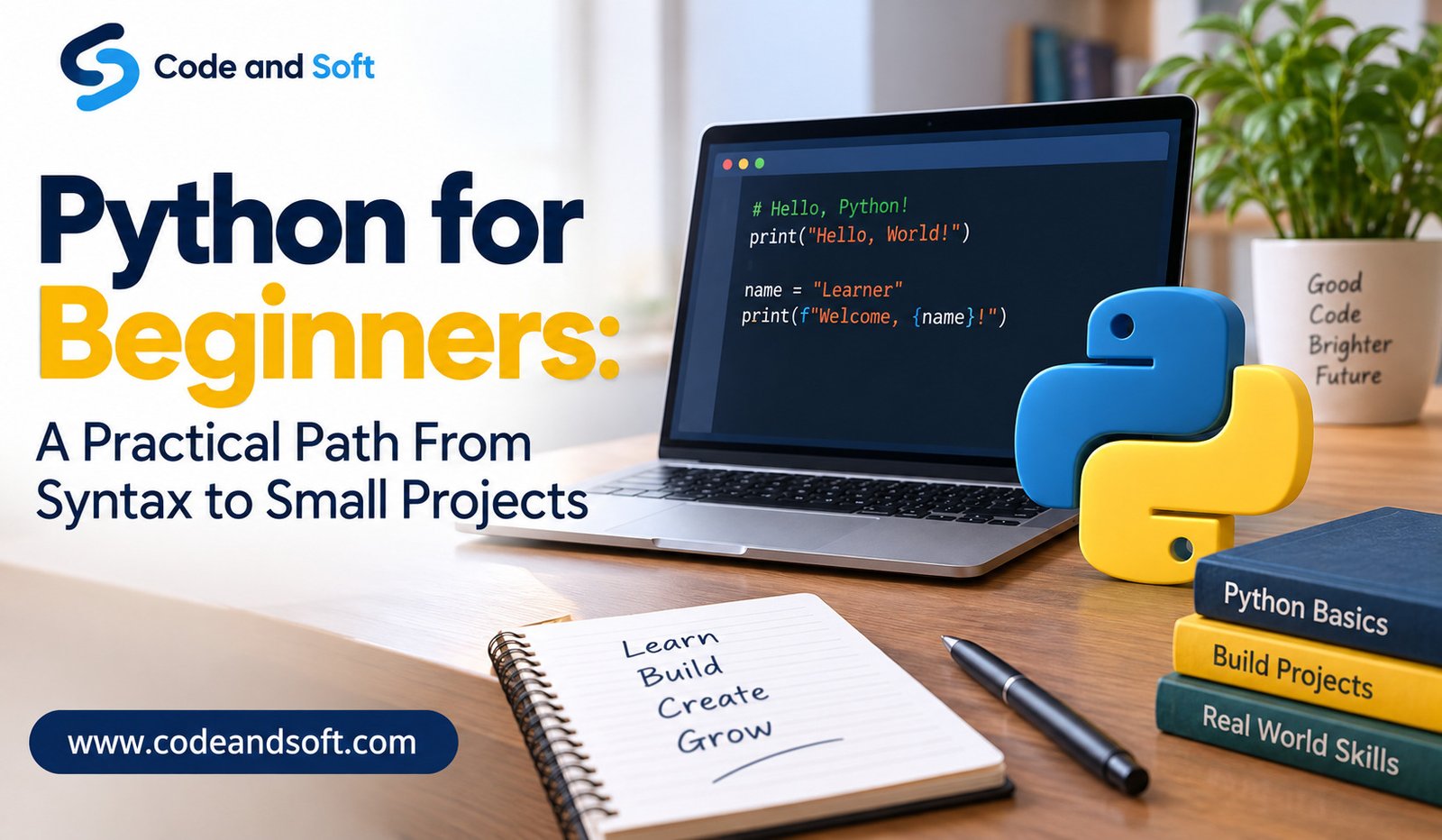
Python is often recommended to beginners because its code is relatively easy to read. You can write a simple instruction without adding many extra symbols. For example, if you want your program to display a message, you can write:
print(“Hello, welcome to Python!”)
The meaning is easy to understand. The print command tells Python to show something on the screen.
This simple style allows beginners to focus on learning how programs work instead of spending too much time remembering complicated writing rules.
Python is also useful beyond beginner exercises. People use it for websites, data work, automation, artificial intelligence, education, and many other areas. This means the time you spend learning the basics can become useful later if you decide to continue with programming.
Start With the Basic Building Blocks
Before creating projects, you need to understand a few basic parts of Python. The first thing to learn is how Python stores information.
A variable is simply a name that you give to a piece of information. You might write:
name = “Rahul”
age = 25
Here, name stores the word Rahul, while age stores the number 25. You can use these names later in your program.
print(name)
print(age)
Python will display the information stored in those variables.
You should also become comfortable with different kinds of information. Text is written inside quotation marks, while numbers can be written directly. You can also work with values such as true and false.
At this stage, there is no need to memorize every possible type of information. The important thing is to understand that a program works with information and that you can give names to that information.
Learn How to Work With Numbers and Text
Once you understand variables, start using them in simple calculations and messages.
Python can perform normal calculations:
price = 100
quantity = 3
total = price * quantity
print(total)
The result will be 300.
You can also join text together or place information inside a sentence. A simple way to do this is with an f-string:
name = “Anita”
age = 22
print(f”My name is {name} and I am {age} years old.”)
This becomes especially useful when you start creating programs that respond to information entered by the user.
For example, Python can ask a person for their name:
name = input(“What is your name? “)
print(f”Nice to meet you, {name}!”)
This is a small example, but it introduces an important idea. A program does not always have to display the same result every time. It can receive information and use that information to produce a response.
Understand Decisions in Your Program
Real programs often need to make choices. For example, a shopping program may need to check whether a customer has enough money. A simple game may need to check whether the player guessed the correct answer.
Python uses if to make these decisions.
age = 18
if age >= 18:
print(“You can continue.”)
else:
print(“You cannot continue yet.”)
The program checks the age and chooses one message.
This is an important step because you are moving beyond programs that simply follow instructions from top to bottom. Your program can now react differently depending on what happens.
Do not worry if these statements seem confusing at first. Write small examples and change the values to see what happens. Changing 18 to 15, for example, will help you understand the decision more clearly.
Learn Repetition Through Simple Examples
Another useful part of Python is repetition. Sometimes you need a program to perform the same action several times. Instead of writing the same line again and again, you can use a loop.
For example:
for number in range(5):
print(number)
This displays numbers from 0 to 4.
Loops become very useful when working with collections of information. Imagine that you have several names and want your program to display each one. You can do this without writing a separate command for every name.
names = [“Amit”, “Sara”, “John”]
for name in names:
print(name)
This also introduces another important Python feature: lists. A list allows you to keep several pieces of information together.
At first, you only need to understand the basic idea. You can create a list, add information to it, and use a loop to work through its contents.
Make Your Code Easier to Manage
As programs become longer, putting everything in one place can make your code difficult to understand. Python allows you to create functions, which are small sections of code designed to perform a particular task.
For example:
def greet(name):
print(f”Hello, {name}!”)
greet(“Priya”)
greet(“Ravi”)
The function is called greet. Instead of writing the same instructions every time, you can use the function whenever you need it.
You do not need to become an expert in functions immediately. Simply understand that functions help you organize your code and avoid repeating the same instructions.
This will become especially helpful when you begin making small projects.
Move From Exercises to Small Projects
Many beginners spend a lot of time watching lessons but very little time actually writing programs. Practice is important because programming becomes easier when you use it.
Your first project should be small enough to finish without feeling overwhelmed. A simple calculator is a good example.
You could ask the user for two numbers and then allow them to add, subtract, multiply, or divide them. This project brings together variables, input, numbers, decisions, and calculations.
Another useful beginner project is a number guessing game. The program can choose a number, ask the user to guess it, and tell them whether their guess is too high or too low.
A simple version might look like this:
secret = 7
guess = int(input(“Guess the number: “))
if guess == secret:
print(“Correct!”)
else:
print(“Try again.”)
It is a very small program, but it gives you a chance to think like a programmer. You have a goal, information coming from the user, a comparison, and a result.
You can improve the game later by giving the player several chances or by choosing a random number.
Try a Simple To-Do Program
Once you understand lists, loops, input, and functions, you can create something closer to a real everyday tool.
A small to-do program can allow someone to enter tasks and then display those tasks. You might start with a list:
tasks = []
task = input(“Enter a task: “)
tasks.append(task)
print(“Your task:”)
print(tasks[0])
This is not a complete to-do application, but that is perfectly fine. Your goal is not to create a professional app on your first attempt. Your goal is to understand how the pieces fit together.
You can slowly add features. The program could allow the user to enter several tasks, view them, or remove a completed task. Each new feature gives you another reason to practice Python.
This approach is much better than trying to build a huge application before you understand the basics.
Learn by Changing Existing Code
One of the easiest ways to improve is to take a working example and change it.
If a program says:
name = “Ravi”
print(f”Hello, {name}”)
change the name. Add another message. Ask the user for the name instead. Then try to change the program so it asks for an age.
These small changes help you understand what each part of the code actually does.
You should also expect errors. Errors are a normal part of programming. Even experienced programmers make mistakes. A missing quotation mark, incorrect spelling, or misplaced space can stop a program from working.
Instead of seeing an error as a failure, treat it as information. Read the message, look at the line it points to, and check what you wrote. Learning how to find and fix mistakes is just as important as learning how to write code.
Build Projects That Match Your Interests
Once you are comfortable with the basics, choose projects that are connected to things you already enjoy.
If you like personal finance, you could create a simple expense tracker. If you enjoy games, you could make a quiz or a basic text adventure. If you like books, you could create a program that stores book names and allows you to search for one.
The subject does not matter as much as the practice.
When you create something that solves a small problem you actually care about, learning becomes more meaningful. You also start asking useful questions on your own, such as how to save information, how to improve the design, or how to make the program easier to use.
Those questions naturally lead you toward new Python skills.
Do Not Try to Learn Everything at Once
One common mistake among beginners is trying to memorize the entire language. Python has many features, but you do not need all of them when you are starting.
Focus on the basics first. Learn how to store information, receive input, perform calculations, make decisions, repeat actions, work with lists, and create simple functions. Then use those skills in small projects.
When you need something new, learn it because your project requires it.
This creates a natural learning process. Instead of asking yourself, “What should I study next?” you can ask, “What do I need to make this program work?”
That small change in thinking can make learning much easier.
A Practical Learning Routine
You do not need to spend several hours every day learning Python. Regular practice is more valuable than occasional long study sessions.
Even thirty minutes of writing code can be useful if you do it consistently. Spend some time learning one idea, then write a small example without copying it directly. After that, change the example and see what happens.
As your skills improve, spend more time building than reading.
For example, after learning about loops, create a small program that uses a loop. After learning about lists, create something that stores and displays information. After learning about functions, reorganize an older program using functions.
This keeps your learning connected to actual use.
Your First Python Goal
Your first goal should not be to become an expert Python programmer. A better goal is to become comfortable enough to create a small program without being afraid of the code.
Start with simple commands. Learn how variables work. Practice numbers and text. Understand user input. Add decisions and repetition. Learn how lists hold information and how functions help organize your code.
Then start building.
Your first calculator may be basic. Your first game may have very few features. Your first to-do program may look simple. That is exactly how it should be.
Every small project gives you another chance to understand Python. Over time, the pieces that once looked confusing will begin to feel familiar.
Python becomes much easier when you stop treating programming as something you only study and start treating it as something you use. Learn one idea, write some code, make a small project, find your mistakes, and improve it. By following this path, you can move from knowing basic Python syntax to creating useful programs of your own.