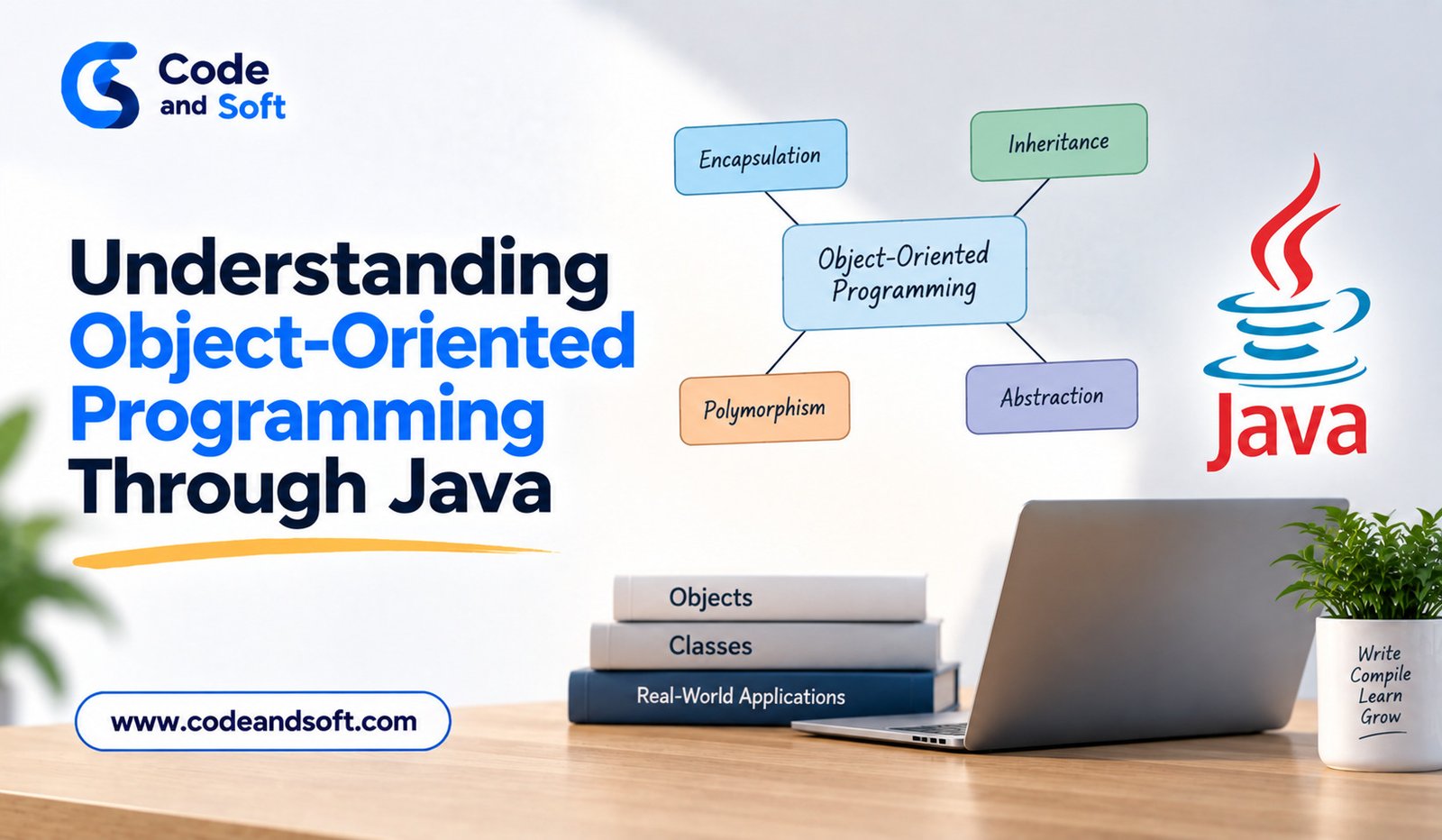
Object-oriented programming is one of the most important concepts for students and new developers who want to build a strong foundation in software development. Java is particularly useful for learning this programming approach because object-oriented concepts are deeply integrated into the language.
Instead of treating a program as only a sequence of instructions, object-oriented programming allows developers to organize software around objects that contain data and behavior. This approach can make large programs easier to structure, understand, maintain, and expand.
For beginners, terms such as classes, objects, inheritance, abstraction, encapsulation, and polymorphism may initially sound complicated. However, these concepts become much easier when they are connected to practical examples.
What Is Object-Oriented Programming?
Object-oriented programming, commonly called OOP, is a programming approach in which software is organized around objects.
An object can represent something meaningful within an application. For example, a student management program could have objects representing students, courses, teachers, and assignments.
Each object can contain information about itself and actions that can be performed using that information.
A student object might contain a name, age, and course. It could also have methods for displaying student information or updating course details.
The main purpose is to organize related data and behavior together rather than keeping everything separate.
Why Java Is Useful for Learning OOP
Java is widely associated with object-oriented programming and provides clear language features for creating classes and objects.
When learning Java, beginners naturally encounter concepts such as classes, objects, constructors, methods, access modifiers, inheritance, interfaces, and polymorphism.
This makes Java useful for understanding how object-oriented applications are structured.
The concepts learned through Java can also help developers understand other object-oriented languages because many programming principles are transferable.
Classes: The Blueprint of an Object
A class can be viewed as a blueprint that describes what an object should contain and what it should be able to do.
For example, consider a simple Student class:
class Student {
String name;
int age;
void introduce() {
System.out.println(“My name is ” + name);
}
}
The class defines two pieces of information, name and age, along with a method called introduce().
The class itself is not necessarily a specific student. Instead, it defines the structure that individual student objects can follow.
This distinction between a class and an object is one of the first important ideas beginners should understand.
Objects: Creating Real Instances
An object is an instance of a class.
For example:
Student student1 = new Student();
student1.name = “Aarav”;
student1.age = 20;
Here, student1 is an object created from the Student class.
Another object can be created from the same class:
Student student2 = new Student();
student2.name = “Meera”;
student2.age = 21;
Both objects follow the structure defined by the class, but they can contain different information.
This is one of the major advantages of object-oriented programming. Developers can create many objects from a common design.
Encapsulation Keeps Data Organized
Encapsulation is another important OOP concept.
It involves controlling how the internal data of an object can be accessed or changed.
Instead of allowing every part of a program to directly modify important information, developers can restrict access and provide controlled methods.
For example:
class BankAccount {
private double balance;
public void deposit(double amount) {
if (amount > 0) {
balance += amount;
}
}
public double getBalance() {
return balance;
}
}
The balance variable is private, meaning other classes cannot directly modify it.
The deposit() method provides a controlled way to change the balance.
This can help protect data and reduce unexpected changes inside an application.
Abstraction Simplifies Complex Systems
Abstraction means focusing on the important details while hiding unnecessary implementation details.
Think about using a mobile application. You may press a button to upload a photo without knowing everything happening behind the scenes.
The application hides complicated processes behind a simple interface.
Java provides different ways to implement abstraction, including abstract classes and interfaces.
For example:
interface Payment {
void processPayment();
}
A developer using this interface can work with the idea of processing a payment without necessarily needing to know how every payment method is implemented internally.
Abstraction becomes especially useful when applications contain many components with different responsibilities.
Inheritance Allows Classes to Reuse Features
Inheritance allows one class to receive characteristics and behavior from another class.
For example:
class Vehicle {
void start() {
System.out.println(“Vehicle started”);
}
}
class Car extends Vehicle {
void drive() {
System.out.println(“Car is moving”);
}
}
The Car class inherits the start() method from Vehicle.
This can reduce duplication when several classes share common characteristics.
However, inheritance should not be used simply because it is available. Good application design requires developers to consider whether the relationship between classes genuinely represents an appropriate hierarchy.
Polymorphism Gives Objects Flexible Behavior
Polymorphism is another major OOP concept.
The term refers to the ability to use a common interface or parent type while allowing different objects to provide their own behavior.
For example, different types of animals could have their own implementation of a sound-related method.
class Animal {
void sound() {
System.out.println(“Animal makes a sound”);
}
}
class Dog extends Animal {
void sound() {
System.out.println(“Dog barks”);
}
}
class Cat extends Animal {
void sound() {
System.out.println(“Cat meows”);
}
}
A program can work with the common Animal type while individual objects provide different behavior.
Polymorphism becomes particularly valuable in larger applications where developers want flexible and extensible designs.
Constructors in Java
Constructors are special methods used when objects are created.
They can initialize an object’s data.
For example:
class Student {
String name;
int age;
Student(String name, int age) {
this.name = name;
this.age = age;
}
}
An object can then be created with initial values:
Student student = new Student(“Riya”, 20);
Constructors are useful because they allow objects to begin their life in a valid and predictable state.
Methods Represent Object Behavior
Methods define actions that an object can perform.
A Student class might have methods for displaying details, while a BankAccount class might have methods for depositing or withdrawing money.
For example:
void displayDetails() {
System.out.println(name + ” – ” + age);
}
Breaking functionality into methods makes programs easier to understand and maintain.
Instead of placing all application logic inside one large block, developers can divide responsibilities into smaller operations.
Interfaces and Flexible Design
Interfaces are especially useful when developers want different classes to follow a common contract.
For example:
interface Printable {
void print();
}
Different classes can implement this interface:
class Report implements Printable {
public void print() {
System.out.println(“Printing report”);
}
}
Another class could implement the same interface differently.
This approach allows software to work with common behaviors while keeping individual implementations separate.
Interfaces are widely useful in large applications because they can help reduce tight dependencies between components.
How OOP Helps With Large Java Applications
Object-oriented programming becomes especially valuable as applications grow.
Imagine building an online shopping platform. The application may contain customers, products, orders, payments, shipping details, reviews, and inventory.
Without proper organization, managing all these components could become difficult.
With OOP, developers can create classes representing different responsibilities. Each class can contain relevant data and methods.
This separation can make it easier for development teams to understand the application and work on different parts without constantly modifying unrelated code.
Common OOP Mistakes Beginners Make
New developers sometimes try to use every OOP feature in every program.
That is not necessary.
A simple application does not automatically become better because it contains multiple inheritance relationships or complicated class structures.
Another common mistake is creating classes that have too many responsibilities. A class should generally have a clear purpose.
Beginners should also avoid using inheritance when simple composition or another design approach would be more appropriate.
The goal of OOP is not to make code complicated. It is to make software easier to understand, manage, and change.
How Students Can Practice Java OOP
The best way to understand object-oriented programming is to build small projects.
Students can begin with a Student management program containing classes for students and courses.
After that, they can create projects such as a library management system, simple banking application, inventory tracker, or vehicle management program.
Each project can introduce new concepts.
For example, a library project can use classes for books and members, encapsulation for managing data, methods for borrowing and returning books, and interfaces for common behaviors.
This kind of practice makes abstract OOP concepts much easier to understand.
Final Thoughts
Understanding object-oriented programming through Java can give students and new developers a strong foundation for building structured applications.
Classes provide blueprints, objects represent individual instances, encapsulation helps control data, abstraction hides unnecessary complexity, inheritance enables reuse, and polymorphism allows flexible behavior.
The most effective way to learn these concepts is not through memorization alone. Write small programs, create classes, experiment with objects, make mistakes, and gradually improve your designs.
Once these fundamentals become familiar, developers can move toward larger Java applications, frameworks, databases, APIs, and enterprise software with a much stronger understanding of how the pieces fit together.