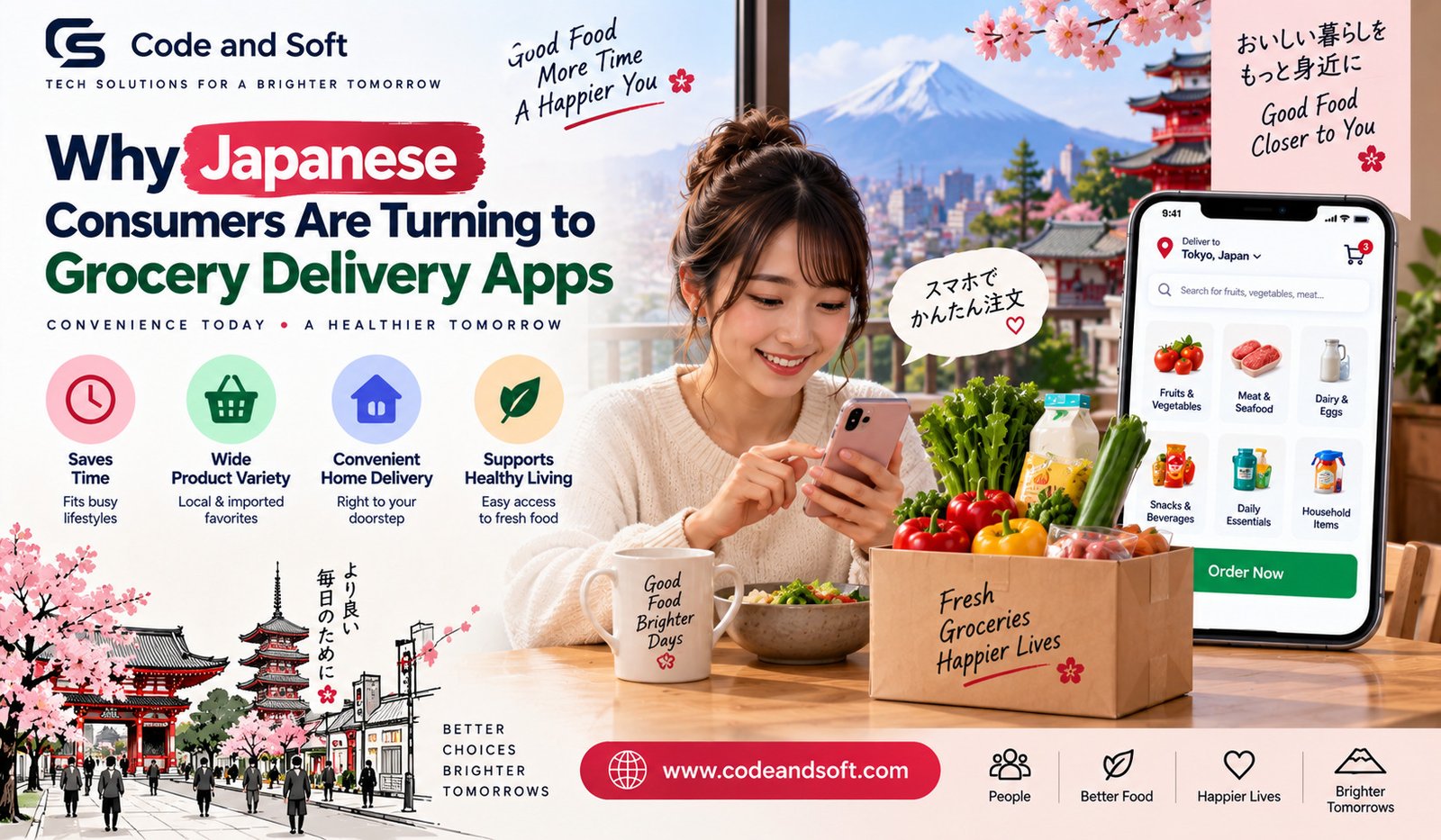
Imagine finishing a long day at work, getting home tired, and realizing you still need vegetables, milk, rice, snacks, and a few household essentials. Instead of changing clothes, heading to the supermarket, standing in line, and carrying heavy shopping bags home, you simply open an app, choose what you need, select a delivery slot, and wait for your groceries to arrive.
That convenience is becoming increasingly attractive to consumers in Japan.
The rise of Grocery Delivery Apps in Japan is not simply about saving a trip to the supermarket. It reflects a bigger change in how you manage your time, household responsibilities, food shopping, and everyday routines. From quick delivery platforms such as Uber Eats to online supermarkets such as AEON Net Super and Rakuten’s supermarket services, you now have more ways to shop without physically visiting a store.
Japan’s delivery ecosystem also covers different needs. You can order a few urgent items, complete a large weekly grocery order, arrange regular co-op deliveries, or choose premium produce and meal kits. This flexibility is one of the biggest reasons grocery delivery is becoming part of everyday life.
Why Grocery Delivery Is Becoming More Popular in Japan
One of the simplest reasons is time.
If you have a busy job, commute for several hours, manage children, or simply have a packed schedule, supermarket shopping can feel like another task on your to-do list. Grocery delivery allows you to combine shopping with other activities.
You can place an order during your lunch break, in the evening, or whenever it is convenient for you.
Japan’s changing household structure also matters. Dual-income households, families with young children, older consumers, and people living alone can all benefit from having groceries brought directly to their homes. Delivery is particularly useful when you need to buy heavy products such as rice, bottled drinks, cooking oil, detergent, or bulk household supplies.
At the same time, rising living costs are encouraging consumers to think more carefully about how they spend. Japanese household spending fell 3.6% year over year in July 2026, with food spending among the areas where consumers were cutting back.
That makes convenience important, but value is equally important. Consumers increasingly want delivery services that offer useful promotions, reasonable fees, loyalty points, and supermarket-level pricing.
1. Uber Eats: More Than Restaurant Delivery
When you think of Uber Eats, you may immediately think about burgers, sushi, ramen, or pizza. However, the platform has expanded beyond restaurant meals in Japan.
Depending on your location, you can use Uber Eats to order items from convenience stores and participating grocery retailers. That makes it useful when you need something quickly rather than planning a large weekly shop.
For example, if you suddenly realize that you are out of milk, snacks, drinks, or other everyday items, opening Uber Eats can be easier than making a separate trip to the store.
Its familiar app experience also makes the process straightforward. For consumers who already use Uber Eats for restaurant delivery, adding grocery shopping to the same app feels natural.
The key advantage for you is flexibility: you can use it for small, urgent orders rather than treating grocery shopping as a major weekly activity.
2. Wolt: A Former Option Worth Knowing
Wolt deserves a mention when discussing Japan’s delivery-app evolution because it was previously an important player in the country’s delivery market.
The service was known for restaurant delivery as well as delivery from selected retailers and stores, including everyday goods.
However, if you are researching Grocery Delivery Apps in Japan in 2026, there is an important update: Wolt reportedly exited the Japanese market in March 2026 after several years of operation.
That change is actually useful to understand. It shows that Japan’s delivery market is competitive and that consumer demand alone does not guarantee that every platform will remain available.
So, while you may see older articles recommending Wolt, you should check its current availability rather than assuming it remains an active option in Japan.
3. Demae-can: A Strong Japanese Delivery Platform
Demae-can, or 出前館, is another major name in Japan’s delivery ecosystem.
Although it is strongly associated with restaurant delivery, its broad delivery network demonstrates why Japanese consumers are becoming comfortable ordering products through apps instead of visiting stores themselves.
If you are comfortable using Japanese-language services, Demae-can can be particularly interesting because it provides access to a large selection of local businesses. The platform has traditionally competed through broad coverage, promotions, and local restaurant partnerships.
For grocery-related shopping, its importance is less about replacing a full weekly supermarket trip and more about the growing expectation that everyday products can be delivered to your door.
4. AEON Net Super: Your Online Supermarket
If you want to complete a proper grocery shop rather than order just a few emergency items, AEON Net Super is a more traditional solution.
You can think of it as taking the supermarket experience online.
Instead of walking through the aisles, you browse categories, select your groceries, choose a delivery time, and have your order delivered. Depending on your local service area, you can shop for vegetables, meat, fish, dairy products, frozen foods, beverages, household products, and other everyday essentials.
This type of service is particularly appealing when you already know what you want to buy.
Rather than paying for convenience-store prices on individual emergency items, you can plan a larger basket and have your regular shopping delivered.
For you, the biggest benefit is simple: you get supermarket convenience without the supermarket trip.
5. Rakuten / Seiyu: Grocery Shopping With Rewards
Rakuten’s supermarket ecosystem adds another interesting element to online grocery shopping: loyalty.
Rakuten’s online supermarket service allows customers to purchase fresh food, meat, vegetables, fruit, daily necessities, and other products online. Depending on the participating supermarket and service area, customers can choose delivery times and receive orders as early as the same day. Rakuten Points can also be earned and used through the service.
The connection with Seiyu is especially relevant for everyday shopping.
If you already use Rakuten services, the ability to connect grocery shopping with your wider Rakuten account and points ecosystem can make online grocery shopping feel more rewarding.
For a regular shopper, these small benefits can add up. You are not only saving a trip to the store; you may also be making your grocery spending work within a loyalty program you already use.
6. Pal System & Co-op Deli: Designed Around Routine Shopping
Not everyone wants groceries delivered in 30 minutes.
For many Japanese households, predictable weekly delivery can actually be more useful.
This is where services such as Pal System and Co-op Deli stand out. Cooperative delivery models are built around regular household shopping rather than last-minute purchases.
You can plan meals, order groceries in advance, and receive products through scheduled delivery routes.
This approach can be especially useful if you have children, manage a household, or prefer to plan your shopping instead of repeatedly opening an app throughout the week.
Co-op services also commonly focus on household-friendly products, fresh foods, frozen foods, prepared items, and other everyday necessities.
The real advantage is consistency. Once you build the habit, grocery shopping becomes part of your weekly routine rather than another task you need to remember.
7. Oisix: Convenience With a Premium Touch
If your priority is not simply getting groceries delivered but improving what you cook at home, Oisix offers a different approach.
Oisix is positioned more toward premium groceries, quality produce, and meal solutions. Its offering includes meal kits such as Kit Oisix, which can help you prepare meals without starting completely from scratch.
That makes it attractive if you want to cook but do not want to spend a lot of time planning recipes, measuring ingredients, and shopping for every component.
You can also find organic and higher-quality produce through the service, although this type of shopping can cost more than buying basic groceries from a conventional supermarket.
For you, the appeal is less about getting groceries as quickly as possible and more about making home cooking easier.
Convenience Is Changing What You Expect From Grocery Shopping
The biggest change caused by Grocery Delivery Apps in Japan may not be the delivery itself. It is the change in expectations.
Once you become comfortable ordering groceries from your phone, you may start asking different questions.
Why spend an hour shopping for basic items if you can order them online? Why carry a heavy bag of rice home? Why make another supermarket trip when you can schedule delivery around your day?
This convenience-first behavior is becoming more visible across Japan’s digital retail environment. Research on Japan’s quick-commerce market indicates that consumers are increasingly using delivery services for daily necessities rather than only restaurant meals.
At the same time, different delivery models are finding their own audiences.
You might use Uber Eats when you need something immediately. You might choose AEON Net Super or Rakuten/Seiyu for a larger supermarket order. You could rely on Pal System or Co-op Deli for routine weekly shopping. Or you might select Oisix when meal kits and premium ingredients are more important to you.
The Future of Grocery Delivery in Japan
The future is unlikely to belong to just one type of grocery delivery.
Instead, you will probably see different services serving different moments in your life.
Quick delivery can solve an urgent need. Scheduled supermarket delivery can handle your weekly shopping. Cooperative services can support predictable household routines. Premium platforms can make cooking more convenient.
That variety is exactly what makes the Japanese market interesting.
For consumers, grocery delivery is no longer simply about avoiding a supermarket visit. It is about gaining control over your time.
As Japanese consumers balance work, family, changing household needs, and higher living costs, the ability to order exactly what they need and have it delivered when convenient becomes increasingly valuable.
And that is why Grocery Delivery Apps in Japan are becoming more than a technology trend. They are gradually becoming part of the way you shop, plan meals, manage your household, and spend your everyday time.