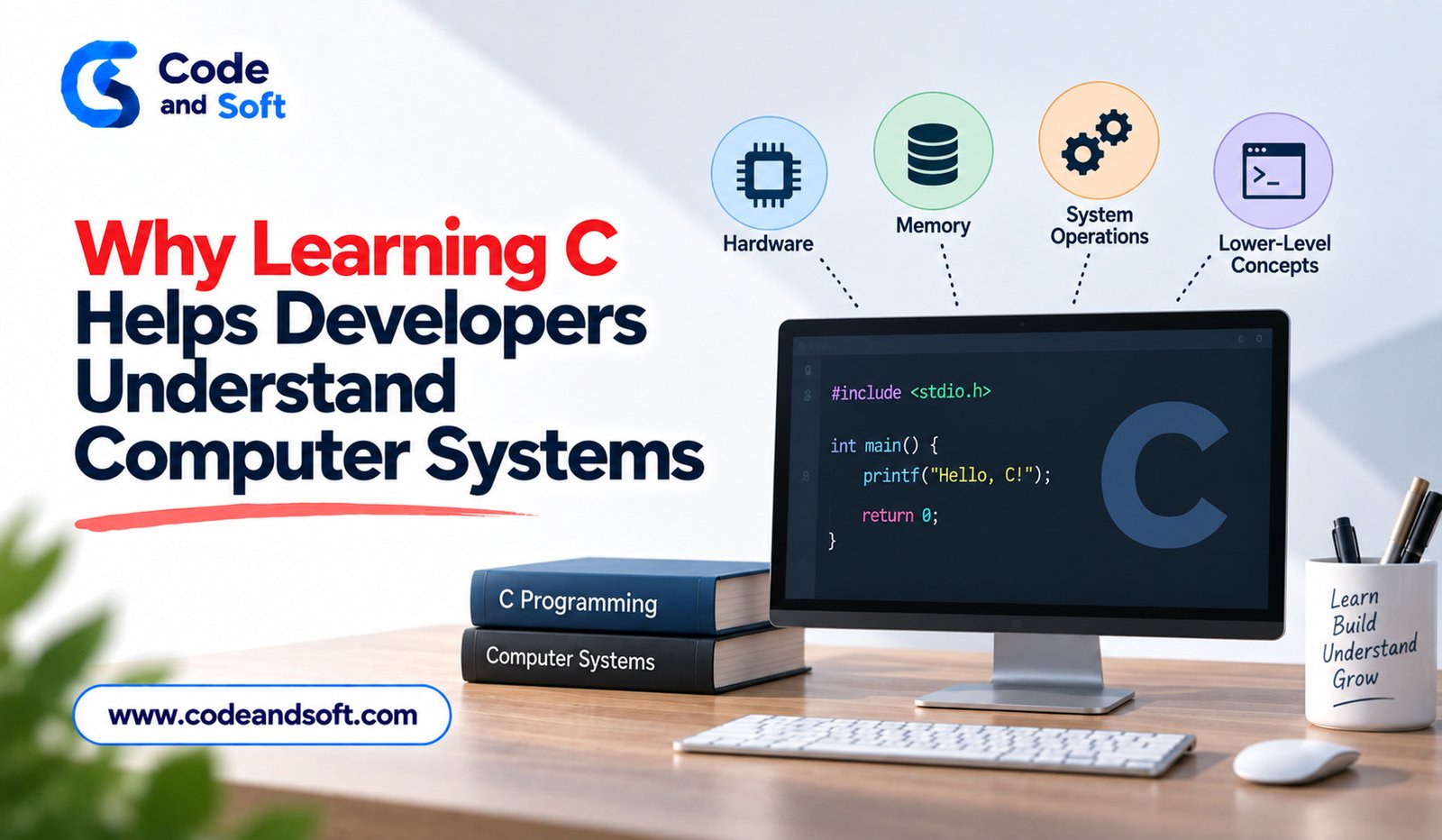
Modern developers can choose from a wide range of programming languages. Python is popular for automation and data science, Java is widely used for enterprise software, JavaScript powers much of the web, and many newer languages focus on developer productivity and safety. With so many choices available, it is reasonable to ask why learning C programming still matters.
The answer is that C provides something particularly valuable: a clearer view of how software interacts with a computer. Instead of hiding many system-level details behind high-level abstractions, C gives developers more direct access to memory, data representation, addresses and program execution.
For computer science students and developers who want to understand what happens underneath an application, learning C can build a strong technical foundation.
C Connects Software With Hardware
One of the biggest advantages of learning C is that it helps developers understand the relationship between software and hardware.
When writing a program in a high-level language, developers can often create useful applications without thinking about where individual values are stored in memory or how data is represented internally. C makes these concepts much more visible.
Variables occupy memory, pointers can hold addresses, arrays are stored in contiguous memory regions, and operations ultimately have to be translated into instructions that a processor can execute.
This does not mean that developers need to manually control every hardware operation. Instead, C gives them an opportunity to understand the layers between source code and physical computer operations.
Learning Memory Management
Memory is one of the most important resources in a computer system. Understanding how it works can help developers write more efficient and reliable software.
C makes memory management an important part of programming. Developers need to understand how variables use memory and how dynamically allocated memory should be handled.
This creates an awareness that is sometimes less obvious in languages with automatic memory management.
For example, when a program requests memory dynamically, that memory has to be used correctly and eventually released when it is no longer needed. Forgetting to manage memory properly can result in memory leaks, while accessing invalid memory can cause crashes or unpredictable behavior.
Learning these issues through C can make developers more aware of resource management in other programming environments as well.
Pointers Explain How Addresses Work
Pointers are one of the most distinctive features of C. A pointer stores the memory address of another piece of data.
For beginners, pointers can initially seem difficult because they introduce a different way of thinking. Instead of working only with values, developers must also consider where those values are located.
However, this concept is extremely useful for understanding computer systems.
Pointers demonstrate that memory is organized into addresses and that programs can use those addresses to access data. They also help explain how arrays, structures, dynamic memory and certain function operations work internally.
Once developers understand pointers, concepts such as references, memory buffers and low-level data structures can become easier to understand.
Understanding How Data Is Stored
Computers ultimately work with binary data, even when developers write familiar values such as numbers, letters and characters.
C encourages developers to think about how different data types are represented in memory. Integers, characters, floating-point values and other types have different storage requirements and behaviors.
This can help developers understand concepts such as memory size, data representation and type conversion.
For example, a developer working with a network protocol, file format or hardware interface may need to understand exactly how bytes are arranged. C provides practical experience with this kind of thinking.
C Makes Compilation Easier to Understand
Learning C also provides insight into the compilation process.
A C program normally goes through several stages before it becomes an executable program. Source code is processed, compiled and linked to produce a program that the operating system can run.
Developers who understand this process can better appreciate what happens between writing source code and launching an application.
Compilation also introduces useful concepts such as compiler warnings, linker errors, object files and executable files. These ideas can be valuable when working with larger software projects, build systems and system-level development.
Seeing the Cost of Abstractions
High-level programming languages are powerful partly because they provide abstractions. These abstractions make development faster and can protect programmers from many low-level details.
However, abstractions sometimes hide the resources being used.
Learning C can help developers recognize what may be happening underneath those abstractions. A simple operation in a high-level language might involve memory allocation, copying data or calling library functions.
C does not eliminate abstraction, but it exposes more of the underlying mechanics.
This knowledge can be especially helpful when developers are investigating performance problems. Instead of assuming that an operation is free, they can begin thinking about CPU work, memory access and data movement.
C Builds Stronger Debugging Skills
Debugging C programs can be challenging, particularly when problems involve memory or pointers. However, that challenge can become an important learning opportunity.
A syntax error is usually straightforward to identify. Memory-related problems can be much harder because the program may compile successfully but fail later during execution.
Developers working with C learn to pay attention to warning messages, invalid memory access, incorrect pointer operations and unexpected program states.
These debugging habits can transfer to other programming languages. Even when a developer moves to a language with automatic memory management, the ability to reason systematically about program behavior remains useful.
Understanding Operating Systems
C has a close relationship with operating system development. Many important system-level components have historically been written in C because the language provides a balance between low-level control and practical programming capabilities.
Learning C can therefore make operating system concepts easier to explore.
Processes, memory, files, system calls and hardware interaction can be studied with a better understanding of what programs are doing at a lower level.
A developer does not necessarily need to become an operating system programmer to benefit from this knowledge. Even application developers can gain a better understanding of how their software interacts with the operating system.
Why C Is Important for Embedded Systems
C is also widely associated with embedded programming.
Embedded devices often operate with limited memory, processing power and storage. Developers working in these environments may need precise control over resources and hardware interfaces.
C is well suited to situations where performance, memory usage and predictable behavior matter.
Learning C therefore provides a useful introduction to concepts found in microcontrollers, device drivers and other hardware-oriented software.
Even developers who eventually specialize in web development or mobile applications can benefit from understanding why embedded systems require a different approach to software design.
C Strengthens Data Structure Knowledge
Many fundamental data structures can be implemented directly in C. Arrays, linked lists, stacks, queues, trees and other structures can be built using the language’s basic features.
This can provide a deeper understanding of how these structures actually work.
For example, implementing a linked list requires understanding nodes, pointers and dynamically allocated memory. Instead of simply using a built-in collection, the developer can see how the structure is constructed.
This practical experience can make algorithms and data structures easier to understand conceptually.
C Encourages Efficient Programming
C gives developers fewer layers between their code and system resources. As a result, inefficient code can sometimes become more noticeable.
Developers learn to think about memory usage, data access, algorithmic complexity and unnecessary operations.
This does not mean every C program has to be optimized aggressively. Good programming is still about clarity and maintainability. However, learning C can encourage developers to consider the computational cost of their decisions.
That mindset can be useful regardless of which programming language a developer eventually uses.
Learning C Does Not Mean Using C for Everything
The value of C is not that every developer should write every application in C.
Modern development often benefits from higher-level languages that provide automatic memory management, extensive libraries and faster development workflows.
Instead, C can serve as a foundation. Once developers understand memory, compilation, pointers, data representation and system interaction, they can apply that knowledge when working with other languages.
The goal is not simply to memorize C syntax. The bigger goal is to understand what software is doing underneath the surface.
Final Thoughts
Learning C helps developers move beyond writing code that simply produces an expected result. It encourages them to think about how programs use memory, how data is represented, how source code becomes executable instructions and how software communicates with computer systems.
Pointers introduce the concept of memory addresses, compilation explains how source code becomes a runnable program, and manual resource management demonstrates why memory and system resources matter. C also provides a strong foundation for understanding operating systems, embedded programming and data structures.
For developers who want deeper computer science knowledge, C remains a valuable language to learn. Its syntax may not be as convenient as some modern alternatives, but the technical understanding gained from working with it can remain useful throughout a developer’s career.
Ultimately, learning C is less about becoming a C programmer and more about becoming a developer who understands what happens behind the code.