
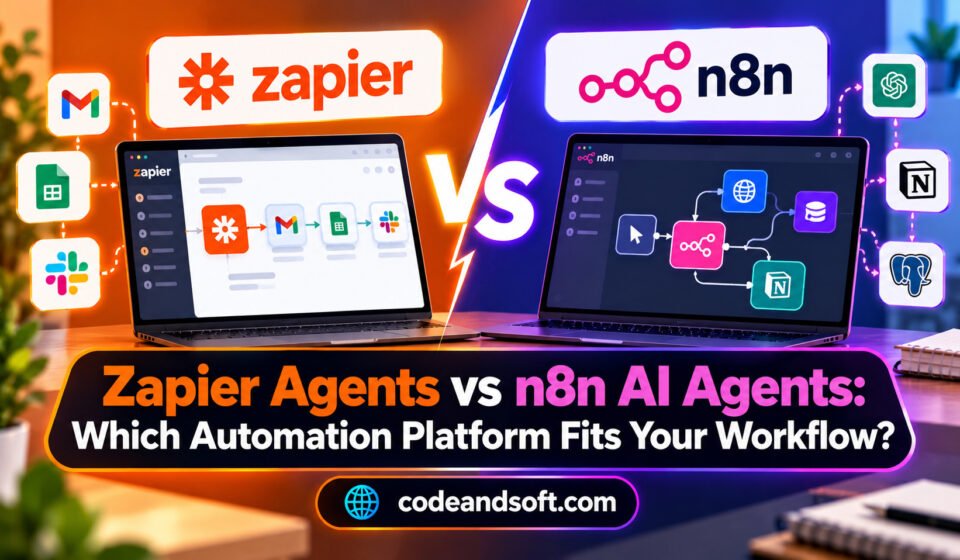

Businesses are increasingly using AI to automate repetitive tasks, connect applications, and manage complex workflows. From processing customer enquiries to qualifying sales leads and updating databases, AI agents can help organizations reduce manual effort and improve operational efficiency.
However, choosing the right automation platform can be challenging. Some tools prioritize simplicity and ready-made integrations, while others provide greater control over workflows, APIs, and technical configurations.
Zapier and n8n are two platforms worth comparing. Zapier is widely known for connecting business applications through automated workflows, while n8n combines visual workflow automation with developer-oriented customization and AI capabilities.
Both platforms can help businesses build AI-powered systems, but their approaches differ. This comparison explores their features, integrations, customization options, pricing models, advantages, and limitations to help you decide which platform fits your workflow.
What Is Zapier Agents?
Zapier Agents is an AI automation tool designed to let users create AI-powered assistants that perform tasks across connected applications. Users can provide instructions, connect relevant tools and knowledge sources, and configure agents to perform work independently or in response to specific triggers.
For example, a marketing team could create an agent that reviews incoming leads, researches relevant company information, and helps organize the information in its CRM.
Zapier’s wider automation ecosystem connects thousands of applications, making it attractive to businesses that want to bring AI into existing workflows without building every integration from scratch.
An important product update: Zapier is migrating its standalone Agents product to AI by Zapier, which brings agentic capabilities into the main Zap editor. Businesses evaluating the platform should check the current migration status and availability rather than assuming that every legacy Agents feature will remain unchanged. Zapier’s official migration guide explains the transition.
What Are n8n AI Agents?
n8n is a visual workflow automation platform that combines application integrations, conditional logic, APIs, code, and AI components. It allows users to create workflows that move information between systems and perform actions based on defined conditions.
Its AI capabilities include the AI Agent node, which can use a language model and connected tools to decide how to handle a task within a workflow. n8n has also introduced a separate Agents feature, currently described in its documentation as being in preview.
For example, an operations team could build an AI workflow that reads an incoming support request, classifies the issue, retrieves information from a database, and sends a response for human approval before updating a support system.
n8n offers hosted cloud plans and a self-hosted Community Edition. This flexibility makes it appealing to developers, technical teams, and businesses that need greater control over how their automation infrastructure is deployed.
Zapier Agents vs n8n AI Agents: Key Differences
1. Ease of Use and Setup
Zapier generally appeals to users who want to automate business tasks with minimal technical involvement. Its application-focused interface and large integration ecosystem make it relatively straightforward to connect common services and create workflows.
A small business could automate lead notifications, organize form submissions, or summarize incoming messages without developing a custom integration for every application.
n8n also uses a visual interface, but its workflows expose more of the underlying logic. Users can configure individual nodes, define branching conditions, manipulate data, and make API requests. This provides flexibility, although complex workflows can require more technical knowledge.
Best fit: Zapier for teams prioritizing quick setup and ease of use; n8n for teams that want to inspect and customize workflow behavior in greater detail.
2. AI Agent Capabilities
Both platforms support AI-driven decision-making, but their implementations differ.
Zapier’s AI capabilities are designed to work alongside its established automation ecosystem. AI can interpret information, make decisions, and use connected actions within a broader workflow. This is useful when an agent needs to interact with familiar business applications.
n8n supports AI agents that can reason through a request and use configured tools. Those tools can include other workflows, API calls, data sources, and application integrations. Developers can combine AI-driven decisions with conventional workflow steps for more predictable execution.
For example, a sales team might use Zapier to classify leads and route them to the appropriate CRM pipeline. With n8n, a technical team could build a more customized lead research process involving several APIs, validation rules, database lookups, and conditional approvals.
AI outputs can be incorrect on either platform. Important actions should use suitable validation, permissions, and human approval where necessary.
3. App Integrations and Connectivity
Zapier’s major strength is its extensive application ecosystem. It connects with thousands of business applications, allowing teams to automate tasks involving email, spreadsheets, CRM systems, project management platforms, and marketing tools.
This can reduce the need to build custom connections for routine business processes. Zapier also provides webhooks and other capabilities for connecting services that require more specialized integrations.
n8n supports a broad range of integrations through built-in nodes, community nodes, HTTP requests, and APIs. Its approach is particularly useful when an application lacks a ready-made connector but exposes an API that developers can access.
For instance, a company could use either platform to move form submissions into a CRM. If the workflow requires custom authentication, multiple API calls, and extensive data transformation, n8n may provide more direct control.
4. Workflow Customization and Coding
Zapier focuses on making automation accessible through a largely no-code experience. Users can combine triggers, actions, filters, and AI steps without needing to write code for most common tasks. Custom code and developer tools are also available for more advanced requirements.
n8n provides a more developer-oriented environment. Users can write JavaScript or Python in supported code steps, make custom HTTP requests, process complex data structures, and create reusable workflow components.
This flexibility is valuable for businesses with specialized requirements. Teams building custom automation services may also find it useful to understand web application development approaches such as why startups have historically chosen Ruby on Rails. That article offers relevant background on application development and rapid product building, which can complement decisions about when to use an automation platform versus developing custom software.
However, the ability to customize everything is not always an advantage. More flexible workflows can require additional testing, documentation, and maintenance.
5. Hosting, Data Control, and Security
Zapier is a hosted platform, so businesses can use its services without managing their own automation servers. This reduces infrastructure responsibilities and can make deployment easier for teams without dedicated technical staff.
n8n offers cloud hosting as well as a self-hosted Community Edition. Self-hosting can give organizations greater control over deployment, infrastructure, and data-handling arrangements. It also introduces responsibilities for updates, backups, monitoring, access control, and server security.
Neither approach automatically guarantees compliance with every company’s security requirements. Businesses should review data-processing terms, credential management, retention settings, access permissions, and applicable regulatory obligations before deploying AI workflows.
6. Pricing and Usage Models
Pricing is another important difference between the platforms.
Zapier’s broader automation platform uses task-based pricing. Successful actions, AI steps, and certain connector operations can consume tasks, depending on the action and applicable billing rules. Its official pricing page lists a Free plan and paid plans, with Professional starting at $19.99 per month and Team at $69 per month under the displayed pricing structure. AI and agent-related features may have separate or evolving availability and usage conditions.
n8n’s hosted plans are primarily priced according to workflow executions rather than charging separately for every individual step. Its pricing page lists a Starter plan at €20 per month and a Pro plan at €50 per month when billed annually. Self-hosted and enterprise options have different requirements and terms.
These prices are indicative of the official pricing information reviewed for this article and may change. AI model usage, infrastructure, external API services, and other costs may affect the total expense.
7. Monitoring, Testing, and Maintenance
Reliable automation requires more than creating a workflow and leaving it running.
Zapier provides task history and workflow monitoring tools that help users investigate failed actions and understand how their automations behave. Its managed environment can simplify maintenance for teams that do not want to operate their own infrastructure.
n8n provides execution histories, error handling, retry options, and workflow monitoring features. Depending on the plan and deployment, users can also access more advanced evaluation, observability, and version-control capabilities.
For AI workflows, both platforms benefit from testing against realistic inputs, recording important decisions, and setting boundaries around actions that affect customers or business records.
Advantages and Limitations of Each Platform
Zapier is a strong option for teams that want to connect business applications quickly, reduce manual administration, and introduce AI into familiar processes. Its main limitation is that highly customized workflows can become difficult to manage or expensive as task usage increases.
n8n stands out for technical flexibility, custom integrations, and self-hosting options. However, complex workflows and self-managed deployments can demand more development and operational expertise.
Neither platform is universally better. The right choice depends on the complexity of your processes, your team’s technical skills, your preferred hosting model, and your expected usage.
Which Platform Should Different Businesses Choose?
Small businesses and marketing teams that primarily need to automate forms, emails, notifications, and CRM updates may prefer Zapier for its straightforward setup.
Developers and technical operations teams may prefer n8n when they need custom API integrations, detailed workflow logic, data transformations, or self-hosted infrastructure.
Startups should evaluate both platforms based on the workflows they need today and how those workflows might evolve. A simple integration may not justify a custom technical setup, while a complex AI system may require more control than a basic automation provides.
Before making a decision, build a small proof of concept using the same task on both platforms. Compare setup time, reliability, monitoring, usage costs, and the effort needed to maintain the workflow.
Final Verdict: Zapier Agents vs n8n AI Agents
Zapier and n8n both make AI-powered automation more accessible, but they serve different priorities.
Zapier is well suited to businesses that value convenience, a broad app ecosystem, and fast implementation. Its evolving AI by Zapier offering brings agentic capabilities closer to its established workflow builder.
n8n is particularly attractive to developers and technical teams that need detailed control over AI tools, workflow logic, integrations, and deployment options.
Choose Zapier for convenience and rapid business automation; choose n8n when customization and technical control are more important. Before committing, verify the latest AI feature availability, pricing, and usage limits, and test the platform against a real business workflow.