
Introduction
Customer communication has become a critical part of business operations. Whether a company handles sales calls, technical support, order inquiries, or customer complaints, an efficient call center can directly influence customer satisfaction and retention.
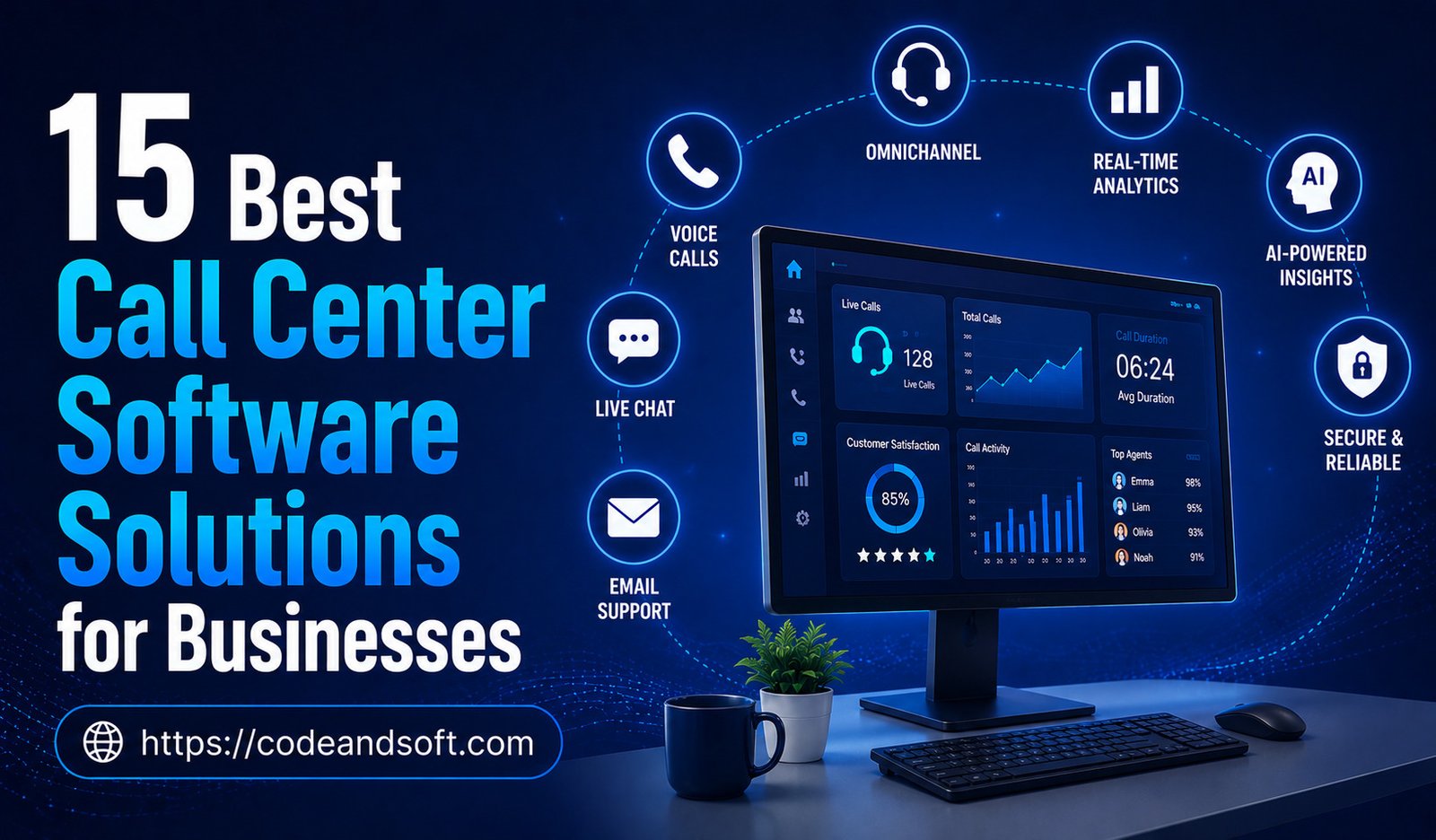
Modern call center software has evolved far beyond basic telephone systems. Today’s platforms can combine voice calling with intelligent routing, customer relationship management, analytics, call recording, artificial intelligence, workforce management, automation, and digital communication channels.
For businesses, choosing the right platform can be challenging because different solutions are designed for different needs. A small business may prioritize simplicity and affordability, while a large enterprise may require advanced analytics, workforce optimization, and extensive integrations.
This guide covers 15 leading call center software solutions businesses can consider in 2026. The list focuses on capabilities, potential use cases, and the types of organizations each platform may suit.
What Is Call Center Software?
Call center software is a technology platform that helps organizations manage inbound and outbound customer communications.
Depending on the solution, businesses can use it for:
- Incoming customer support
- Outbound sales calls
- Lead generation
- Appointment scheduling
- Technical support
- Customer retention
- Call routing
- Agent management
- Call analytics
Modern platforms may also support email, SMS, live chat, social messaging, and other digital channels.
Automatic Call Distribution
Automatic call distribution routes incoming calls to appropriate agents or departments.
Interactive Voice Response
IVR lets customers interact with automated menus and complete certain tasks without speaking to an agent.
CRM Integration
CRM integration gives representatives access to customer information during calls.
Call Recording
Call recording can support training, quality assurance, and dispute resolution where legally appropriate.
Analytics
Analytics can help managers understand call volume, agent performance, customer satisfaction, and service levels.
AI Features
Modern platforms may provide transcription, summaries, sentiment analysis, automated quality monitoring, and conversational AI.
Scalability
The platform should be able to support additional agents, locations, and communication channels as the business grows.
15 Best Call Center Software Solutions for Businesses in 2026
1. Five9
Five9 is a cloud contact center platform designed to support inbound and outbound customer interactions.
It provides tools for call routing, IVR, analytics, workforce management, and AI-powered customer experiences.
Key Features
- Inbound and outbound calling
- IVR
- Predictive dialing
- Call recording
- Analytics
- Workforce management
- AI capabilities
- CRM integrations
Best For
Five9 is a strong option for growing businesses and enterprises that need a comprehensive contact center platform.
2. Genesys Cloud CX
Genesys Cloud CX provides cloud-based contact center technology with a broad range of customer experience capabilities.
Its platform can support voice, digital channels, routing, analytics, workforce management, and artificial intelligence.
Key Features
- Intelligent routing
- IVR
- Voice and digital communication
- AI tools
- Analytics
- Workforce management
- CRM integration
Best For
Genesys Cloud CX is particularly suitable for organizations managing complex customer journeys and large contact center operations.
3. NICE CXone
NICE CXone combines contact center functionality with analytics, workforce management, automation, and AI.
The platform is designed to help businesses manage customer interactions across multiple channels.
Key Features
- Inbound and outbound calling
- IVR
- Workforce management
- Quality management
- Speech analytics
- AI
- Omnichannel communication
Best For
NICE CXone is well suited to larger organizations with sophisticated contact center requirements.
4. Talkdesk
Talkdesk offers cloud-based customer experience software with voice, digital communication, automation, and analytics.
It provides tools for managing customer conversations while connecting interactions with business systems.
Key Features
- Call management
- IVR
- AI tools
- Analytics
- CRM integration
- Call recording
- Automation
Best For
Talkdesk is a useful option for businesses seeking a modern cloud contact center with strong automation capabilities.
5. RingCentral Contact Center
RingCentral provides business communication and contact center technology.
Its platform can combine customer communications with broader business calling, collaboration, and messaging capabilities.
Key Features
- Contact center calling
- Call routing
- IVR
- Analytics
- CRM integration
- AI capabilities
- Omnichannel communication
Best For
RingCentral is suitable for organizations that want customer service functionality alongside a wider business communications environment.
6. Dialpad
Dialpad combines cloud communications with AI-powered features.
Its platform can help businesses manage calls while generating transcripts, summaries, and conversation insights.
Key Features
- Business calling
- Contact center tools
- AI transcription
- Call summaries
- Conversation intelligence
- Analytics
- CRM integrations
Best For
Dialpad is a good choice for businesses interested in AI-assisted communication and sales or support workflows.
7. 8×8
8×8 provides cloud communications and contact center technology for businesses.
Its platform supports voice, digital channels, analytics, routing, and customer experience management.
Key Features
- Contact center calling
- IVR
- Automatic call distribution
- Analytics
- Call recording
- Omnichannel communication
- CRM integration
Best For
8×8 can work well for businesses looking for an integrated communications and contact center platform.
8. Avaya Experience Platform
Avaya has a long history in enterprise communications and provides modern contact center technology through its experience platform.
Businesses can use it for customer interaction management, routing, analytics, and automation.
Key Features
- Contact center management
- IVR
- Intelligent routing
- Analytics
- AI capabilities
- Digital channels
- Customer experience management
Best For
Avaya is particularly relevant for large organizations with complex communication environments.
9. Amazon Connect
Amazon Connect is a cloud contact center service designed to help businesses create customer communication workflows.
It can support voice interactions, automated processes, routing, analytics, and integrations with cloud services.
Key Features
- Cloud contact center
- IVR
- Contact flows
- Call routing
- Analytics
- Self-service
- AI integration
Best For
Amazon Connect is suitable for organizations seeking flexible cloud infrastructure and businesses with technical resources.
10. Twilio Flex
Twilio Flex is a programmable contact center platform.
Unlike traditional contact center systems that provide mostly predefined workflows, Flex allows businesses to customize customer communication experiences.
Key Features
- Programmable contact center
- Voice
- Messaging
- Custom workflows
- APIs
- CRM integrations
- Analytics
Best For
Twilio Flex is a strong choice for businesses that require highly customized customer communication experiences and have development resources.
11. Zendesk
Zendesk is widely known for customer service software and provides tools for managing customer interactions across multiple channels.
Key Features
- Customer support
- Voice communication
- Ticketing
- Messaging
- Analytics
- CRM functionality
- AI tools
Best For
Zendesk is particularly useful for customer support teams that want voice communication connected to broader help desk operations.
12. Aircall
Aircall is a cloud phone and communication platform designed with sales and support teams in mind.
It emphasizes ease of use and integrations with popular business applications.
Key Features
- Cloud calling
- Call routing
- IVR
- Call recording
- Analytics
- CRM integrations
- Power dialing
Best For
Aircall can be a practical option for small and medium-sized sales or customer support teams.
13. CloudTalk
CloudTalk provides cloud-based calling and contact center features for sales and customer service teams.
Its platform includes outbound dialing, call routing, analytics, and integrations.
Key Features
- Inbound and outbound calls
- Power dialing
- Call recording
- Analytics
- CRM integration
- International calling
- Call routing
Best For
CloudTalk is suitable for growing businesses that need flexible cloud calling and international communication capabilities.
14. Nextiva
Nextiva offers business communication and customer experience technology.
Its platform can combine calling, customer interaction management, analytics, and other business communication features.
Key Features
- Business phone systems
- Contact center tools
- Call management
- Analytics
- Customer experience features
- CRM integration
- AI capabilities
Best For
Nextiva is useful for businesses that want an integrated communications environment rather than a standalone call center system.
15. JustCall
JustCall is a cloud calling and messaging platform designed for sales and support teams.
It provides outbound calling, business messaging, analytics, and CRM integrations.
Key Features
- Cloud calling
- Power dialing
- SMS
- Call recording
- CRM integration
- Call analytics
- Automation
How to Compare Call Center Software
A platform should not be selected based only on the number of features it offers.
Consider Your Business Size
Large enterprises may need advanced routing, analytics, security, and workforce management.
Evaluate Call Volume
A company receiving thousands of calls daily may require a more sophisticated system than a business handling a few dozen customer conversations.
Review Integration Requirements
Check whether the platform works with your existing CRM, help desk, ERP, e-commerce, and workforce management systems.
Examine AI Capabilities
AI can provide valuable tools such as transcription, summaries, sentiment analysis, automated quality monitoring, and virtual agents.
However, businesses should focus on practical value rather than adopting AI features simply because they are available.
Consider Reporting
Managers need reliable information about:
- Call volume
- Wait times
- Abandonment
- Agent performance
- Customer satisfaction
- Resolution rates
Check Security
Call center platforms can process sensitive customer information.
Review access controls, authentication, encryption, data retention, compliance features, and recording policies.
Benefits of Modern Call Center Software
Better Customer Experience
Intelligent routing and faster access to information can make customer interactions smoother.
Improved Agent Productivity
Automation reduces repetitive tasks and gives agents better access to customer information.
Lower Operational Costs
Cloud software can reduce some infrastructure and maintenance requirements.
Better Performance Visibility
Analytics help managers understand what is happening across the contact center.
Greater Scalability
Cloud platforms can make it easier to add users and expand communication capacity.
Omnichannel Communication
Modern customers may want to communicate through phone, email, chat, SMS, or social platforms.
Omnichannel software can bring these interactions into a more unified environment.
Common Call Center Software Mistakes
Businesses can make several mistakes when choosing a platform.
Selecting software based only on price can lead to missing features later.
Choosing a platform with excessive complexity can make adoption difficult.
Ignoring integrations can create disconnected workflows.
Failing to train employees can prevent teams from using important features effectively.
Businesses should also avoid automating every interaction. Human agents remain important for complicated and emotionally sensitive conversations.
Final Thoughts
The best call center software depends on the specific requirements of a business. There is no single platform that will be ideal for every organization.
Five9, Genesys Cloud CX, NICE CXone, Talkdesk, RingCentral, Dialpad, 8×8, Avaya, Amazon Connect, Twilio Flex, Zendesk, Aircall, CloudTalk, Nextiva, and JustCall all offer different approaches to customer communication and contact center management.
Before making a decision, businesses should consider call volume, team size, customer service goals, integrations, AI capabilities, analytics, security, scalability, and budget.
Small businesses may prefer a straightforward cloud calling solution, while larger organizations may need advanced workforce management, omnichannel routing, AI, and detailed analytics.
The most successful implementation is not necessarily the platform with the longest feature list. It is the solution that fits the organization’s workflow, employees, customers, and long-term growth plans.
As call center technology continues to evolve in 2026, businesses that combine automation with human expertise can create faster, more efficient, and more personalized customer experiences.