
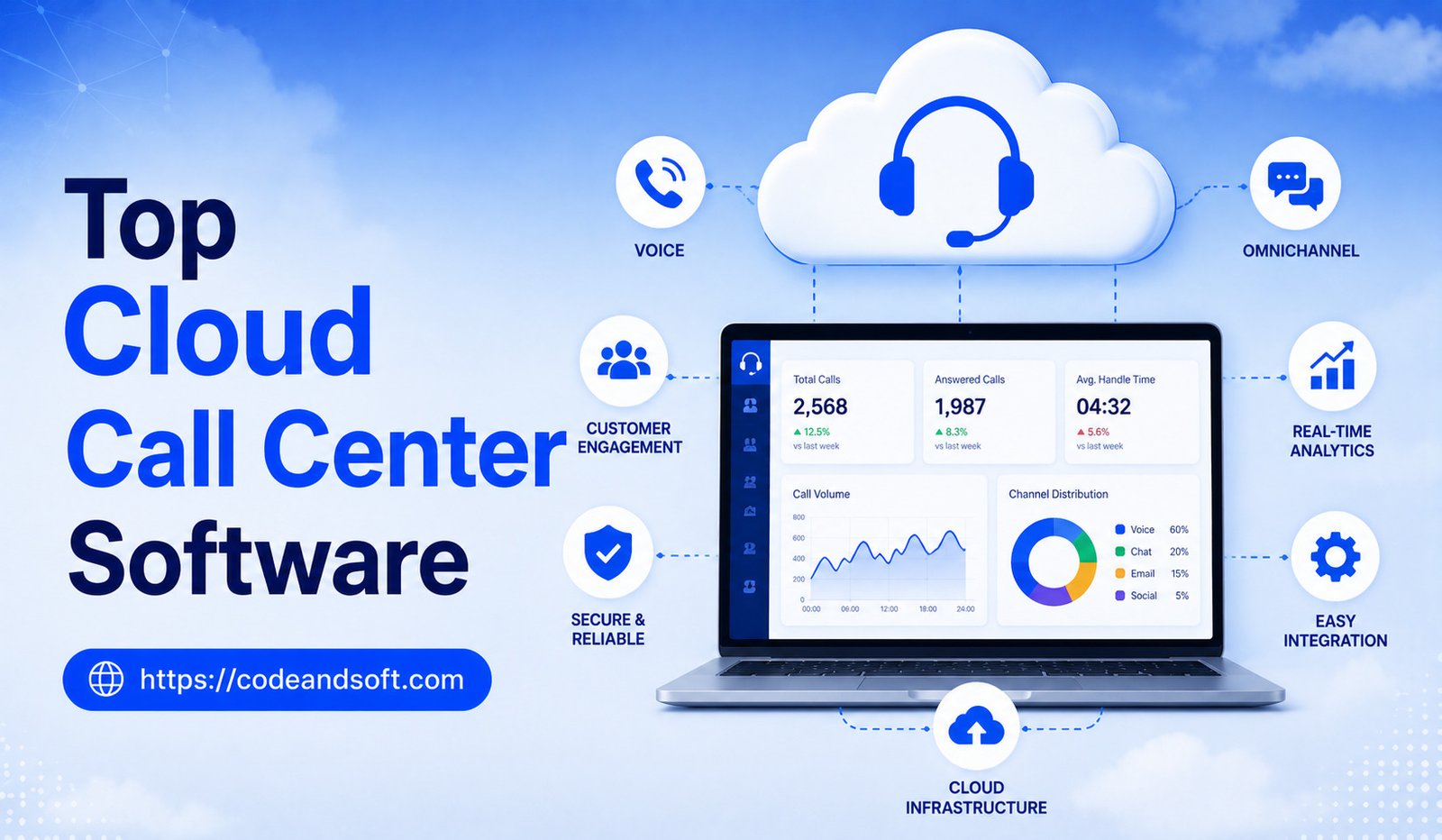

Introduction
Cloud call center software has changed how businesses manage customer communication. Businesses can access interactive voice response systems, automatic call distribution, customer relationship management integrations, call recording, analytics, workforce management, artificial intelligence, outbound dialing, and omnichannel communication from a single platform.
Small companies can use lightweight platforms to manage customer calls, while large enterprises can deploy sophisticated systems across multiple countries and thousands of agents.
However, choosing the right platform can be difficult. Pricing models differ, features may be divided between plans, and some vendors charge separately for voice usage, AI, storage, integrations, or premium capabilities.
This guide compares some of the leading cloud call center platforms based on features, pricing approach, usability, scalability, and ideal use cases.
What Is a Cloud Call Center Platform?
A cloud call center platform is software that allows businesses to operate customer communication services through internet-based infrastructure.
Unlike traditional on-premise systems, the core technology is hosted by the provider.
Agents can often work from offices, homes, or other locations as long as they have a suitable internet connection and authorized access.
Cloud platforms can manage:
- Inbound customer calls
- Outbound sales calls
- Call queues
- IVR menus
- Agent routing
- Call recording
- Customer information
- Performance analytics
- Customer messaging
- AI-powered automation
The cloud model can also make it easier to add users and expand operations without purchasing additional telephone hardware.
Why Businesses Are Moving to Cloud Call Centers
One of the biggest advantages of cloud platforms is flexibility.
Businesses can add agents without rebuilding their entire phone infrastructure. Remote employees can also connect to the same customer service environment.
Cloud platforms can provide additional advantages such as:
Faster Deployment
Traditional contact center systems can require significant hardware and installation work. Cloud systems generally reduce the need for physical infrastructure.
Remote Accessibility
Agents can access communication tools from different locations, which is particularly useful for distributed teams.
Scalability
Companies can increase or decrease user capacity as business requirements change.
Automatic Updates
The provider generally manages software updates and infrastructure maintenance.
Advanced Analytics
Managers can monitor customer interactions, agent performance, waiting times, and service trends.
Top Cloud Call Center Platforms Compared
1. Genesys Cloud CX
Genesys Cloud CX is an enterprise-oriented cloud contact center platform designed for organizations with complex customer service requirements.
It supports voice and digital communication, intelligent routing, workforce management, analytics, and AI-powered capabilities.
Its broad feature set makes it particularly useful for businesses managing sophisticated customer journeys. Current comparisons also identify Genesys as a strong enterprise option with extensive routing, workforce management, APIs, and journey analytics.
Key Features
- Cloud contact center
- IVR
- Intelligent routing
- Workforce management
- AI tools
- Analytics
- Digital channels
- CRM integrations
- Customer journey analytics
Pricing
Genesys generally uses subscription-based pricing, with costs varying according to capabilities, users, and selected features. Businesses should request a current quote for a precise estimate.
Best For
Large organizations and enterprises that need advanced routing, analytics, workforce management, and omnichannel communication.
2. NICE CXone
NICE CXone combines contact center functionality with artificial intelligence, analytics, workforce management, quality management, and customer experience tools.
The platform is designed for organizations that need extensive control over customer interactions.
Key Features
- Inbound and outbound calling
- IVR
- Intelligent routing
- Workforce management
- Quality management
- Speech analytics
- AI
- Omnichannel communication
Pricing
NICE CXone pricing can vary based on selected modules, users, usage, and enterprise requirements. Businesses should obtain a customized quotation rather than relying on a single advertised number.
Best For
Large contact centers that need workforce optimization, analytics, automation, and sophisticated customer experience management.
3. Five9
Five9 is a well-known cloud contact center platform with strong inbound and outbound capabilities.
Its predictive dialing capabilities can be particularly useful for high-volume outbound sales operations. Current cloud call center comparisons continue to highlight Five9 for outbound automation and predictive dialing.
Key Features
- Predictive dialing
- Power dialing
- IVR
- Automatic call distribution
- Call recording
- Analytics
- AI-powered tools
- Workforce management
- CRM integration
Pricing
Five9 generally uses customized pricing depending on the package, users, and features selected.
Best For
Sales teams, customer service operations, and enterprises that need strong inbound and outbound functionality.
4. Talkdesk
Talkdesk is a cloud contact center platform focused on customer experience, automation, AI, and omnichannel communication.
It provides tools that allow businesses to connect customer conversations with CRM systems and other applications.
Key Features
- IVR
- Call routing
- AI-powered automation
- Analytics
- CRM integrations
- Call recording
- Digital channels
- Workforce tools
Pricing
Talkdesk typically offers subscription-based plans, with final costs depending on the chosen package and additional features.
Best For
Businesses looking for modern cloud contact center software with automation and AI capabilities.
5. RingCentral RingCX
Its platform can connect customer service with broader business communication tools.
Key Features
- Contact center calling
- IVR
- Call routing
- AI receptionist
- Conversation intelligence
- Analytics
- CRM integration
- Digital communication
Pricing
Pricing depends on the selected service package, number of users, and additional capabilities.
Best For
Businesses that want customer service software connected with a wider communications ecosystem.
6. Dialpad
Dialpad combines cloud calling with artificial intelligence and conversation intelligence.
Its AI features can help businesses transcribe calls, create summaries, and provide useful insights from customer conversations.
Key Features
- Cloud calling
- AI transcription
- Call summaries
- Conversation intelligence
- Call analytics
- Contact center tools
- CRM integration
Pricing
Dialpad commonly offers per-user subscription plans, although advanced contact center capabilities and usage can affect the total cost.
Best For
Small and medium-sized businesses that want AI-powered calling without the complexity of a large enterprise contact center.
7. 8×8
8×8 provides cloud communications and contact center services that bring voice, messaging, analytics, and customer interaction tools together.
Key Features
- IVR
- Automatic call distribution
- Call recording
- Analytics
- Omnichannel communication
- CRM integration
- Contact center reporting
Pricing
Pricing varies according to the selected package and number of users.
Best For
Businesses looking for an integrated cloud communication and contact center environment.
8. Amazon Connect
Amazon Connect is a cloud contact center service designed around flexible cloud infrastructure.
It allows businesses to create contact flows and integrate customer communication with other cloud-based services.
Key Features
- IVR
- Contact flows
- Call routing
- Self-service
- Analytics
- Cloud scalability
- AI integrations
Pricing
Amazon Connect follows a usage-oriented pricing model rather than relying only on traditional per-user licensing. This can be attractive to businesses with variable usage, but forecasting the total bill requires considering call duration, features, and related services.
Best For
Technology-focused companies and organizations that want a flexible cloud platform and have technical resources available for configuration.
9. Twilio Flex
Twilio Flex is a programmable contact center platform designed for businesses that want to customize customer communication.
Instead of forcing companies into a rigid workflow, Flex allows organizations to build customized experiences using programmable communication technology.
Key Features
- Voice
- Messaging
- Programmable workflows
- APIs
- CRM integrations
- Custom routing
- Analytics
Pricing
Twilio’s pricing approach can include usage-based charges and platform-related costs. Total expenses depend heavily on how the system is configured and used.
Best For
Businesses with developers that need customized contact center workflows.
10. Aircall
Aircall is a cloud phone platform designed particularly for sales and customer support teams.
It focuses on ease of use and integrations with popular business applications.
Key Features
- Cloud calling
- IVR
- Call routing
- Call recording
- Power dialing
- Analytics
- CRM integrations
Pricing
Aircall commonly uses per-user subscription pricing, with costs depending on the plan and billing arrangement. Current 2026 comparisons list entry-level pricing around the lower end of the business VoIP market, although exact pricing should be confirmed directly before purchasing.
Best For
Small and medium-sized businesses that want a relatively simple cloud phone and call center solution.
Cloud Call Center Pricing Explained
Pricing is one of the most confusing parts of choosing a cloud call center platform.
There is rarely a single number that tells you the complete cost.
A platform may charge for:
- Agent licenses
- Supervisor licenses
- Voice minutes
- Phone numbers
- Call recording
- Storage
- AI features
- SMS
- Digital channels
- Premium integrations
- Workforce management
Some providers use primarily per-user pricing, while others combine subscriptions with usage-based billing.
In India, for example, current industry pricing guides note that cloud call center costs may combine seat charges with voice minutes, messaging, recording, and AI usage.
Therefore, businesses should compare total cost of ownership instead of comparing only the advertised price per user.
Cloud Call Center Features to Compare
IVR
Interactive Voice Response allows callers to navigate automated menus and reach the appropriate department.
Automatic Call Distribution
ACD routes incoming calls to suitable agents based on rules such as availability, department, or skills.
Predictive Dialing
Predictive dialers can help outbound sales teams contact large numbers of prospects more efficiently.
CRM Integration
CRM integration allows agents to view customer information during conversations.
Call Recording
Recording can support quality management, training, and compliance when used according to applicable laws.
Analytics
Analytics can help managers monitor:
- Call volume
- Wait times
- Abandonment
- Resolution rates
- Agent performance
- Customer satisfaction
Artificial Intelligence
AI features increasingly include:
- Call transcription
- Automated summaries
- Sentiment detection
- Agent assistance
- Virtual agents
- Conversation analysis
Workforce Management
Large contact centers may need forecasting, scheduling, adherence monitoring, and workforce optimization.
Cloud Platforms vs Traditional Call Center Systems
Traditional systems require organizations to manage physical infrastructure, hardware, telephone equipment, and often more complex maintenance.
Cloud systems shift much of that infrastructure responsibility to the provider.
This can make cloud platforms easier to scale and support remote operations.
However, cloud software does not eliminate all costs. Businesses still need reliable internet connectivity, appropriate devices, implementation resources, and trained employees.
How to Select the Best Cloud Call Center Platform for Your Business
Start With Your Team Size
A ten-agent customer service team does not necessarily need the same platform as a 5,000-agent enterprise.
Determine Your Calling Model
Identify whether your operation is:
- Primarily inbound
- Primarily outbound
- Blended
- Omnichannel
Identify Required Integrations
List your CRM, help desk, ERP, e-commerce, and workforce systems before comparing vendors.
Evaluate AI Carefully
AI can provide major productivity benefits, but businesses should evaluate accuracy, pricing, security, and actual use cases.
Review Scalability
Make sure the platform can support future growth.
Test Administration
A platform may have excellent features but still be difficult for administrators to configure.
Compare Support
Ask about implementation assistance, technical support, service-level agreements, and escalation procedures.
What Reviews Tell Buyers
Software reviews can provide useful information about usability, integrations, support, reliability, and day-to-day administration.
For example, CloudCall currently has a 4.0/5 rating from 40 reviews on Capterra, while GetApp also reports a 4.0 rating based on verified reviews.
However, reviews should not be treated as the only decision factor.
A platform that works well for a 20-agent sales team may not be appropriate for a multinational contact center.
Businesses should use reviews to identify recurring strengths and weaknesses and then validate those findings through demonstrations and trials.
Common Cloud Call Center Buying Mistakes
Comparing Only Monthly Seat Prices
The cheapest license does not always produce the lowest total cost.
Ignoring Usage Fees
Voice minutes, SMS, storage, and AI usage can significantly affect expenses.
Buying Too Many Features
Advanced features are valuable only when they solve actual business problems.
Forgetting Implementation
Migration, integrations, configuration, and employee training can require significant time and resources.
Ignoring Customer Experience
A platform should make it easier for customers to get assistance, not simply automate more interactions.
Final Thoughts
Cloud call center platforms give businesses a flexible way to manage customer conversations without depending entirely on traditional on-premise telephone infrastructure.
Genesys Cloud CX and NICE CXone are strong choices for sophisticated enterprise operations. Five9 is particularly attractive for businesses with significant outbound calling requirements. Talkdesk combines contact center functionality with automation and AI, while RingCentral can connect customer service with broader business communications. Dialpad is appealing to teams interested in AI-powered calling, while Aircall can be a practical choice for smaller organizations.
Amazon Connect and Twilio Flex stand out for businesses that want greater technical flexibility and customizable cloud architectures.
The right platform ultimately depends on your team size, call volume, customer service model, integrations, budget, and future growth plans.
Most importantly, do not compare cloud call center platforms based on headline pricing alone. Examine licensing, voice usage, AI charges, storage, integrations, implementation, and support to understand the real cost.
A successful cloud contact center is not simply the one with the most features. It is the platform that gives agents useful tools, managers actionable information, and customers a fast and reliable way to receive help.