Modern applications depend heavily on backend systems. Whenever a user logs into an account, places an order, checks a payment, uploads information, or retrieves data from a database, backend software is usually working behind the scenes.
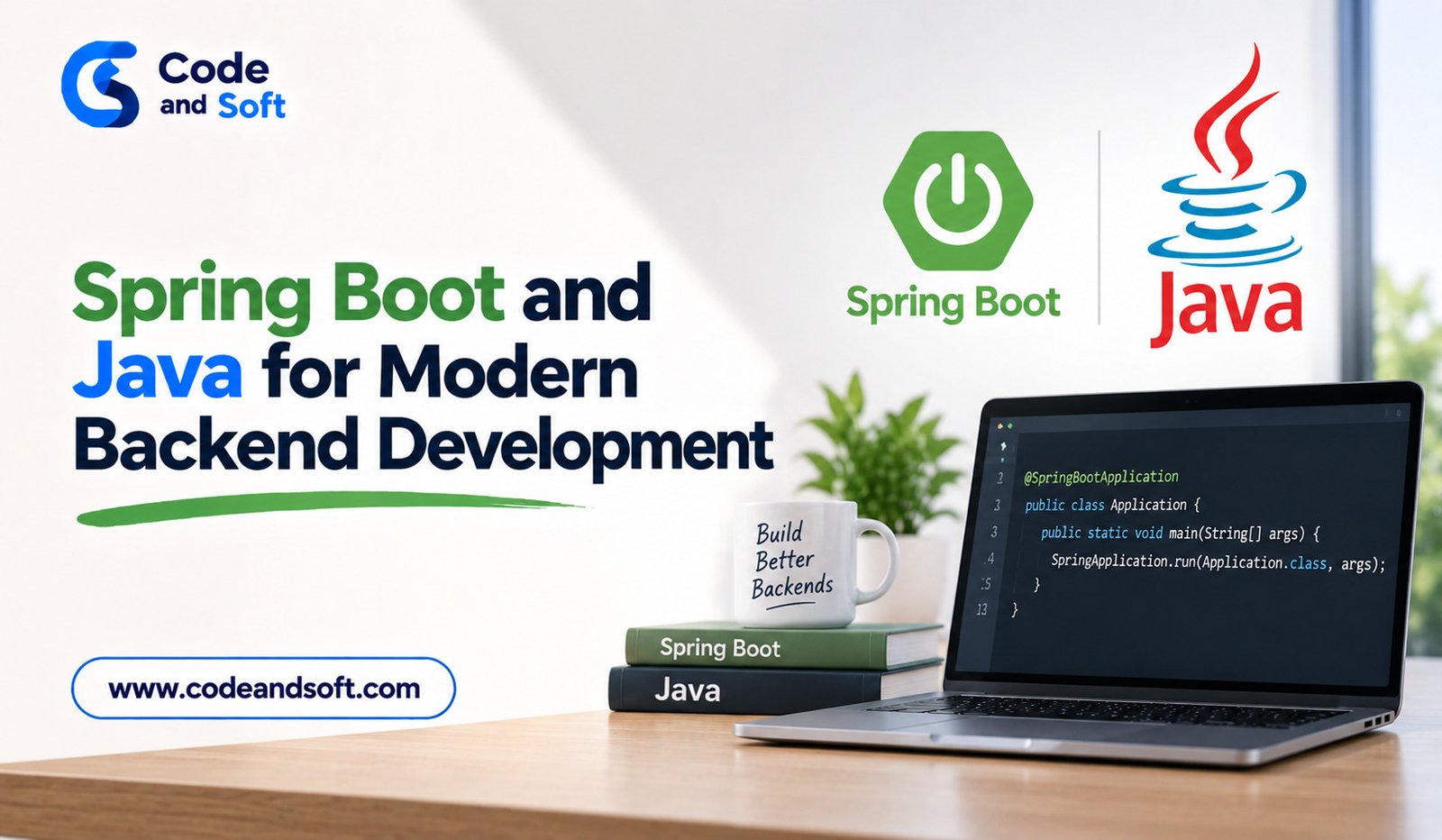
Java has been a major backend programming language for many years, and Spring Boot has made building Java-based applications more convenient and productive. Together, Java and Spring Boot provide a powerful combination for creating APIs, web applications, business systems, microservices, and enterprise platforms.
For students and new developers, learning Java first and then moving into Spring Boot can provide a practical path toward backend development.
What Is Java in Backend Development?
Java is a general-purpose programming language that is widely used to create server-side applications.
In backend development, Java can be responsible for processing business logic, communicating with databases, handling user requests, managing authentication, processing data, and connecting different services.
Java provides the fundamental programming concepts needed to build these applications. Developers can use classes, objects, methods, interfaces, collections, exception handling, and other language features to organize application logic.
However, creating a complete modern backend application using only basic Java can require a significant amount of configuration and supporting code. This is where frameworks such as Spring Boot become useful.
What Is Spring Boot?
Spring Boot is a framework built around the Spring ecosystem that simplifies the development of Java applications.
Traditional Spring applications can involve considerable configuration. Spring Boot reduces much of this complexity by providing sensible defaults, automatic configuration, embedded server support, and tools that help developers get applications running quickly.
Instead of spending a large amount of time configuring the foundation of an application, developers can focus more on implementing business requirements.
Spring Boot is particularly popular for developing backend services and REST APIs.
Why Java and Spring Boot Work Well Together
Java provides the programming foundation, while Spring Boot provides tools and structure for building modern applications.
A simple way to understand the relationship is to think of Java as the language and Spring Boot as a development framework that helps organize and run Java applications efficiently.
Developers can write Java classes containing business logic and use Spring Boot features to expose that logic through web endpoints, connect to databases, manage dependencies, configure applications, and handle other backend requirements.
This combination is especially useful for projects that need to grow over time.
Building REST APIs With Spring Boot
One of the most common uses of Spring Boot is creating REST APIs.
An API allows different software components to communicate with each other.
For example, an online shopping application might have a frontend that requests product information from a Spring Boot backend. The backend receives the request, retrieves the required information, processes it, and sends a response.
A basic Spring Boot controller can look like this:
@RestController
public class ProductController {
@GetMapping(“/products”)
public String getProducts() {
return “Product list”;
}
}
This simple example demonstrates how Spring Boot can map an HTTP request to a Java method.
Real applications would normally return structured data, often using JSON.
Understanding Spring Boot Controllers
Controllers are responsible for handling incoming web requests.
A controller can contain endpoints for operations such as retrieving products, creating users, updating information, or deleting records.
For example, an application might provide endpoints such as:
GET /products
GET /products/10
POST /products
PUT /products/10
DELETE /products/10
These endpoints can represent different operations within an application.
Learning how controllers work is an important step for beginners because APIs are central to modern web and mobile applications.
Connecting Spring Boot to Databases
Most useful business applications need persistent data.
A shopping application needs product and order information. A school management system needs student and course records. A banking application needs account and transaction information.
Spring Boot applications can connect to databases using technologies within the broader Spring ecosystem, including Spring Data.
Developers can create Java classes representing application data and use repository-based approaches to perform database operations.
For example, a repository can provide operations for finding, saving, updating, and deleting records without requiring developers to manually write every database operation.
This can significantly reduce repetitive code.
Understanding Dependency Injection
Dependency injection is one of the important concepts developers encounter when working with Spring.
Instead of a class creating every object it needs by itself, required components can be provided to the class by the framework.
Consider a service that needs a product repository. Instead of manually creating the repository inside the service, Spring can manage the dependency and provide it when required.
This approach can make applications easier to test, maintain, and modify.
For beginners, dependency injection may initially seem abstract, but it becomes much easier to understand after building a few Spring Boot projects.
Service and Repository Layers
A well-organized backend usually separates different responsibilities.
A controller can handle web requests, a service can contain business logic, and a repository can communicate with the database.
For example, an online store might have:
ProductController
ProductService
ProductRepository
The controller receives a request. The service decides what should happen. The repository handles database-related operations.
This separation prevents one class from becoming responsible for everything.
It can also make larger applications easier to maintain because developers can work on individual layers without mixing unrelated responsibilities.
Spring Boot and Microservices
Modern software systems sometimes use a microservices architecture.
Instead of building one massive application, organizations can divide functionality into smaller services.
For example, an e-commerce platform might have separate services for users, products, orders, payments, and notifications.
Spring Boot is frequently used for creating such backend services because developers can build relatively independent applications with their own APIs and responsibilities.
However, beginners should not assume that microservices are always better. Small applications may be easier to manage as a single service. Microservices introduce additional operational and architectural complexity.
Understanding basic backend development should come before attempting complex distributed systems.
Security in Spring Boot Applications
Backend applications often handle sensitive information, so security is an important consideration.
The Spring ecosystem includes Spring Security, which can help developers implement authentication and authorization.
Authentication determines who a user is, while authorization determines what that user is allowed to do.
For example, an application may allow regular users to view their own information while giving administrators additional permissions.
Security should be considered from the beginning of development rather than added as an afterthought.
Error Handling and Validation
Real applications need to deal with incorrect input and unexpected situations.
A user might submit an incomplete form, request a product that does not exist, or provide invalid information.
Spring Boot applications can use validation and exception-handling mechanisms to respond appropriately.
Instead of allowing an application to fail unexpectedly, developers can return meaningful responses that explain what went wrong.
Good error handling also makes APIs easier for frontend developers and other systems to use.
Testing Spring Boot Applications
Testing is another important part of backend development.
Developers need to verify that individual methods work correctly and that different components behave as expected when they interact.
Java has a mature testing ecosystem, and Spring Boot provides support for testing different parts of an application.
Beginners can start with simple unit tests before moving toward integration testing and broader application testing.
Learning testing early can encourage developers to write code that is easier to maintain and change.
Why Spring Boot Is Useful for Beginners
Spring Boot may seem complicated at first because it introduces many concepts beyond basic Java.
However, students who already understand Java fundamentals will have a much easier time learning it.
Before starting Spring Boot, beginners should be comfortable with variables, methods, classes, objects, interfaces, collections, exception handling, and basic object-oriented programming.
After that, they can learn HTTP, REST APIs, controllers, services, repositories, databases, dependency injection, and application configuration.
This creates a natural progression from Java programming to professional backend development.
Building Projects With Java and Spring Boot
Practical projects are one of the best ways to learn Spring Boot.
A beginner can start with a simple task management API that allows users to create, view, update, and delete tasks.
After becoming comfortable with CRUD operations, the project can be expanded with database storage, validation, authentication, search functionality, and pagination.
Other useful projects include a student management API, product catalog, expense tracker, library system, appointment platform, or simple e-commerce backend.
Each project can introduce a new backend concept without overwhelming the learner.
Career Opportunities With Java and Spring Boot
Java and Spring Boot can be useful for developers interested in backend engineering, enterprise application development, API development, cloud applications, and large-scale software systems.
Companies often need backend developers who understand more than programming syntax. They also need people who understand databases, APIs, security, testing, version control, software architecture, and deployment.
Therefore, learning Spring Boot should be part of a broader backend development journey.
Final Thoughts
Java and Spring Boot form a strong combination for modern backend development. Java provides a mature programming language and object-oriented foundation, while Spring Boot simplifies many of the tasks involved in creating production-oriented backend applications.
Developers can use the combination to build REST APIs, connect databases, implement business logic, create secure services, and develop applications that can grow with changing requirements.
For beginners, the best approach is to learn Java fundamentals first and then gradually introduce Spring Boot concepts. Start with a small API, understand how requests move through controllers and services, connect a database, add validation and security, and continue improving the project.
With consistent practice, Java and Spring Boot can provide a solid foundation for building real-world backend applications and pursuing a professional software development career.