Pointers are one of the most important concepts in C programming. They are also one of the topics that many beginners find confusing at first. Unlike ordinary variables, which store values directly, pointers store memory addresses. This allows a C program to work more closely with computer memory and provides developers with greater control over how data is accessed and managed.
Understanding pointers is essential for students who want to learn C properly because pointers are closely connected with arrays, strings, functions, dynamic memory allocation and data structures.
Once the basic idea becomes clear, pointers become much easier to work with. The key is to understand what a pointer stores, how an address is obtained and how a pointer can be used to access the value stored at that address.
What Is a Pointer in C?
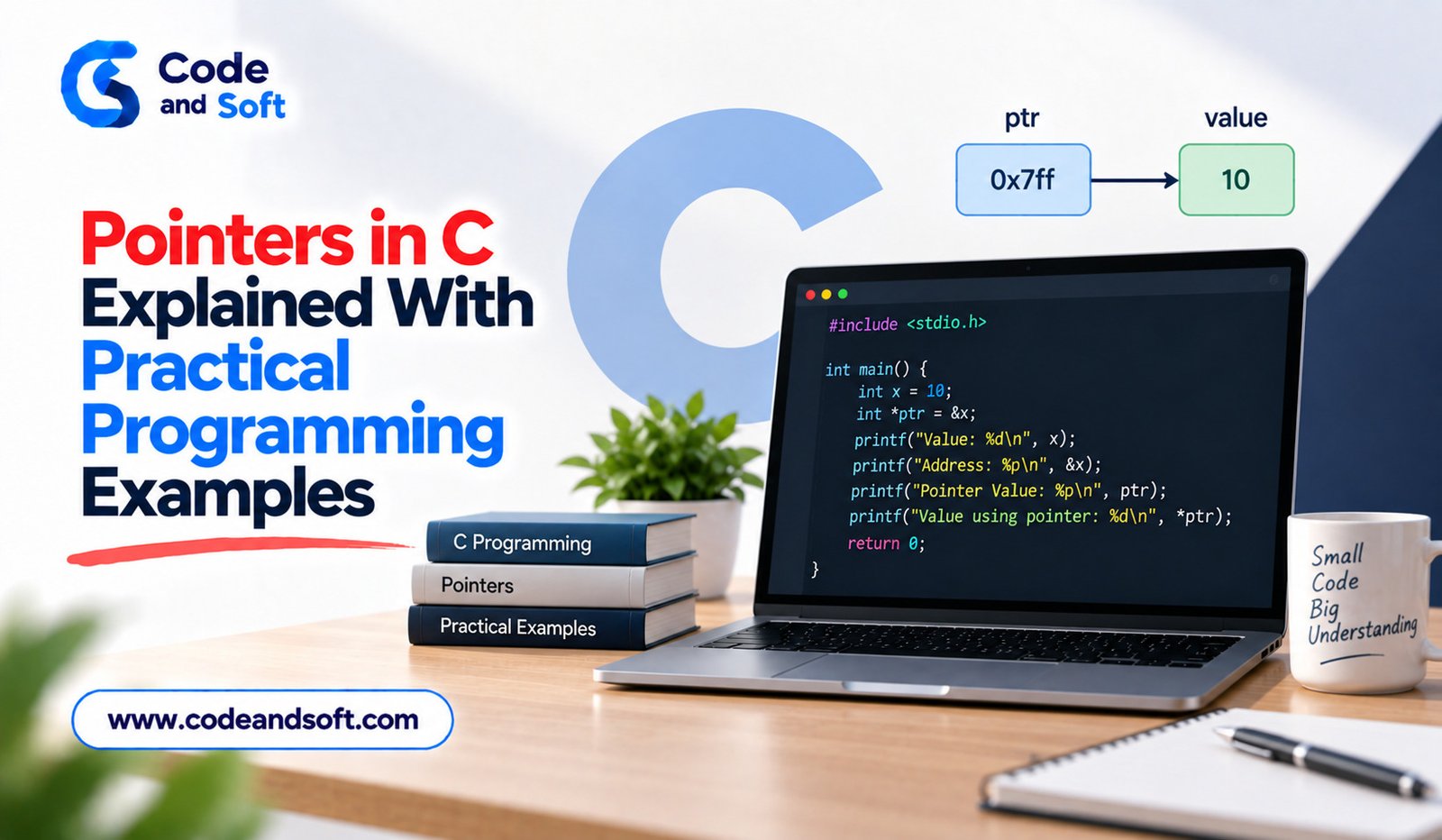
A pointer is a variable that stores the memory address of another variable.
Consider a simple variable:
int number = 25;
The variable number stores the value 25. Somewhere in the computer’s memory, that value has a specific address.
A pointer can store that address:
int *ptr = &number;
Here, ptr is a pointer to an integer. The & operator obtains the address of number, while the * in the declaration indicates that ptr is a pointer.
The pointer does not contain the value 25 directly. Instead, it contains information about where 25 is stored in memory.
Understanding the Address Operator
The ampersand symbol & is known as the address-of operator.
It allows a program to obtain the memory address of a variable.
For example:
int age = 21;
printf(“%p”, (void *)&age);
The exact address displayed can differ each time the program runs because the operating system may place the variable in a different memory location.
The important point is that &age represents the address where the variable age is stored.
This concept is fundamental to understanding pointers because a pointer’s primary purpose is to store such addresses.
Understanding the Dereference Operator
The * operator has another important role when it is used with a pointer expression. It can be used to access the value stored at the address held by the pointer.
For example:
int number = 50;
int *ptr = &number;
printf(“%d”, *ptr);
The expression *ptr accesses the value located at the address stored inside ptr. Therefore, the program prints 50.
This operation is called dereferencing a pointer.
A useful way to remember the concepts is:
&variable means “give me the address.”
*pointer means “give me the value stored at that address.”
Changing a Value Through a Pointer
Pointers are not only useful for reading values. They can also be used to modify the original variable.
Consider:
int score = 70;
int *ptr = &score;
*ptr = 90;
printf(“%d”, score);
The output is:
90
The statement *ptr = 90 changes the value stored at the memory location represented by ptr. Since that location belongs to score, the original variable changes as well.
This ability becomes particularly useful when functions need to modify variables belonging to their calling code.
Pointers and Functions
Normally, C functions receive copies of arguments. This means changing a parameter inside the function does not automatically change the original variable.
Pointers provide a way around this limitation.
For example:
void changeValue(int *value)
{
*value = 100;
}
int main()
{
int number = 25;
changeValue(&number);
printf(“%d”, number);
return 0;
}
The address of number is passed to the function. The function receives that address through the pointer value and changes the data stored there.
As a result, the original number becomes 100.
This technique is commonly used when a function needs to modify one or more values supplied by the caller.
Practical Example: Swapping Two Numbers
A classic example of pointer usage is swapping two variables.
void swap(int *a, int *b)
{
int temp = *a;
*a = *b;
*b = temp;
}
The function receives the addresses of two variables rather than copies of their values.
It can then modify the original variables through dereferencing.
For example:
int first = 10;
int second = 20;
swap(&first, &second);
After the function executes, first contains 20 and second contains 10.
This example demonstrates why pointers are important when functions need to work directly with existing data.
Pointers and Arrays
Pointers and arrays are closely related in C.
Consider an array:
int numbers[3] = {10, 20, 30};
The array stores its elements in a sequence of memory locations. The name of the array can be used in many expressions as an address associated with its first element.
A pointer can therefore be used to access array elements:
int *ptr = numbers;
printf(“%d”, *ptr);
The program prints:
10
Pointer arithmetic can then be used to move through the array:
printf(“%d”, *(ptr + 1));
This accesses the second element.
Understanding this relationship helps explain why pointers are frequently used when processing arrays and other blocks of data.
Pointer Arithmetic
C allows certain arithmetic operations on pointers.
If ptr points to an integer, adding one to the pointer moves it to the next integer-sized memory location rather than simply increasing the address by one byte.
For example:
int values[] = {5, 10, 15};
int *ptr = values;
printf(“%d\n”, *ptr);
printf(“%d\n”, *(ptr + 1));
printf(“%d\n”, *(ptr + 2));
This produces:
5
10
15
The actual number of bytes moved depends on the type of data being referenced.
Pointer arithmetic is powerful, but it should be used carefully. Moving a pointer outside the valid memory associated with an object can result in undefined behavior.
Pointers and Strings
Strings in C are represented using arrays of characters ending with a null character.
A pointer can be used to process a string one character at a time.
For example:
char text[] = “Hello”;
char *ptr = text;
while (*ptr != ‘\0’)
{
printf(“%c”, *ptr);
ptr++;
}
The pointer starts at the first character and moves forward until it reaches the terminating null character.
This demonstrates how pointers can be used to traverse a sequence of data.
Pointers and Dynamic Memory
Pointers are also essential for dynamic memory allocation.
Sometimes a program cannot know in advance how much memory it will require. C provides mechanisms for requesting memory while the program is running.
For example:
int *numbers;
numbers = malloc(5 * sizeof(int));
The pointer numbers can store the address of the allocated memory.
After the program has finished using that memory, it should release it:
free(numbers);
Programs must handle dynamically allocated memory carefully. Failing to release memory that is no longer required can create memory leaks.
It is also important not to access memory after it has been released.
Null Pointers
A pointer should not always point to a valid object. Sometimes a program needs to represent the fact that a pointer currently has no valid target.
This is where a null pointer is useful:
int *ptr = NULL;
Before dereferencing a pointer that may be null, the program should check it:
if (ptr != NULL)
{
printf(“%d”, *ptr);
}
Attempting to dereference an invalid or null pointer can cause serious program errors.
Common Pointer Mistakes
Beginners often make mistakes when learning pointers. One common problem is using an uninitialized pointer.
For example:
int *ptr;
*ptr = 10;
The pointer does not point to a valid location, so writing through it can result in undefined behavior.
Another mistake is confusing an address with the value stored at that address. The expression ptr represents the address stored in the pointer, while *ptr accesses the value at that location.
Using memory after calling free() is another dangerous error. Good pointer programming requires careful attention to ownership, lifetime and valid memory access.
Why Pointers Matter in C
Pointers are much more than a difficult C language feature. They provide a foundation for understanding how programs interact with memory.
They are used in dynamic memory allocation, arrays, strings, functions, structures and many important data structures.
Pointers also prepare students for concepts encountered in operating systems, embedded programming and low-level software development.
Learning pointers can initially require patience, but practical examples make the concept easier to understand. Instead of memorizing symbols, students should practice tracing what each pointer contains and identifying the memory location it refers to.
Final Thoughts
Pointers are a fundamental part of C programming because they allow programs to work directly with memory addresses. By learning the address-of operator, dereferencing, pointer arithmetic and pointer-based function arguments, beginners can develop a much stronger understanding of how C programs operate.
Practical examples such as modifying variables through functions, swapping values, processing arrays and managing dynamically allocated memory show why pointers are so useful.
The best way to become comfortable with pointers is to write small programs and carefully track the relationship between variables, addresses and values. Once this relationship becomes familiar, many advanced C programming concepts become easier to understand.