

Introduction
In the modern business world, data has become one of the most valuable resources for organizations. Companies collect massive amounts of information from customers, sales transactions, financial activities, marketing campaigns, and daily operations. However, data alone does not create value. Businesses need effective methods to analyze information and convert it into actionable insights.
Two important concepts that often create confusion are Business Intelligence (BI) and Business Analytics (BA). Although both involve using data to improve decision-making, they serve different purposes.
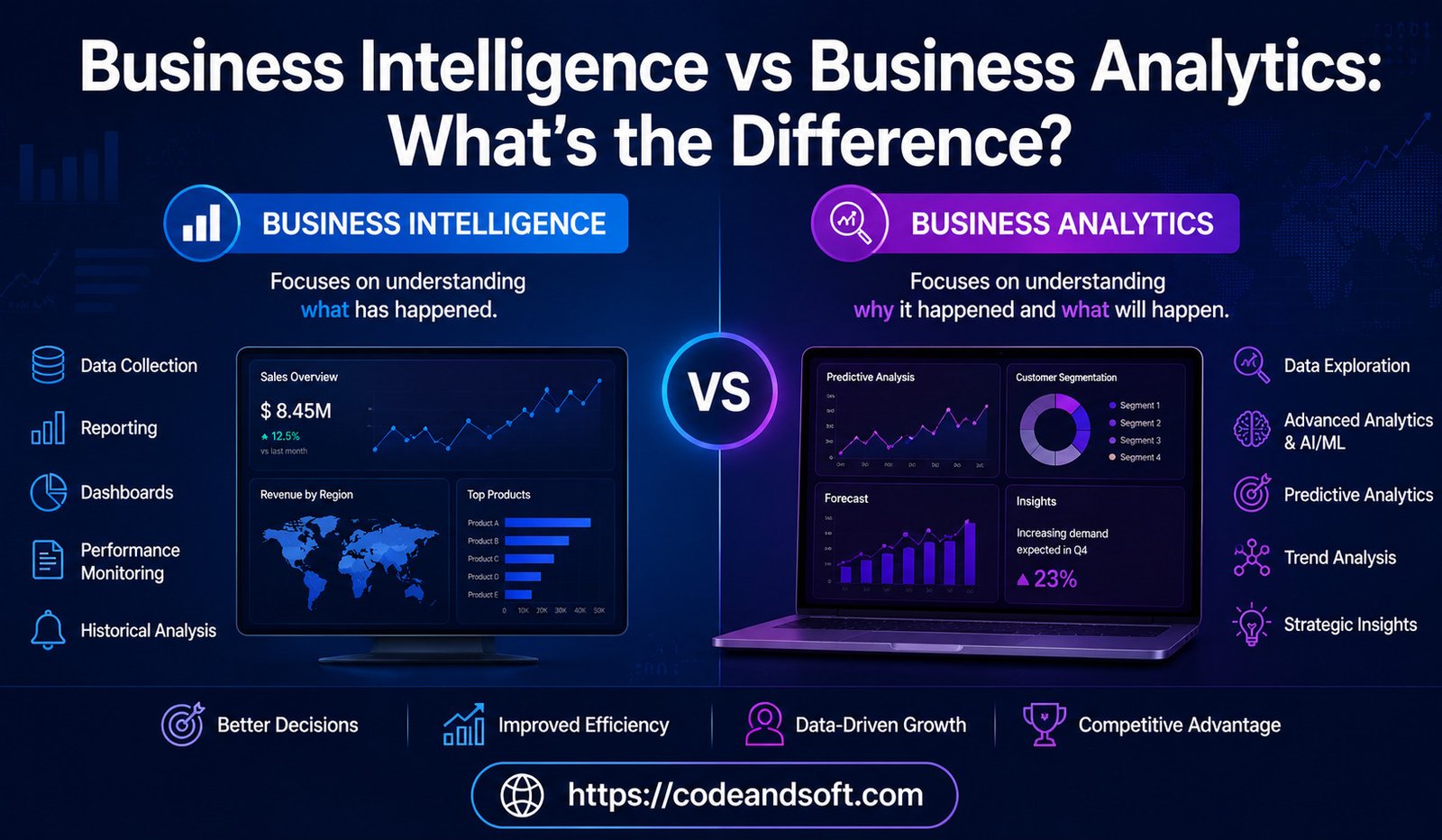
Business Intelligence focuses on analyzing historical and current data to understand what has already happened and what is happening now. Business Analytics goes further by using advanced techniques such as predictive modeling, statistics, and artificial intelligence to forecast future outcomes and recommend actions.
Understanding the difference between Business Intelligence and Business Analytics helps organizations choose the right tools and strategies to improve performance.
What Is Business Intelligence?
Business Intelligence refers to technologies, processes, and tools that help businesses collect, organize, analyze, and visualize data to support decision-making.
BI focuses mainly on transforming raw data into meaningful reports and insights. It helps organizations understand their current performance by analyzing historical and real-time information.
Business Intelligence answers questions such as:
- What happened?
- When did it happen?
- How did performance change?
- What areas are performing well or poorly?
For example, a retail company can use BI software to analyze last year’s sales data, identify top-selling products, and compare performance across different locations.
Key Components of Business Intelligence
Data Collection
BI systems collect information from multiple sources, including:
- Sales databases
- Customer management systems
- Financial software
- Marketing platforms
- Enterprise applications
Data Warehousing
Businesses store collected information in centralized databases called data warehouses. These systems organize large amounts of data for analysis.
Data Reporting
BI tools create reports that summarize important business information.
Examples include:
- Sales reports
- Financial statements
- Performance reports
Data Visualization
BI platforms use dashboards, charts, and graphs to make information easier to understand.
What Is Business Analytics?
Business Analytics is the process of using statistical methods, data analysis techniques, machine learning, and predictive models to understand business data and make future-focused decisions.
While Business Intelligence mainly explains past and present performance, Business Analytics focuses on predicting future possibilities and finding the best actions.
Business Analytics answers questions such as:
- Why did something happen?
- What is likely to happen next?
- What should the business do?
For example, an online retailer can use business analytics to predict customer demand and recommend products customers are likely to purchase.
Types of Business Analytics
Business Analytics is generally divided into four main categories.
1. Descriptive Analytics
Descriptive analytics explains past events using historical data.
It answers:
“What happened?”
Examples:
- Monthly sales reports
- Customer purchase history
- Revenue analysis
Business Intelligence mainly uses descriptive analytics.
2. Diagnostic Analytics
Diagnostic analytics identifies reasons behind specific events.
It answers:
“Why did it happen?”
Examples:
- Why sales declined
- Why customers stopped buying
- Why production costs increased
3. Predictive Analytics
Predictive analytics uses historical data and statistical models to forecast future outcomes.
It answers:
“What is likely to happen?”
Examples:
- Future sales forecasting
- Customer behavior prediction
- Market trend analysis
4. Prescriptive Analytics
Prescriptive analytics recommends actions based on predicted outcomes.
It answers:
“What should we do?”
Examples:
- Best pricing strategy
- Optimal inventory levels
- Marketing recommendations
Business Intelligence vs Business Analytics: Key Differences
| Feature | Business Intelligence | Business Analytics |
| Main Purpose | Understand past and present performance | Predict future outcomes and recommend actions |
| Focus | Reporting and visualization | Analysis and forecasting |
| Data Usage | Historical and current data | Historical data plus advanced models |
| Main Question | What happened? | What will happen and what should be done? |
| Techniques | Reporting, dashboards, data visualization | Statistics, machine learning, predictive modeling |
| Users | Managers, executives, business teams | Analysts, data scientists, strategic teams |
| Complexity | Easier to use | Requires advanced analytical skills |
Difference in Approach
The biggest difference between BI and Business Analytics is their approach toward data.
Business Intelligence Approach
Business Intelligence focuses on understanding existing information.
Example:
A company reviews sales reports to understand which products performed best last quarter.
BI helps businesses monitor performance and identify areas requiring improvement.
Business Analytics Approach
Business Analytics focuses on using data to make future decisions.
Example:
A company analyzes customer behavior to predict which products will become popular next year.
Business Analytics helps organizations plan strategies and reduce uncertainty.
Business Intelligence vs Business Analytics Tools
Popular Business Intelligence Tools
Microsoft Power BI
Power BI helps organizations create dashboards, reports, and interactive data visualizations.
Tableau
Tableau is widely used for creating advanced visual analytics and business dashboards.
Google Looker
Looker provides cloud-based business intelligence solutions for organizations requiring centralized analytics.
Qlik Sense
Qlik Sense offers data visualization and business reporting capabilities.
Popular Business Analytics Tools
Python
Python is widely used for data analysis, machine learning, and predictive modeling.
R Programming
R is commonly used for statistical analysis and advanced analytics.
SAS Analytics
SAS provides enterprise-level analytics solutions for organizations.
Apache Spark
Apache Spark helps process large datasets for advanced analytics applications.
Benefits of Business Intelligence
Better Decision-Making
BI provides accurate reports and insights that help businesses make informed decisions.
Improved Performance Monitoring
Companies can track important metrics and identify performance gaps.
Increased Efficiency
Automated reporting reduces manual work and saves time.
Better Visibility
BI dashboards provide a clear overview of business operations.
Easier Data Access
Employees can access important information without relying on technical teams.
Benefits of Business Analytics
Future Predictions
Business Analytics helps companies forecast trends and prepare for future opportunities.
Improved Customer Understanding
Organizations can analyze customer behavior and create personalized experiences.
Risk Reduction
Predictive models help businesses identify potential risks before they occur.
Better Strategy Development
Analytics provides recommendations that support long-term planning.
Competitive Advantage
Companies can respond faster to market changes using advanced insights.
How Businesses Use Business Intelligence
Retail
Retail companies use BI to track:
- Sales performance
- Inventory levels
- Customer trends
Finance
Financial organizations use BI for:
- Revenue tracking
- Expense analysis
- Financial reporting
Healthcare
Healthcare providers use BI to monitor:
- Patient information
- Resource usage
- Operational performance
Manufacturing
Manufacturers use BI for:
- Production monitoring
- Quality control
- Supply chain reporting
How Businesses Use Business Analytics
Marketing Optimization
Companies analyze customer data to improve advertising strategies and campaign performance.
Sales Forecasting
Businesses predict future sales and identify growth opportunities.
Customer Retention
Analytics helps companies identify customers who may leave and create retention strategies.
Supply Chain Management
Organizations predict demand and optimize inventory planning.
Fraud Detection
Financial companies use analytics to identify unusual transaction patterns.
Can Business Intelligence and Business Analytics Work Together?
Yes, Business Intelligence and Business Analytics are not competing technologies. They work together to create a complete data-driven approach.
Business Intelligence provides a foundation by organizing and visualizing business information.
Business Analytics builds on that foundation by using advanced techniques to predict outcomes and recommend strategies.
For example:
A company may use BI to understand current sales performance and use Business Analytics to predict future customer demand.
Together, they help businesses make smarter decisions.
Which One Does Your Business Need?
The choice between BI and Business Analytics depends on business goals.
Choose Business Intelligence If You Need:
- Regular performance reports
- Business dashboards
- Historical analysis
- Real-time monitoring
- Better data visibility
BI is ideal for companies that want to understand their current operations.
Choose Business Analytics If You Need:
- Future predictions
- Customer behavior forecasting
- Advanced data analysis
- Automated recommendations
- Strategic planning
Business Analytics is suitable for companies looking for deeper insights and future-focused strategies.
Conclusion
Business Intelligence and Business Analytics both play important roles in modern business decision-making, but they serve different purposes.
Business Intelligence focuses on understanding historical and current data through reports, dashboards, and visualization. It helps companies monitor performance and identify existing challenges.
Business Analytics goes beyond traditional reporting by using advanced analysis, predictive models, and artificial intelligence to forecast future trends and recommend actions.
Businesses do not have to choose only one approach. Combining Business Intelligence and Business Analytics creates a powerful data strategy that helps organizations improve efficiency, reduce risks, and make smarter decisions.