C++ is a powerful programming language that can be used to build everything from desktop applications and games to high-performance software and system-level programs. For beginners, however, the number of features available in C++ can make the language seem complicated at first.
The best way to learn C++ is not to study every feature at once. Beginners should first understand the concepts that form the foundation of the language and then gradually move toward more advanced programming techniques.
Learning C++ in the right order can make programming easier and help students develop problem-solving skills that remain useful when they learn other languages. From variables and control statements to classes, objects and the Standard Library, several concepts deserve special attention during the early stages.
Understanding the Basic Structure of C++ Programs
Before exploring advanced features, beginners should understand how a basic C++ program is organized.
A simple program normally contains a main() function, which serves as an entry point for execution.
For example:
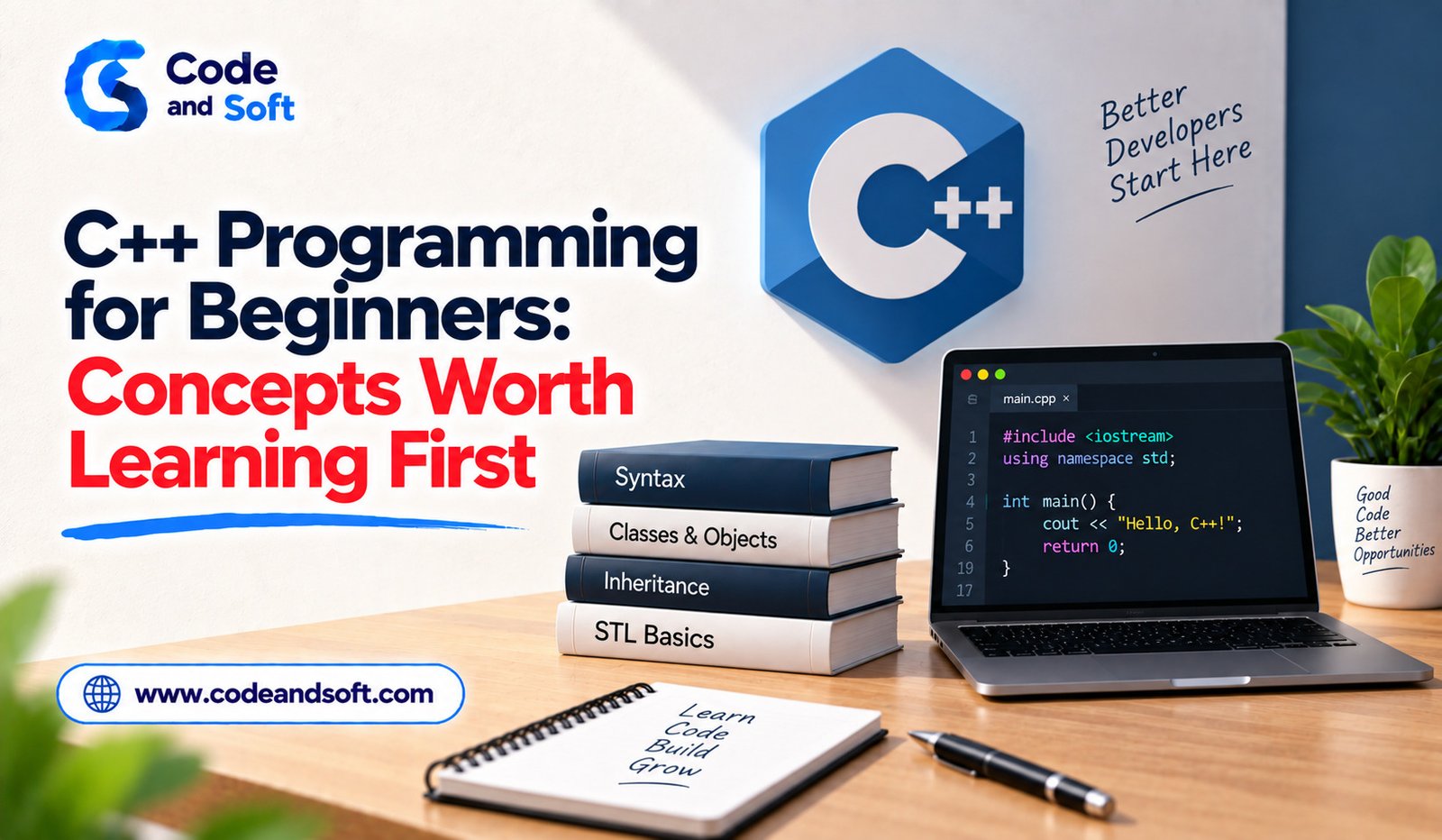
#include <iostream>
int main()
{
std::cout << “Hello, World!”;
return 0;
}
Students should become comfortable with concepts such as headers, functions, statements and the main() function.
It is also useful to understand that C++ source code is compiled before it can normally be executed. Learning the basic compile-and-run process gives beginners a better understanding of how their code becomes a working program.
Variables and Data Types
Variables are fundamental to almost every C++ program. They allow applications to store information that can be used and changed during execution.
C++ supports several common data types, including integers, floating-point values, characters and Boolean values.
For example:
int age = 20;
double price = 99.50;
char grade = ‘A’;
bool active = true;
Beginners should understand not only how to declare variables but also why choosing an appropriate type matters.
Data types influence the kind of information a variable can represent and how much storage may be required.
Understanding variables properly creates a foundation for learning arrays, functions, classes and more advanced data structures.
Operators and Expressions
Operators allow C++ programs to perform calculations, comparisons and logical operations.
Arithmetic operators are used for mathematical calculations, while comparison operators can determine relationships between values. Logical operators allow multiple conditions to be combined.
For example:
int age = 21;
if (age >= 18 && age <= 60)
{
std::cout << “Eligible”;
}
Beginners should also understand assignment, increment and decrement operations.
Learning operator precedence is useful as expressions become more complicated. Using parentheses can make the intended order of operations clearer and reduce mistakes.
Conditional Statements
Programs need to make decisions based on information. C++ provides conditional statements such as if, else if and else.
For example:
if (marks >= 80)
{
std::cout << “Excellent”;
}
else if (marks >= 50)
{
std::cout << “Pass”;
}
else
{
std::cout << “Needs improvement”;
}
The switch statement is another useful tool when a program needs to select from multiple known cases.
Learning conditions helps beginners develop logical thinking because they must determine exactly when each part of their program should execute.
Loops and Repetition
Loops allow programs to perform repetitive tasks efficiently.
C++ provides for, while and do-while loops.
A for loop is often useful when the number of repetitions is known:
for (int i = 1; i <= 5; i++)
{
std::cout << i << std::endl;
}
Beginners should practice loops by creating programs that calculate totals, display sequences, process arrays and repeat menu options.
It is also important to understand loop conditions carefully. A poorly designed condition can cause an infinite loop.
Functions and Modular Programming
Functions allow a large program to be divided into smaller sections.
Instead of placing every instruction inside main(), developers can create functions for specific tasks.
For example:
int add(int a, int b)
{
return a + b;
}
The function can then be called when its result is needed.
Beginners should learn about parameters, return values, function declarations and function calls.
Functions encourage modular programming and make applications easier to read, test and maintain.
Arrays and Strings
Arrays allow developers to store multiple values of the same type.
For example:
int scores[5] = {80, 75, 91, 68, 88};
Instead of creating separate variables for every score, the program can process the values using a loop.
Beginners should also learn how text can be represented and manipulated in C++. Modern C++ provides the std::string class, which is generally more convenient for beginners than manually handling character arrays.
Learning arrays and strings prepares students for more advanced topics such as searching, sorting and data structures.
Pointers and References
Pointers are an important part of C++, particularly for developers who want to understand memory and lower-level programming.
A pointer stores an address, while a reference provides another way to refer to an existing object.
Beginners do not need to master advanced pointer techniques immediately. They should first understand the basic relationship between variables, addresses and stored values.
References are particularly useful when passing objects to functions without making unnecessary copies.
Understanding pointers and references becomes increasingly important when studying dynamic memory, classes and advanced C++ programming.
Classes and Objects
One of the most important concepts that distinguishes C++ from basic procedural programming is object-oriented programming.
A class can combine data and functions into a single logical unit.
For example:
class Student
{
public:
std::string name;
void display()
{
std::cout << name;
}
};
An object can then be created from the class.
Classes allow developers to model concepts within a program and organize related data and behavior.
Beginners should first understand the basic relationship between classes and objects before moving into more advanced object-oriented concepts.
Encapsulation and Access Control
Encapsulation is another important C++ concept.
A class can control which parts of its implementation are accessible from outside code. C++ provides access specifiers such as public, private and protected.
For beginners, the key idea is that not every piece of data needs to be directly accessible.
Keeping internal details protected can make software easier to maintain and reduce accidental changes to an object’s state.
Inheritance and Polymorphism
After understanding classes and objects, beginners can move toward inheritance and polymorphism.
Inheritance allows one class to build upon another class. Polymorphism allows a common interface to represent different types of objects in appropriate situations.
These concepts are important in object-oriented design, but beginners should not rush into them before understanding classes, functions and access control.
A strong foundation makes advanced object-oriented programming much easier to understand.
The C++ Standard Library
One of the biggest advantages of C++ is its extensive Standard Library.
Beginners should gradually become familiar with commonly used components rather than trying to memorize everything.
Containers such as std::vector, std::map and std::set are especially useful because they provide ready-made ways to organize data.
Algorithms in the Standard Library can also perform common operations such as sorting and searching.
Learning to use the library effectively can help beginners write shorter, clearer and more reliable programs.
Exception Handling
C++ provides exception-handling mechanisms for dealing with certain types of errors and exceptional situations.
The basic concepts include try, catch and throw.
Beginners should first understand why error handling is necessary before focusing on advanced exception design.
Good programs should not simply assume that every operation will succeed. Learning to anticipate and handle failures is an important part of becoming a reliable developer.
File Handling
Once basic C++ concepts are comfortable, file handling is a useful next step.
Programs can read information from files and write data for later use. This introduces the idea of persistent information that remains available after the program finishes.
File handling can be combined with classes, strings and containers to create practical projects such as simple record-management applications and note-taking programs.
How Beginners Should Learn C++
Learning C++ effectively requires regular practice rather than simply reading explanations.
Start with small programs that use variables and conditions. Move to loops and functions, then practice arrays and strings. Once these fundamentals are comfortable, begin exploring classes, objects and the Standard Library.
Building small projects is particularly useful. A calculator, quiz application, student record system or simple inventory program can combine multiple concepts into one practical exercise.
Beginners should also learn to read compiler errors and warnings. Debugging is an essential programming skill, and mistakes are a normal part of the learning process.
Final Thoughts
C++ can seem challenging because it combines low-level programming capabilities with powerful high-level features. The solution is to learn its concepts progressively instead of trying to understand the entire language at once.
Variables, data types, operators, conditions, loops and functions should form the initial foundation. Arrays, strings, pointers and references can then expand a beginner’s understanding of data and memory. Classes, objects, encapsulation and other object-oriented concepts provide the next stage of learning.
The C++ Standard Library should also become part of a beginner’s toolkit because it provides practical solutions for common programming tasks.
Most importantly, beginners should write code regularly. Small projects, experimentation and debugging can turn theoretical knowledge into genuine programming ability. With a structured learning approach, C++ becomes far less intimidating and can provide a strong foundation for software development, computer science and problem-solving.