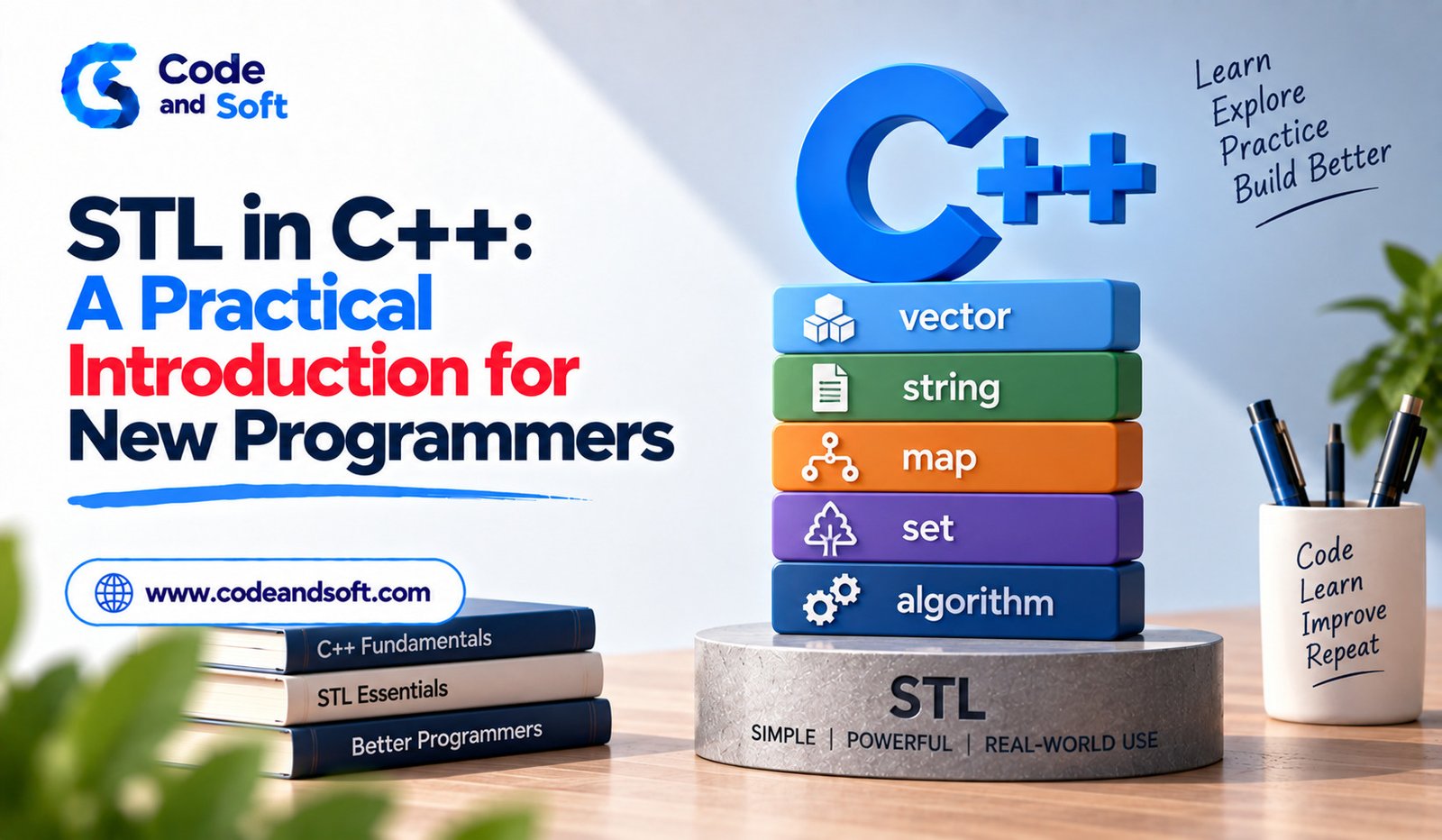
The Standard Template Library, commonly called STL, is one of the most useful parts of modern C++. It provides ready-to-use containers, algorithms, iterators and other programming tools that can save developers from writing common functionality from scratch.
For new C++ programmers, STL may initially seem confusing because it introduces concepts such as templates, iterators and generic programming. However, beginners do not need to learn the entire library at once. Understanding a few important components and learning when to use them can make C++ programming significantly easier.
STL is especially valuable when working with collections of data. Instead of manually creating complex structures for every program, developers can use established components such as vector, map, set and standard algorithms.
What Is STL in C++?
STL is a collection of generic programming components available as part of the C++ Standard Library.
Its most commonly discussed components include containers, algorithms and iterators. Together, these tools allow developers to store, access, search, sort and manipulate data efficiently.
For example, if a program needs to store a list of student marks, a developer could use std::vector instead of creating a custom dynamic array.
#include <iostream>
#include <vector>
int main()
{
std::vector<int> marks = {85, 72, 91, 68};
for (int mark : marks)
{
std::cout << mark << std::endl;
}
return 0;
}
This simple example already demonstrates one of STL’s biggest advantages: common programming tasks can be handled using reusable components.
Why Should Beginners Learn STL?
Learning STL helps new programmers write more practical C++ programs.
Without STL, beginners might spend a large amount of time implementing basic data structures and operations themselves. STL provides standard solutions that have already been designed for common programming requirements.
It also introduces developers to an important programming concept: reusable code.
Instead of thinking about how to build every tool from the beginning, programmers can learn how to select the appropriate component and use it correctly.
STL also becomes extremely useful when solving programming problems involving arrays, searching, sorting and data organization.
Understanding Vectors
std::vector is one of the best STL components for beginners to learn first.
A vector stores multiple elements and can grow or shrink as needed.
std::vector<int> numbers;
numbers.push_back(10);
numbers.push_back(20);
numbers.push_back(30);
The push_back() function adds an element to the end of the vector.
You can access elements using an index:
std::cout << numbers[0];
Vectors are useful when the number of elements may change during program execution.
For many beginner programs, a vector can be a convenient alternative to a traditional fixed-size array.
Working With Sets
A std::set is useful when a program needs to store unique values.
For example:
#include <set>
std::set<int> numbers;
numbers.insert(10);
numbers.insert(20);
numbers.insert(10);
Although 10 is inserted twice, a set keeps only one copy of the value.
Sets are useful for situations where duplicate values are not wanted and ordered storage is useful.
Beginners should understand that a set is different from a vector. A vector focuses on maintaining a sequence of elements, while a set is designed around unique values and efficient lookup.
Using Maps for Key-Value Data
A std::map stores information as key-value pairs.
For example, a program could associate student identification numbers with student names.
#include <map>
#include <string>
std::map<int, std::string> students;
students[101] = “Amit”;
students[102] = “Neha”;
The integer acts as the key, while the string represents the associated value.
Maps are useful when a program needs to retrieve information based on a unique key.
They can be useful in applications such as contact managers, inventory systems, configuration tools and record-management programs.
What Are Iterators?
Iterators provide a way to move through elements stored inside many STL containers.
For example:
std::vector<int> numbers = {10, 20, 30};
for (auto it = numbers.begin(); it != numbers.end(); ++it)
{
std::cout << *it << std::endl;
}
Here, begin() provides an iterator referring to the first element, while end() represents the position after the final element.
The expression *it accesses the element represented by the iterator.
Beginners may find iterators unusual at first. They become easier to understand when viewed as objects that allow a program to move through a container.
STL Algorithms
One of STL’s biggest strengths is its collection of algorithms.
Suppose a vector contains several numbers and the program needs to sort them. Instead of writing a sorting algorithm manually, the program can use std::sort.
#include <algorithm>
#include <vector>
std::vector<int> numbers = {50, 20, 40, 10, 30};
std::sort(numbers.begin(), numbers.end());
After the operation, the elements are arranged in ascending order.
Other algorithms can search, count, reverse or modify elements.
For example, std::find can search for a particular value:
auto result = std::find(numbers.begin(), numbers.end(), 40);
Using standard algorithms can make programs shorter and easier to maintain.
Understanding the Relationship Between Containers and Algorithms
A useful concept for beginners is that STL components are designed to work together.
A container stores data. An iterator provides a way to access that data. An algorithm performs an operation on the elements.
For example, a vector can store numbers, iterators can identify the range of elements, and std::sort can arrange those elements.
std::sort(numbers.begin(), numbers.end());
This design allows the same algorithm to work with different types of containers when their iterator requirements are satisfied.
It is one of the key ideas behind generic programming in C++.
Strings in the Standard Library
Although std::string is technically part of the broader C++ Standard Library rather than being a container such as vector or map, it is an important tool for new programmers.
A string provides a convenient way to work with text.
#include <string>
std::string name = “Rahul”;
std::cout << name.length();
Developers can combine strings with STL containers to create useful applications.
For example, a vector of strings can store names, while a map can associate usernames with other information.
Choosing the Right STL Container
Beginners do not need to memorize every STL container.
A good starting point is understanding the purpose of a few commonly used options.
Use vector when you need a flexible sequence of elements. Consider set when unique values are important. Use map when information needs to be organized through key-value relationships.
As programming experience increases, developers can explore other containers such as deque, list, unordered_map and unordered_set.
The important skill is not memorizing container names. It is understanding the problem and selecting a suitable data structure.
STL and Performance
STL can also help developers write efficient programs, but choosing the right component still matters.
Different containers have different performance characteristics. For example, repeatedly inserting data into one part of a collection may have different costs depending on the container being used.
Developers should therefore learn the basic behavior of the containers they use rather than assuming that every STL component performs the same way.
For beginner projects, correctness and clear code should come first. As programs become larger, understanding performance characteristics becomes increasingly valuable.
Practical Projects for Learning STL
The best way to learn STL is through small projects.
A student record application can use vectors to store records and maps to associate identification numbers with names. An expense tracker can use vectors to hold transactions. A contact manager can use maps for quick access to contact information.
A simple program that reads numbers, removes duplicates and sorts the remaining values can also provide excellent practice with vectors, sets and algorithms.
These projects allow beginners to understand why STL exists instead of simply memorizing syntax.
Common Beginner Mistakes
New programmers sometimes try to use the same container for every problem.
Another common mistake is modifying a container while iterating through it without understanding the rules surrounding iterator validity.
Beginners may also write custom implementations of common operations even when an STL algorithm already provides a suitable solution.
The goal should not be to avoid writing code. Instead, programmers should learn when writing custom logic is necessary and when an existing standard component is the better choice.
How to Learn STL Step by Step
A practical learning sequence can make STL much easier.
Start with std::vector and learn how to add, access and remove elements. Then explore std::string and basic algorithms such as sorting and searching.
After that, learn set and map. Once these components become comfortable, study iterators and the relationship between containers and algorithms.
Later, developers can explore more advanced STL components and concepts such as lambda expressions, custom comparison functions and unordered containers.
This gradual approach prevents beginners from becoming overwhelmed by the size of the library.
Final Thoughts
STL is an essential part of modern C++ programming because it provides reusable tools for storing and processing data.
For new programmers, vector, set, map, iterators and common algorithms are excellent starting points. These components can be used together to create cleaner and more practical programs without requiring developers to reinvent common data structures and operations.
The most effective way to learn STL is through practice. Build small applications, experiment with different containers and compare how different approaches solve the same problem.
Once the basics become familiar, STL can significantly improve both the productivity and quality of C++ programming. More importantly, learning STL helps beginners develop a better understanding of data structures, algorithms and generic programming—skills that remain valuable as they move toward more advanced C++ development.