
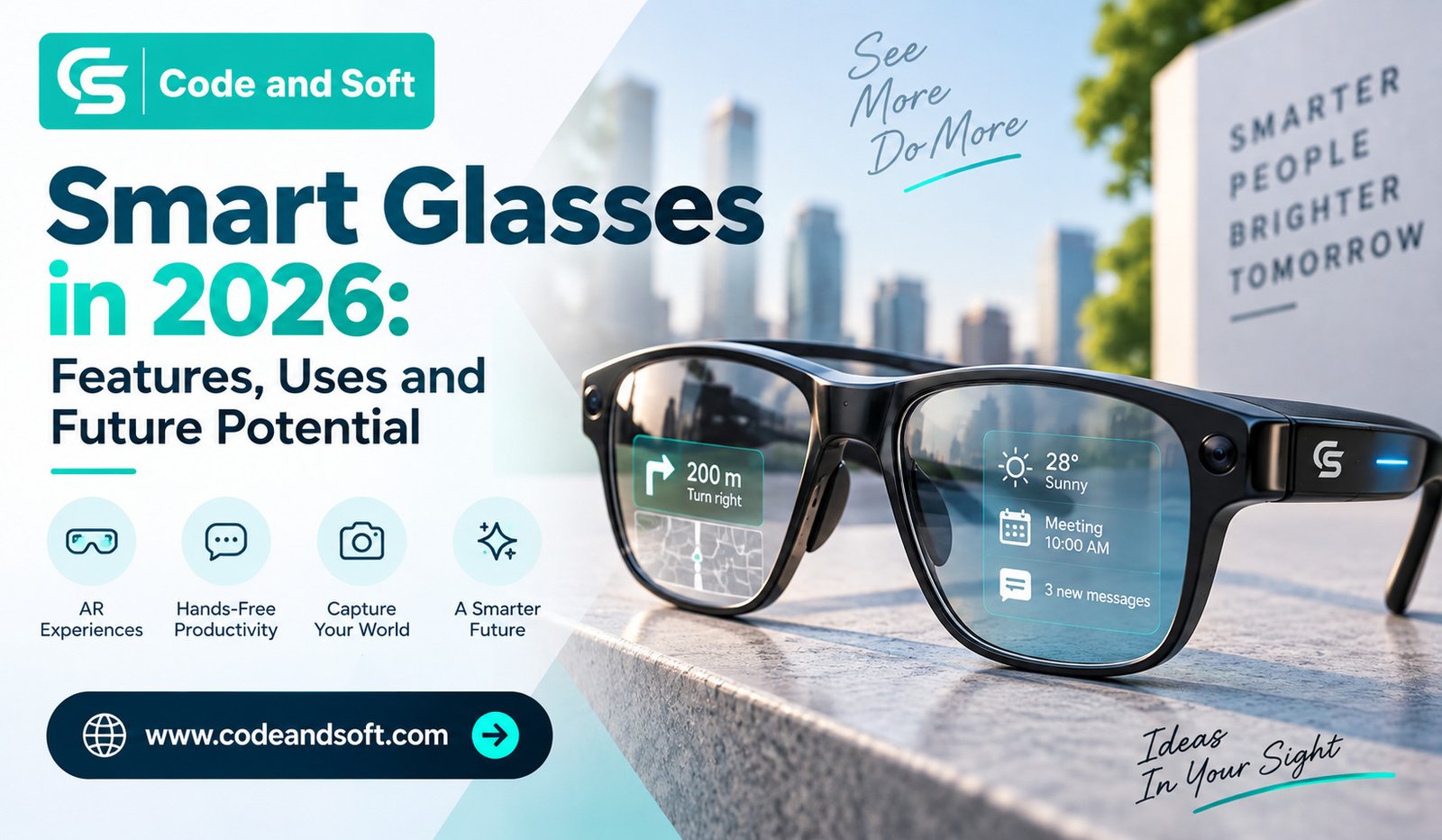

Technology is becoming less about the devices you carry and more about the technology you can wear. You have already seen smartwatches replace some phone functions, wireless earbuds become everyday accessories, and voice assistants become part of daily routines. Now, another category is gaining attention: smart glasses.
Smart Glasses in 2026 are moving beyond the idea of simply putting a tiny screen in front of your eyes. Newer models are becoming more capable, connected and practical, combining cameras, microphones, speakers, artificial intelligence and sensors in a familiar glasses-like design.
If you are curious about where wearable technology is heading, smart glasses are worth watching. They could eventually change how you communicate, navigate, capture memories, consume information and interact with digital assistants.
What Are Smart Glasses?
Smart glasses are wearable devices designed to look and function somewhat like regular glasses while adding digital capabilities. Depending on the model, you can use them to take photos and videos, listen to audio, make calls, interact with an AI assistant, receive notifications or access information without constantly reaching for your smartphone.
Unlike traditional augmented reality headsets, many modern smart glasses do not necessarily place a large virtual display over everything you see. Instead, they focus on hands-free interaction through cameras, speakers, microphones, voice controls and AI.
This makes them more comfortable for everyday use. You can wear them while walking, travelling, working or socialising without feeling like you are wearing a bulky computer on your face.
Why Smart Glasses in 2026 Are Getting More Attention
One of the biggest reasons smart glasses are becoming more interesting is the rapid improvement in artificial intelligence.
Previously, wearable devices often had limited capabilities because their hardware and software were not powerful enough to understand natural conversations or complex surroundings. AI is changing that.
Your smart glasses can potentially understand what you are looking at, respond to questions, describe objects, translate information and help you complete everyday tasks.
Imagine walking through a new city and asking your glasses for directions. Instead of pulling out your phone, you can interact through your voice while keeping your attention on your surroundings.
Similarly, if you see a product, landmark or unfamiliar object, you may be able to ask your glasses what it is and receive an answer almost immediately.
This combination of AI and wearable hardware is one of the biggest developments shaping Smart Glasses in 2026.
Key Features You Can Expect
Smart glasses vary considerably depending on their price and purpose, but several features are becoming common across the category.
1. Built-In Cameras
Cameras are among the most noticeable features in modern smart glasses.
You can use them to capture photographs and short videos from your own point of view. This can be particularly useful when you want to record a moment without holding a phone.
For example, you could record a cycling trip, a family gathering or a travel experience while keeping both hands free.
The challenge is privacy. Because people around you may not always know when you are recording, responsible use and clear recording indicators will remain important.
2. AI Assistants
AI could become the defining feature of smart glasses.
Instead of opening an application on your phone, you can simply speak to your glasses. You might ask a question, request information about your surroundings or ask the device to help with a task.
As AI models become more capable, your glasses could potentially understand context rather than simply responding to individual commands.
That means the experience can feel more like having a digital assistant available whenever you need it.
3. Audio Without Traditional Earbuds
Many smart glasses use built-in speakers positioned near your ears.
This allows you to listen to music, podcasts, navigation instructions or phone calls without inserting earbuds.
For you, this can be convenient when you want to stay aware of your surroundings. You can still hear traffic, conversations and environmental sounds while receiving audio from your glasses.
Audio quality and sound leakage will continue to be important factors, especially in noisy environments.
4. Hands-Free Calling
Smart glasses can also work as an extension of your smartphone.
With built-in microphones and speakers, you can make and receive calls without taking your phone out of your pocket.
This can be particularly useful when you are walking, cooking, working or carrying something.
Voice controls can make the process even simpler, allowing you to perform basic tasks without touching the device.
5. Real-Time Translation
Language translation is another area where smart glasses could become genuinely useful.
Imagine travelling in another country and seeing a sign written in a language you do not understand. Instead of taking out your phone and using a translation app, your glasses could potentially recognise the text and provide translated information.
Real-time spoken translation could make conversations between people speaking different languages easier as well.
While accuracy will depend heavily on software, internet connectivity and supported languages, this is an area with significant potential.
6. Navigation Assistance
Navigation is one of the most natural applications for wearable technology.
Your smartphone already provides maps, but checking a phone while walking or cycling can be inconvenient and distracting.
Smart glasses can deliver navigation instructions through audio, while future display-equipped models could potentially provide visual directions within your field of view.
This could make exploring unfamiliar places more comfortable and intuitive.
How You Could Use Smart Glasses in Everyday Life
The usefulness of Smart Glasses in 2026 depends largely on how well they fit into your existing routine.
For communication, you can use them for calls, messages and voice-based interactions.
For entertainment, you can listen to music, podcasts and other audio content without reaching for your phone.
For travel, they can assist with navigation, translation and capturing photos.
For work, smart glasses could help you access information while keeping your hands available for physical tasks.
You may also find them useful for documenting everyday experiences. Instead of stopping to pull out your smartphone every time something interesting happens, you can capture it directly through your glasses.
That first-person perspective can make photos and videos feel more natural.
Smart Glasses for Work and Professional Use
The potential of smart glasses extends well beyond consumers.
Businesses can use wearable technology for training, remote assistance, maintenance and fieldwork.
Imagine a technician working on a complex machine. Instead of repeatedly checking a manual, the technician could receive instructions while keeping both hands available.
In healthcare, smart glasses could potentially provide professionals with hands-free access to information, although applications involving sensitive medical data require strict privacy and security controls.
In warehouses and logistics, wearable devices could assist workers with inventory information, picking instructions and navigation.
These applications show why smart glasses could become more than another consumer gadget.
What About Augmented Reality?
When you hear about smart glasses, you might immediately imagine holograms and digital objects floating around you.
That is the promise of augmented reality, but not every pair of smart glasses works this way.
Some products focus primarily on cameras, microphones, speakers and AI. Others are designed with displays capable of showing digital information in your field of view.
Display technology remains one of the biggest challenges.
A useful AR experience needs a display that is bright enough outdoors, sharp enough to read, power-efficient and comfortable to wear. It also needs to fit into a relatively small and lightweight frame.
As these technologies improve, you could see more smart glasses offering genuinely useful visual overlays rather than simply notifications.
Battery Life Could Still Be a Challenge
There is one problem that smart glasses cannot easily escape: battery life.
You expect your regular glasses to work all day because they do not require power. Smart glasses have to power cameras, microphones, speakers, processors, wireless connections and sometimes displays.
Adding more features generally means consuming more energy.
Manufacturers therefore need to balance functionality with weight and battery capacity. Nobody wants smart glasses that are impressive for a few hours but require frequent charging.
Better processors, improved batteries and more efficient AI processing could gradually make all-day use more realistic.
Privacy and Security Concerns
The growth of Smart Glasses in 2026 also raises important questions about privacy.
A camera on your face is fundamentally different from a camera you deliberately point at something. People around you may not know whether they are being photographed or recorded.
AI introduces another layer of concern because smart glasses may process information about your surroundings, conversations or visual environment.
You should therefore pay attention to privacy indicators, data policies, permissions and recording controls when choosing a smart glasses product.
Manufacturers will need to make privacy features easy to understand rather than hiding them behind complicated settings.
Are Smart Glasses Going to Replace Your Smartphone?
Probably not in the immediate future.
Your smartphone remains far more versatile. It has a large screen, powerful applications, extensive storage and a mature ecosystem.
Smart glasses are more likely to complement your phone than completely replace it.
Think of them as a quick-access layer between you and your digital world. For short interactions, voice commands, calls, navigation, photos and AI assistance, glasses can be more convenient.
For tasks requiring a large screen, detailed editing, gaming or extensive typing, your phone, tablet or computer will still have an advantage.
Over time, however, the balance could change as wearable hardware becomes more capable.
The Future Potential of Smart Glasses
The long-term potential is perhaps the most exciting part.
Future smart glasses could become more personalised and context-aware. Instead of waiting for you to issue every command, they may be able to provide useful information based on what you are doing.
You could walk into a meeting and receive relevant information about the people attending. You could visit a tourist attraction and receive historical details. You could work on a repair task and get step-by-step guidance.
Display technology could also improve significantly, making digital information feel more naturally integrated with your surroundings.
At the same time, smaller components and better battery technology could make smart glasses look increasingly similar to ordinary eyewear.
That could be the point where the category becomes truly mainstream.
What You Should Look For Before Buying
If you are considering smart glasses, do not judge them only by their appearance.
Check the camera quality if photography matters to you. Look at microphone performance if you expect to make calls. Pay attention to speaker quality, battery life, comfort and smartphone compatibility.
AI features are also worth examining carefully. Some capabilities may require an internet connection or a companion app, while certain advanced features may depend on a subscription.
You should also consider privacy controls and how easily you can disable cameras or microphones when necessary.
Most importantly, think about how you would actually use the glasses. A long feature list does not mean much if the device does not solve a problem in your daily routine.
Final Thoughts
Smart Glasses in 2026 are becoming more practical because several technologies are finally coming together. AI, cameras, voice recognition, wireless connectivity, audio and compact sensors are making wearable computing more useful than it was a few years ago.
You may not replace your smartphone with smart glasses anytime soon, but you can already see where the technology is heading.
The biggest opportunity is not simply putting technology in front of your eyes. It is making digital assistance feel natural, immediate and hands-free.
If manufacturers can improve battery life, privacy, comfort and AI capabilities while keeping designs close to normal eyewear, smart glasses could move from an interesting gadget to an everyday computing device.
For you as a technology user, that could mean spending less time looking down at a screen and more time interacting naturally with the world around you.