

For years, your smartwatch has been the gadget sitting quietly on your wrist, counting your steps, tracking your workouts, showing notifications, and occasionally reminding you to stand up. It has become so familiar that it is easy to assume wearable technology has already reached its final form.
But it hasn’t.
The next stage of wearable technology could look very different from the smartwatch you use today. Instead of simply displaying information, your wearable may understand what you are doing, respond to your voice, learn your habits, and help you complete tasks without constantly asking you to look at a screen.
This is where AI Wearables come into the picture.
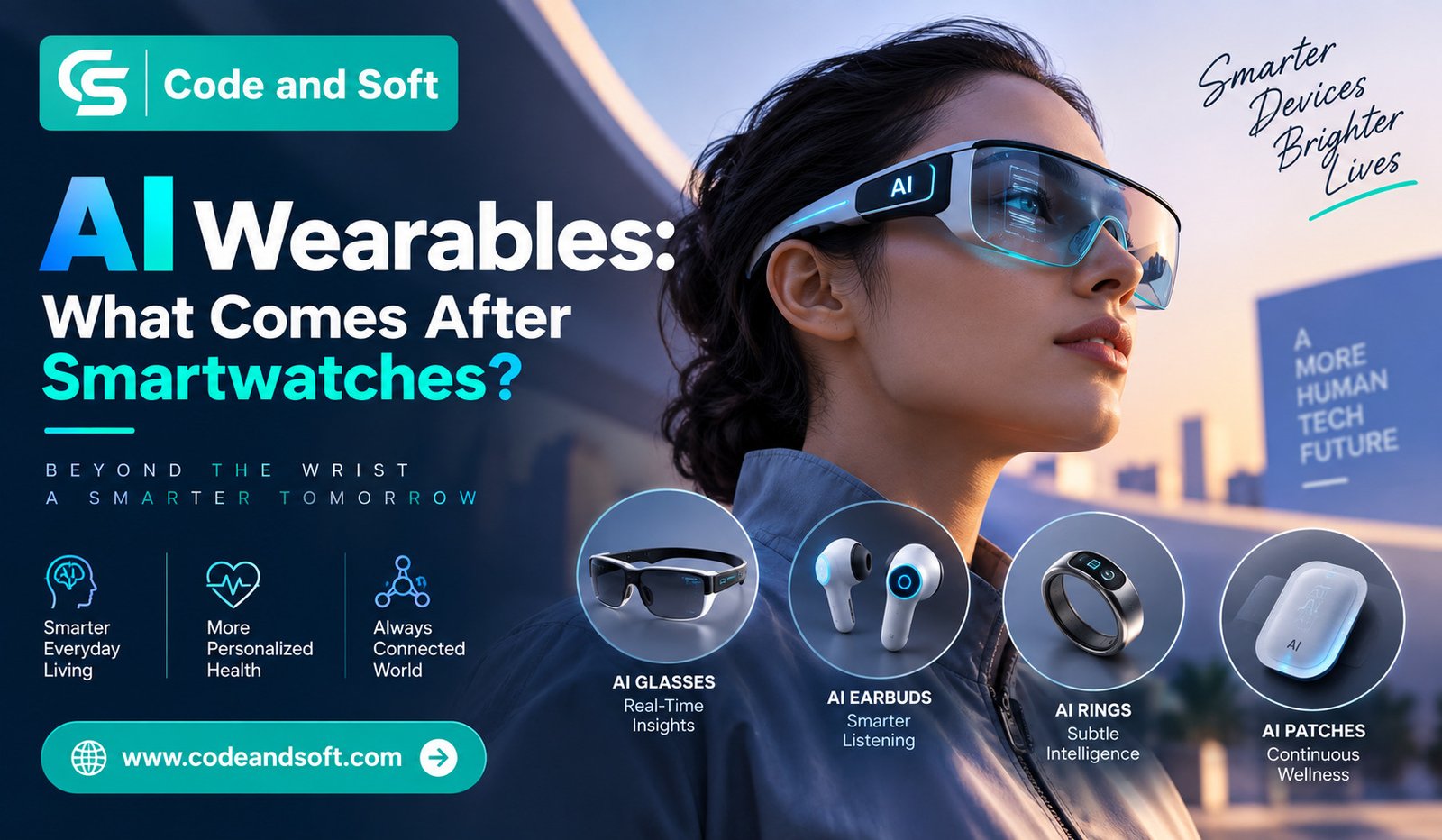
AI-powered glasses, smart rings, intelligent earbuds, AI pins, and other emerging devices are pushing wearable technology beyond the traditional smartwatch. The focus is gradually moving from displaying information on a tiny screen to providing assistance in a more natural and personal way.
So, what exactly comes after smartwatches, and how could AI change the way you interact with your devices?
What Are AI Wearables?
AI Wearables are wearable devices that use artificial intelligence to understand information, process commands, recognize patterns, and provide personalized assistance.
Unlike conventional wearables that mainly collect and display data, AI-powered devices can potentially interpret that data and act on it.
For example, your smartwatch might tell you that you walked 8,000 steps today. An AI wearable could go a step further by understanding your usual activity level, noticing that you have been less active recently, and suggesting a short walk based on your routine.
The difference may seem small, but it represents a major shift.
You are moving from a device that simply records information to a device that can understand and assist.
AI Wearables can include several types of products, such as:
- AI-powered smart glasses
- Smart rings with intelligent features
- AI-enabled earbuds
- Voice-controlled wearable assistants
- AI pins and screenless devices
- Smart clothing and sensors
- Advanced health and fitness wearables
Each category approaches wearable computing differently, and some could eventually become more important than smartwatches.
Why Could Smartwatches Become Less Important?
That doesn’t mean your smartwatch is going away anytime soon. Smartwatches are already deeply integrated into smartphones, fitness platforms, payment systems, navigation, and communication.
However, one limitation remains: you still need to look at the screen.
If you want to read a message, check directions, change a setting, or interact with an app, you usually need to raise your wrist and focus on the display.
AI Wearables are exploring another approach.
Imagine walking through a new city while wearing AI glasses. Instead of repeatedly checking your phone for directions, information could appear within your field of view or be delivered through audio.
Or imagine wearing AI earbuds that understand a conversation and provide useful information when you need it.
In these situations, the technology becomes less noticeable.
That could be the biggest change after smartwatches: technology that works around you instead of demanding your attention.
AI Glasses Could Become the Next Major Wearable
Among emerging AI Wearables, smart glasses have perhaps the clearest potential to challenge the smartwatch.
You can wear glasses naturally throughout the day, making them an interesting platform for AI assistants.
Future AI glasses could potentially recognize objects, translate signs, summarize conversations, provide navigation assistance, answer questions, capture photos, and interact with digital services.
The important part is that you may not need to pull out your phone.
For example, you could look at a restaurant menu and ask your glasses which dishes are popular. You could look at a landmark and ask for information about it. During a conversation in another language, your wearable could potentially help you understand what is being said.
The technology still has limitations, including battery life, privacy concerns, processing requirements, and social acceptance. But glasses have one major advantage: they sit naturally in front of your eyes.
That makes them a strong candidate for the next generation of personal computing.
Smart Rings: Smaller Devices With Bigger Potential
If glasses focus on what you see, smart rings focus heavily on what your body is doing.
Smart rings are already becoming popular for tracking health and fitness information without putting a screen on your wrist.
You can use them to monitor metrics such as sleep, activity, heart rate, and other wellness-related measurements, depending on the device.
AI could make these measurements more useful.
Instead of presenting dozens of numbers, an AI-powered ring could analyze patterns over time and turn them into understandable insights. You might receive a simple explanation of how your recent sleep, activity, and daily routine are changing.
That makes the wearable less about collecting data and more about interpreting it.
For you, that could mean fewer charts and more useful recommendations.
AI Earbuds Could Become Personal Assistants
Your earbuds already do much more than play music.
They can answer calls, connect to voice assistants, cancel background noise, and interact with your smartphone. Adding more advanced AI capabilities could turn them into highly practical everyday assistants.
Imagine asking your earbuds to summarize an incoming message, translate a sentence, explain something you just heard, or remind you about an upcoming task.
Because earbuds are already designed for voice interaction, they don’t need a large display.
This could make them one of the most natural forms of AI Wearables.
You could simply speak, listen, and continue what you were doing.
The Screenless Wearable Revolution
One of the most interesting developments in wearable technology is the movement toward screenless devices.
Smartwatches introduced miniature screens to your wrist. The next generation may decide that screens are not always necessary.
Instead, AI Wearables could rely on:
- Voice commands
- Audio responses
- Cameras
- Sensors
- Gesture controls
- Smartphone connectivity
- Cloud-based AI
- On-device AI processing
This approach could reduce the amount of time you spend staring at screens.
Think about how often you unlock your phone just to perform a tiny task. You might check the weather, set a timer, respond to a short message, or look up a quick fact.
A capable AI wearable could eventually handle many of these tasks without requiring you to open your phone.
Personalization Will Be the Real Game Changer
Hardware alone won’t determine the success of AI Wearables.
The real advantage could come from personalization.
Your wearable could gradually learn how you communicate, travel, work, exercise, and organize your day. Instead of giving everyone the same experience, it could adapt to your habits.
For example, if you normally leave for work at a certain time, an AI assistant could understand that routine. If traffic suddenly becomes heavier, it could alert you and suggest leaving earlier.
Similarly, your wearable could recognize patterns in your daily activity and present information when it is actually useful rather than constantly sending notifications.
This could make AI Wearables feel less like gadgets and more like personal assistants.
Privacy Will Become a Major Concern
The more intelligent your wearable becomes, the more information it may have access to.
Cameras, microphones, location data, health information, conversations, and personal routines can all be extremely sensitive.
That creates an important question: How much of your life are you comfortable sharing with an AI-powered device?
AI Wearables will need strong privacy controls if they are going to become everyday products.
You should be able to understand what your device is recording, where that information is processed, how long it is stored, and which services can access it.
Manufacturers will also need to think carefully about privacy beyond the person wearing the device. A pair of AI glasses with a camera, for example, could capture other people without them realizing it.
Convenience may drive adoption, but privacy could determine whether people actually trust these devices.
Battery Life Could Decide the Winners
There is another practical problem that AI Wearables must solve: battery life.
AI processing, cameras, sensors, wireless connectivity, and continuous monitoring can consume significant power.
You don’t want a wearable assistant that needs charging several times a day.
Future devices will likely depend on more efficient chips, improved batteries, better power management, and a balance between on-device and cloud-based AI processing.
The companies that can combine useful AI features with reliable all-day battery life will have a significant advantage.
Will AI Wearables Replace Your Smartwatch?
Probably not immediately.
Instead, you could see a period where different wearables work together.
Your smartwatch might remain useful for fitness tracking, notifications, payments, and quick interactions. Your smart glasses could handle visual information and navigation. Your earbuds could provide voice-based assistance, while a smart ring could focus on health and activity tracking.
Your smartphone could continue acting as the central hub connecting everything.
Over time, however, some people may decide that they don’t need a smartwatch at all.
If AI glasses and earbuds can provide enough functionality without a wrist-mounted screen, the smartwatch may become one option rather than the default wearable.
What Comes After Smartwatches?
The future of wearable technology isn’t necessarily about putting more features into a smaller watch.
It could be about spreading intelligence across different devices that work together.
Your glasses could help you see and understand the world. Your earbuds could help you communicate. Your ring could monitor your activity. Your phone could handle heavier computing tasks. AI could connect all of these experiences and make them feel like one personal assistant.
That is the bigger promise of AI Wearables.
The next generation of wearable technology may not look like a dramatic replacement for your smartwatch. Instead, it could gradually become something you barely think about.
And that may ultimately be the point.
The most successful wearable of the future may not be the device with the biggest screen or the longest list of features. It could be the one that understands what you need, responds naturally, stays out of your way, and helps you get things done without making you feel like you are constantly using technology.
Smartwatches made computing wearable.
AI Wearables could make computing almost invisible.