
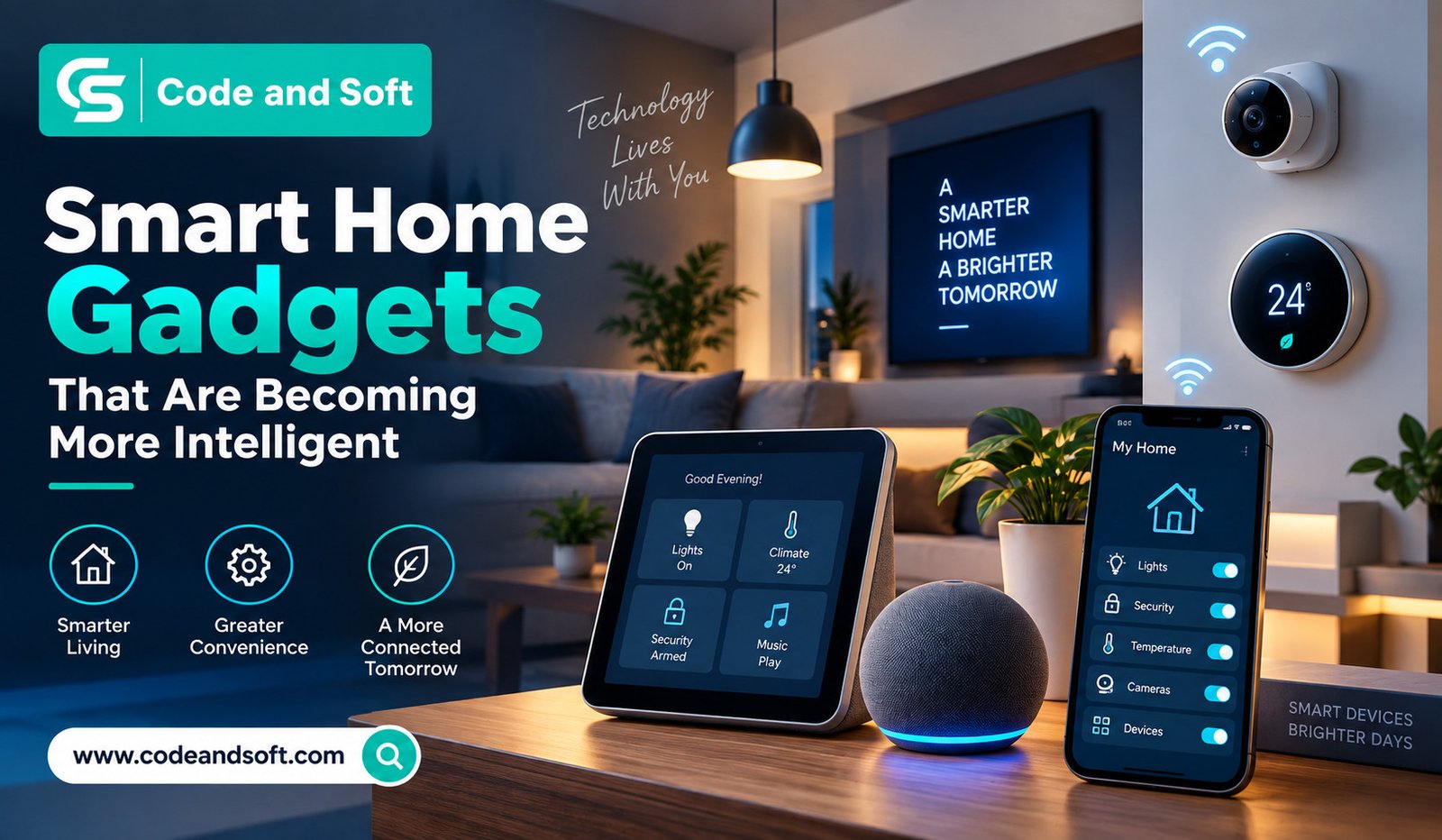

Your home is no longer just a place where you live. It is gradually becoming a space that can understand your habits, respond to your needs, and even make everyday decisions for you. From lights that adjust themselves to cameras that recognize familiar faces, technology is changing the way you interact with your living space.
The interesting part is that Smart Home Gadgets are moving beyond simple remote controls and voice commands. Earlier, you had to tell a smart device what to do. Now, many devices can learn from your routines and react accordingly.
Whether you are setting up your first smart home or already have several connected devices, you are likely to notice how quickly this technology is evolving. Here are some of the smart home gadgets that are becoming more intelligent and what you can expect from them.
1. Smart Speakers Are Becoming More Helpful
Smart speakers were among the first connected devices to become popular in homes. You could ask them about the weather, play music, set an alarm, or control compatible devices.
Today, smart speakers are becoming much more useful.
Instead of simply responding to a specific command, newer generations of voice assistants are moving toward more natural conversations and contextual responses. This means you can interact with your devices in a way that feels less like operating a machine and more like having a conversation.
For example, you might ask your smart speaker to turn off the lights and then follow up with another request without repeating the context.
You can also connect your speaker with other Smart Home Gadgets, allowing you to control lighting, entertainment systems, thermostats, plugs, and other devices from one place.
2. Smart Lighting Can Learn Your Routine
Smart bulbs and lighting systems are no longer limited to changing colors or turning on and off through an app.
Your lighting can now become part of your daily routine.
You can create schedules that turn lights on before you wake up, reduce brightness in the evening, or switch off automatically when you leave home. Some systems can also react to motion, ambient light, or your preferred settings.
Imagine returning home after sunset and having your hallway lights automatically switch on. You don’t have to reach for your phone or flip a switch.
You can also create different lighting scenes for working, watching movies, reading, or relaxing. Over time, these small changes can make your home feel more comfortable while helping you avoid unnecessary energy consumption.
3. Smart Thermostats Are Getting Better at Understanding You
Temperature control is another area where smart technology is becoming more practical.
Traditional thermostats generally follow the temperature you set. Smart thermostats can go a step further by learning your preferences and routines.
If you usually lower the temperature before going to bed, for example, the system can learn that pattern. Some connected systems can also use occupancy information and environmental data to adjust heating or cooling.
You can control the temperature remotely when you are away, which can be particularly useful if your plans change.
The bigger advantage is convenience. Instead of constantly adjusting the temperature yourself, you can allow the system to make routine adjustments automatically.
4. Robot Vacuum Cleaners Are Learning Their Way Around Your Home
Robot vacuum cleaners have changed significantly since they first appeared.
Earlier models mostly moved around randomly and could struggle with furniture, corners, or obstacles. Newer models are increasingly capable of mapping rooms, recognizing objects, planning cleaning routes, and avoiding obstacles.
This means you can leave your robot vacuum to clean while you focus on other things.
Some advanced models can recognize different floor types and adjust their cleaning behavior accordingly. Others can combine vacuuming and mopping, while their companion apps allow you to create room-specific cleaning schedules.
You may even be able to tell the robot to clean a particular room rather than running the same cleaning cycle throughout the entire house.
For busy households, this is one of those Smart Home Gadgets that can save a surprising amount of time.
5. Smart Security Cameras Are Becoming More Aware
Home security cameras are becoming considerably more intelligent.
A basic camera simply records what is happening. Intelligent security cameras can analyze what they see and send more specific alerts.
For instance, instead of receiving constant notifications whenever something moves, you may receive an alert when a person is detected. Some systems can distinguish between people, pets, vehicles, and other types of movement.
This can make security notifications less annoying and more useful.
You can also check live footage from your smartphone, communicate through two-way audio, and receive alerts when unusual activity is detected.
However, as these cameras become smarter, privacy becomes increasingly important. Before buying one, you should check how recordings are stored, what data is collected, and what security features are available.
6. Smart Doorbells Are Doing More Than Showing You Who Is Outside
A smart doorbell can turn your front door into another connected part of your home.
When someone approaches your door, the device can send an alert to your phone. Depending on the model, you may be able to see the visitor, communicate with them, or review previous activity.
Intelligent detection is also becoming an important feature. Instead of notifying you about every movement, some systems can focus on relevant activity around your entrance.
This becomes particularly useful when you receive deliveries while you are away.
You can check whether a package has arrived without physically being at home, making a smart doorbell more than just a digital replacement for a traditional doorbell.
7. Smart Plugs Are Becoming Surprisingly Useful
Smart plugs may look simple, but they can make ordinary appliances smarter.
You can connect a lamp, fan, coffee maker, or another compatible appliance to a smart plug and control it through an app or voice assistant.
You can also create schedules. For example, you could have a lamp switch on at a specific time every evening or turn off automatically when you normally leave for work.
Some smart plugs also provide energy monitoring, allowing you to understand how much electricity a connected appliance consumes.
This gives you a relatively inexpensive way to add smart functionality without replacing all your existing appliances.
8. Smart Refrigerators Are Becoming More Connected
Your refrigerator might not be the first gadget you think of when you hear about smart technology, but manufacturers are adding increasingly advanced features to connected refrigerators.
Depending on the model, you may get internal cameras, temperature monitoring, alerts, inventory-related features, and app connectivity.
The idea is to give you more information about what’s happening inside your refrigerator without opening the door repeatedly.
Some systems can help you keep track of food and receive reminders. While these features may not be essential for everyone, they show how everyday appliances are gradually becoming connected computing devices.
9. Smart Air Purifiers Can Respond to Your Environment
Air purifiers are also becoming more intelligent.
Instead of running at one fixed speed, connected air purifiers can monitor air quality and automatically adjust their performance.
If the air quality worsens, the purifier can increase its cleaning level. Once conditions improve, it can reduce its operation.
You can also monitor air-quality information through a smartphone app and receive alerts when conditions change.
For you, this means less manual adjustment and a better understanding of the environment inside your home.
10. Smart Home Hubs Are Bringing Everything Together
As you add more devices to your home, managing them individually can become complicated. That’s where smart home hubs and centralized platforms become important.
Instead of opening separate apps for your lights, cameras, thermostat, plugs, and other devices, you can increasingly manage compatible gadgets from a central system.
Automation is where things get particularly interesting.
You could create a “Good Night” routine that switches off selected lights, locks compatible doors, adjusts the temperature, and activates security devices with a single command.
The goal is no longer simply to connect devices. It is to make those devices work together.
Why Smart Home Gadgets Are Becoming More Intelligent
The biggest change is the shift from automation based on commands to automation based on context.
Previously, you had to tell a device what to do. Increasingly, devices can use sensors, schedules, location information, and learned patterns to determine what action makes sense.
That can make your home feel more responsive.
However, smarter technology also means you need to think carefully about privacy and security. Your connected devices can collect information about your routines, movements, preferences, and home environment.
You should therefore use strong passwords, enable available security features, keep device software updated, and understand what information your devices collect.
What the Future of Smart Homes Could Look Like
The next stage of smart home technology is likely to focus less on individual gadgets and more on how everything works together.
You may eventually have a home where lighting, climate control, security, entertainment, and appliances respond to your routines with minimal input.
For you, the biggest benefit may not be having dozens of futuristic gadgets. It could simply be having a home that requires fewer small decisions throughout the day.
Your lights can handle the schedule. Your vacuum can handle routine cleaning. Your thermostat can manage the temperature. Your security system can watch for unusual activity.
That is what makes the future of Smart Home Gadgets particularly interesting. The technology is becoming less about showing off what a device can do and more about quietly making your everyday life easier.
Final Thoughts
Smart home technology is moving quickly, and the definition of a “smart” device is changing along with it. A gadget that once needed constant instructions can now learn routines, recognize patterns, communicate with other devices, and respond to changing conditions.
You don’t have to turn your entire house into a futuristic showroom to benefit from these developments. Starting with a smart speaker, lighting system, security camera, robot vacuum, or smart plug can be enough to experience the convenience.
As these technologies continue to improve, your home may become less dependent on manual controls and more capable of anticipating what you need. The smartest home, after all, may not be the one filled with the most gadgets—it may be the one where technology works quietly in the background and makes your everyday routine a little easier.