
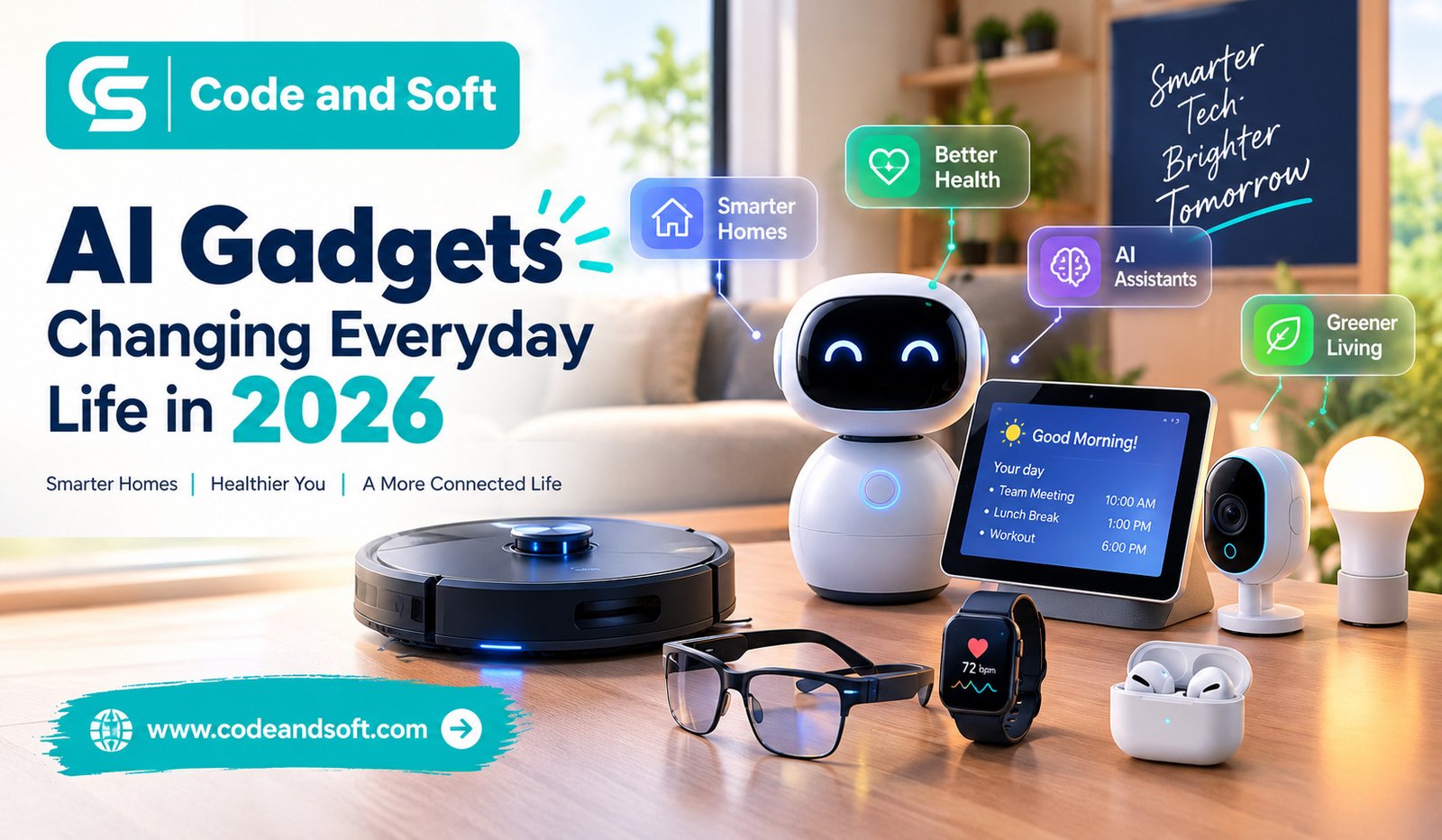

Artificial intelligence is no longer something you only associate with chatbots, smartphones, or futuristic movies. In 2026, AI is quietly becoming part of the gadgets you use every day. From smart glasses and AI-powered earbuds to intelligent home devices and personal health trackers, technology is becoming more responsive to the way you live.
The interesting part is that you don’t always have to tell these devices what to do. Many of today’s AI Gadgets can understand your habits, recognize what you need, and provide useful information at the right moment.
You might already be using AI without realizing how deeply it has entered your routine. Your phone can summarize conversations, your earbuds can translate languages, your smartwatch can interpret health data, and your home devices can automate everyday tasks.
So, what exactly is changing in 2026? Let’s look at how AI-powered gadgets are making everyday life more convenient, connected, and personalized.
What Are AI Gadgets?
AI gadgets are electronic devices that use artificial intelligence to understand information, recognize patterns, make recommendations, or respond intelligently to your commands.
Traditional gadgets generally wait for you to give them instructions. AI-powered devices can go a step further. They can learn from interactions, process information, and sometimes predict what you may need next.
For example, instead of simply counting your steps, an AI-enabled wearable may analyze your activity, sleep, heart-rate patterns, and daily routine to provide more personalized insights.
Similarly, AI earbuds aren’t limited to playing music. They can potentially assist with calls, noise management, voice commands, and real-time language translation.
This shift from “you control the gadget” to “the gadget understands you” is one of the biggest technology trends of 2026.
1. AI Smart Glasses Are Becoming More Useful
Smart glasses have moved beyond being a novelty. In 2026, AI is making them considerably more practical for everyday situations.
With cameras, microphones, speakers, and AI processing, smart glasses can act like a hands-free digital assistant. You can ask questions, identify objects, get information about something you’re looking at, or receive directions without constantly taking your smartphone out of your pocket.
Imagine walking through a new city and asking your glasses where a particular location is. Or you see a product in a store and want quick information about it. Instead of stopping to search manually, you can interact with your glasses using your voice.
For you, the biggest advantage is convenience. Your information stays within your immediate surroundings rather than requiring you to look down at a screen every few minutes.
Privacy will remain an important consideration, particularly for glasses equipped with cameras. But as the technology matures, AI smart glasses could become one of the most noticeable categories of AI Gadgets.
2. AI Earbuds Are Doing More Than Playing Music
Wireless earbuds have become everyday accessories, but AI is giving them a new role.
Modern AI-enabled earbuds can help you manage calls, understand spoken commands, reduce unwanted background sounds, and provide more intelligent audio experiences.
One particularly interesting development is translation. AI-powered earbuds can assist conversations between people speaking different languages by processing speech and translating it almost instantly.
You can also expect AI to improve how earbuds handle your surroundings. Instead of simply switching between noise cancellation and transparency modes manually, intelligent audio systems can adapt to different environments.
For example, when you’re on a busy street, your earbuds may prioritize awareness of surrounding sounds. When you’re sitting on a flight, they can focus more heavily on reducing background noise.
The result is a more personalized listening experience that changes according to what you’re doing.
3. AI Smartwatches Are Becoming Personal Health Assistants
Smartwatches have already changed how you track fitness. In 2026, AI is making the information collected by these devices more useful.
Your smartwatch can collect data such as heart rate, sleep patterns, physical activity, workouts, and other wellness indicators. AI can analyze these different data points together instead of showing you isolated numbers.
For example, rather than simply telling you that you slept for seven hours, an intelligent wearable could help identify patterns in your sleep and activity routine.
You may also receive personalized suggestions related to workouts, recovery, activity levels, or daily routines.
This doesn’t mean your smartwatch replaces a doctor or professional medical advice. Instead, AI can make large amounts of personal data easier for you to understand.
The bigger change is moving from data collection to data interpretation. Your wearable isn’t just recording what happened; it’s increasingly helping you understand what the information could mean for your everyday habits.
4. AI-Powered Home Gadgets Are Making Homes Smarter
Your home is another area where AI Gadgets are becoming increasingly useful.
Smart speakers, robotic vacuum cleaners, security cameras, lighting systems, thermostats, and other connected devices can now use AI to respond more intelligently to your routines.
Consider an AI-powered robot vacuum. Older robotic vacuums mainly followed programmed paths. Newer systems can recognize objects, understand room layouts, avoid obstacles, and adjust cleaning behavior based on their surroundings.
AI security cameras can also distinguish between different types of activity, reducing unnecessary alerts.
Instead of receiving a notification every time something moves in front of your camera, an intelligent system can potentially identify whether the activity involves a person, vehicle, pet, or another object.
Your smart home can also become more personalized. Lights, temperature, entertainment, and other connected systems can be automated according to your preferences.
The goal isn’t simply to add more technology to your home. It’s to reduce the number of small tasks you need to think about.
5. AI Personal Assistants Are Moving Beyond Smartphones
You’ve probably interacted with an AI assistant through your smartphone or computer. Now, similar capabilities are appearing across dedicated gadgets.
AI assistants can help you create reminders, answer questions, summarize information, organize schedules, and interact with connected devices.
What makes 2026 different is that AI assistance is becoming distributed across multiple devices.
You might start a conversation with an AI assistant on your phone, continue it through your earbuds, and interact with it through smart glasses or a home speaker.
This creates a more continuous technology experience.
Instead of thinking about which device you need to use, you can focus on what you want to accomplish.
6. AI Gadgets Are Making Travel Easier
Travel is another area where intelligent gadgets can make a noticeable difference.
AI translation devices and earbuds can help you communicate when you don’t speak the local language. Smart glasses can provide directions, while AI-powered travel accessories can help you organize information.
Even your smartphone-connected accessories can become more useful when AI is involved.
For instance, an AI assistant could help summarize booking information, remind you about important timings, or organize travel details.
The biggest benefit is reducing friction. When you’re traveling, you don’t want to spend your time switching between apps, searching for information, and managing small details.
AI Gadgets can help bring some of those tasks together.
7. AI Is Making Everyday Productivity More Personal
You don’t have to be a technology professional to benefit from AI gadgets.
Students, office workers, freelancers, creators, and business owners can all use AI-enabled devices to save time.
AI headphones or microphones can assist with meetings and conversations. Smart devices can help capture ideas when you’re away from your desk. AI-powered cameras can improve content creation by assisting with framing, tracking, or other functions.
For you, this means technology can increasingly handle repetitive tasks while you concentrate on more important work.
The real productivity benefit isn’t necessarily doing everything faster. It’s reducing the small interruptions that break your concentration throughout the day.
8. AI Gadgets Are Becoming More Personalized
One of the biggest advantages of AI is personalization.
Two people can use the same device but receive different experiences because AI can adapt to individual habits and preferences.
Your wearable may understand your activity patterns. Your earbuds may adjust audio according to your environment. Your smart home may learn when you typically use certain appliances.
This creates gadgets that feel less like generic electronics and more like personal tools.
However, personalization comes with an important question: How much personal information are you comfortable sharing with your devices?
AI systems often depend on data to become more useful. Before buying an AI-powered gadget, you should check what information it collects, where that data is processed, and what privacy controls are available.
What Should You Consider Before Buying an AI Gadget?
AI features can sound impressive, but you shouldn’t buy a device simply because it has “AI” written on the box.
Before making a purchase, consider what the AI actually does.
Ask yourself:
- Does the AI feature solve a problem you regularly have?
- Does the gadget work without a constant internet connection?
- What personal data does it collect?
- How long will the manufacturer provide software updates?
- Does the device work well with your existing phone or smart-home setup?
- Is the AI feature genuinely useful or mainly a marketing feature?
You should also consider battery life and ease of use. A gadget with impressive AI capabilities isn’t very useful if you have to charge it constantly or spend hours configuring it.
The Future of AI Gadgets
The biggest change coming from AI Gadgets isn’t that every electronic device will suddenly become intelligent. It’s that gadgets are becoming better at understanding context.
Your devices are gradually learning to recognize where you are, what you’re doing, and what you may need.
That could eventually lead to technology that feels less intrusive and more natural. Instead of opening an app, searching for a feature, and manually completing a task, you may simply communicate what you want.
At the same time, privacy, security, accuracy, and battery consumption will remain major challenges. AI-powered gadgets will need to become smarter without requiring unnecessary access to your personal information.
Final Thoughts
AI Gadgets are changing everyday technology by making devices more responsive, personalized, and useful. Smart glasses can provide information without requiring your phone, AI earbuds can assist with communication, smartwatches can turn health data into useful insights, and connected home devices can automate routine tasks.
You don’t necessarily need a house full of AI-powered technology to benefit from these developments. The better approach is to choose gadgets that solve real problems in your daily routine.
In 2026, the most exciting part of AI isn’t simply how intelligent a device can become. It’s how naturally that intelligence can fit into your life.
The future of gadgets may not be about having more devices around you. It could be about having technology that understands what you need — and helps you get it done with less effort.