
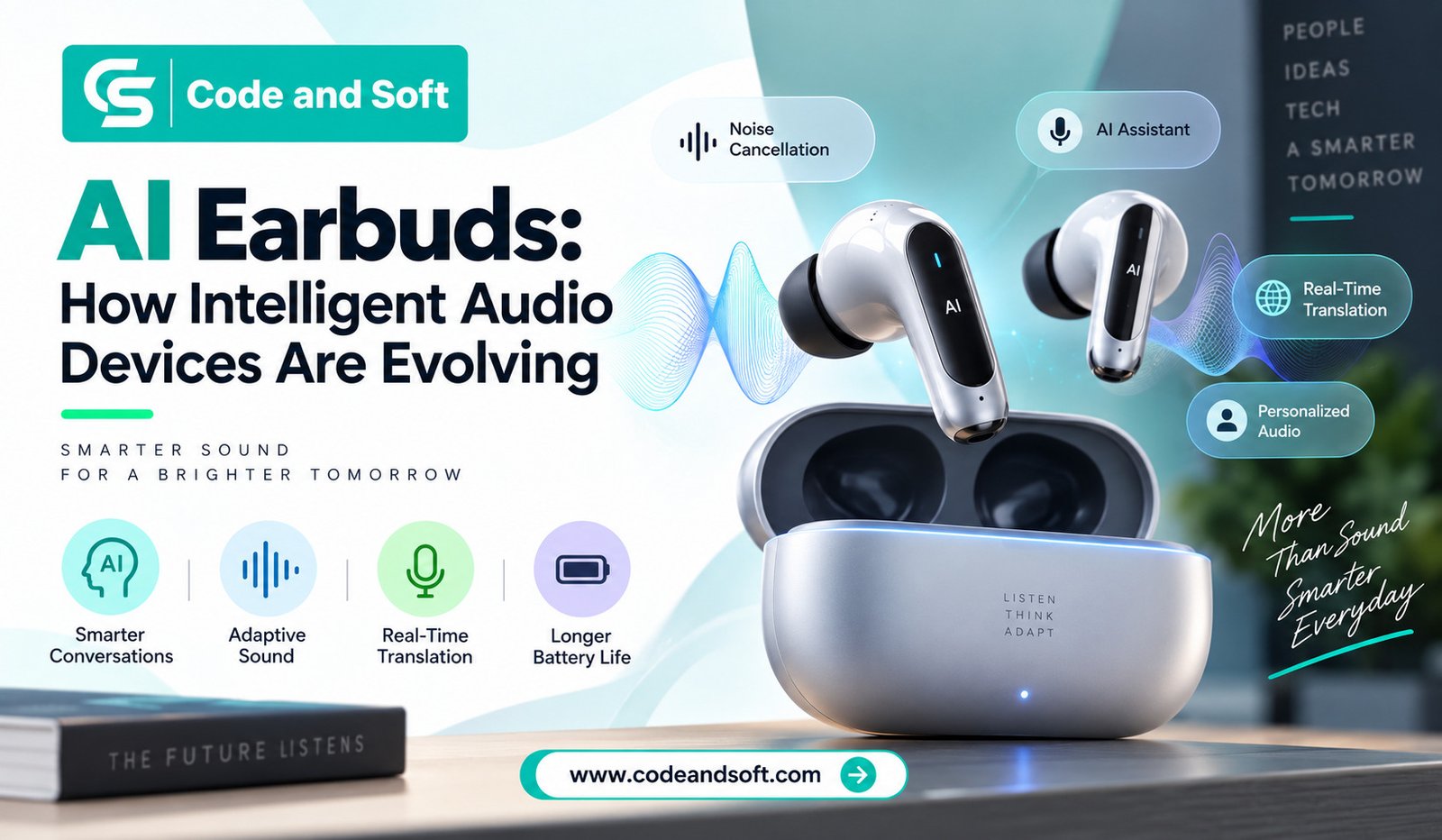

Your earbuds may look like simple audio accessories, but they are quickly becoming much more than that. With artificial intelligence making its way into everyday technology, AI Earbuds are changing how you listen to music, take calls, interact with voice assistants, and even manage your daily conversations.
Instead of simply playing whatever audio you send to them, modern intelligent earbuds can understand your surroundings, recognize voice commands, reduce unwanted noise, and personalize your listening experience. Some emerging models are also exploring real-time translation, voice enhancement, contextual assistance, and smarter interactions with your smartphone.
If you already use wireless earbuds, the next generation may feel surprisingly different. Here is how AI is transforming earbuds and what you can expect from intelligent audio devices.
What Are AI Earbuds?
AI Earbuds are wireless earbuds that use artificial intelligence or machine-learning technologies to provide smarter audio and interaction features.
Traditional wireless earbuds primarily focus on audio playback, microphones, connectivity, and battery life. AI-powered models add another layer of intelligence. They can process information from microphones, sensors, connected devices, and software to make the earbuds respond more intelligently to what you are doing.
For example, your earbuds may detect background noise and adjust noise cancellation automatically. During a phone call, AI can help separate your voice from surrounding sounds. In some cases, AI can also assist with voice commands, transcription, translation, or personalized audio.
The important difference is that your earbuds are no longer just an output device. They are becoming an intelligent interface between you and your digital world.
How AI Is Changing Your Everyday Listening Experience
One of the biggest changes you will notice with AI Earbuds is how much less manual control you need.
Think about using earbuds in a busy café. With conventional earbuds, you might manually increase the volume, activate noise cancellation, or switch between different sound modes.
AI-powered earbuds can potentially handle some of these decisions automatically.
Using microphones and software algorithms, your earbuds can analyze the surrounding environment and adjust their behavior accordingly. When you move from a quiet room to a crowded street, the audio experience can be adapted without requiring you to constantly open an app.
This makes your earbuds feel more responsive to your environment rather than simply following fixed settings.
Smarter Noise Cancellation
Active noise cancellation has already become a major feature in premium wireless earbuds. AI is helping take this technology further.
Your earbuds can use multiple microphones to identify sounds around you. Intelligent algorithms can then distinguish between different types of environmental noise and determine how aggressively unwanted sounds should be reduced.
For example, continuous sounds such as airplane engines or air conditioners are relatively easy to manage. More unpredictable sounds, such as conversations, traffic, or sudden announcements, are more challenging.
AI-based processing can help earbuds respond dynamically to these changing conditions.
This can be particularly useful when you are travelling, working in a shared office, studying in a café, or commuting through a busy city.
AI-Powered Call Quality
Poor call quality is one of the most frustrating problems with wireless earbuds. You may hear the other person clearly, but they might struggle to understand you because of traffic, wind, people talking, or other background sounds.
AI can help address this problem.
Modern earbuds can use machine-learning algorithms to identify your speech and separate it from surrounding noise. The microphones capture the sound, while software processing attempts to suppress unwanted audio before transmitting your voice to the other person.
The result can be clearer calls in noisy environments.
You may also see improvements in voice pickup during online meetings, video calls, gaming chats, and voice recordings as AI-based speech processing continues to develop.
Real-Time Translation Could Become More Useful
One of the most interesting possibilities for AI Earbuds is real-time language translation.
Imagine travelling to another country and having a conversation with someone who speaks a different language. Instead of constantly typing sentences into a translation application, your earbuds could work with your smartphone or another connected device to translate conversations.
The technology is still developing, and real-world translation accuracy can vary depending on language, accents, internet connectivity, and context. However, AI models are becoming increasingly capable of understanding spoken language.
In the future, your earbuds could potentially recognize speech, translate it, and deliver the translated response directly into your ears.
That could make communication while travelling, working internationally, or learning languages much more convenient.
Voice Assistants Are Becoming More Natural
Voice assistants have been available on smartphones and smart speakers for years, but earbuds provide a much more personal way to interact with them.
With AI becoming more conversational, you may be able to ask your earbuds questions without using rigid commands.
Instead of simply saying a predefined activation phrase followed by a short command, future AI assistants may understand conversational context.
You could ask for information, request a reminder, control music, draft a message, or interact with other applications while keeping your phone in your pocket.
This is one area where AI Earbuds could become particularly useful because the microphone and speaker are already positioned close to your mouth and ears.
Personalized Audio Based on Your Preferences
Everyone hears audio differently. Your preferred volume, bass level, treble response, and listening habits can be different from someone else’s.
AI can help earbuds learn these preferences.
Instead of relying entirely on manually adjusted equalizer settings, intelligent earbuds could analyze your listening behavior and gradually create a more personalized sound profile.
Some devices may also adapt audio depending on what you are listening to. Music, podcasts, movies, phone calls, and gaming can require different sound characteristics.
You could therefore see earbuds becoming increasingly adaptive rather than forcing you to choose from a small collection of preset sound modes.
Health and Fitness Features
Another emerging area is the use of earbuds for health and fitness-related features.
Earbuds already contain microphones, motion sensors, and other compact components. As sensors become smaller and AI algorithms become more capable, manufacturers can explore new ways to use this hardware.
Future intelligent earbuds could potentially analyze activity patterns, provide workout-related feedback, or monitor certain audio and environmental conditions.
However, you should not assume that every AI health feature is medically accurate. Consumer earbuds are not automatically medical devices, and health-related information should be treated carefully unless the manufacturer has appropriate validation and regulatory clearance.
Still, the potential is significant.
AI Earbuds and Battery Life
There is one obvious challenge with all these intelligent features: processing requires power.
Noise cancellation already consumes battery energy, and adding continuous AI processing can increase the workload further.
Manufacturers are therefore working toward more efficient chips, optimized software, low-power processing, and better integration between earbuds and smartphones.
Some AI tasks may happen directly on the earbuds, while more demanding processing can be handled by a connected smartphone or cloud service.
The balance between intelligence and battery life will be important. You may love having advanced AI features, but not if your earbuds need to be charged several times a day.
Privacy Will Matter More
As earbuds become smarter, privacy becomes an increasingly important consideration.
Think about what your earbuds can potentially hear: conversations, voices, background sounds, commands, and other environmental audio.
If AI systems process this information, you should pay attention to how the manufacturer handles recordings and personal data.
Before buying AI Earbuds, check whether voice data is processed locally on the device or sent to a cloud service. You should also look at privacy settings, data retention policies, microphone permissions, and options for deleting stored information.
The smartest earbuds will not necessarily be the ones with the most features. They will be the ones that give you useful intelligence while also giving you meaningful control over your data.
Are AI Earbuds Replacing Smartphones?
Probably not anytime soon.
Your smartphone still provides a much larger screen, more processing capability, applications, storage, and control. Instead, AI Earbuds are likely to become an extension of your phone.
You can think of them as a hands-free interface.
Your phone can handle complex tasks in the background while your earbuds provide the interaction layer. You hear information through the earbuds, speak naturally into their microphones, and let your connected devices handle the rest.
This approach could make everyday technology feel less dependent on screens.
What the Future of AI Earbuds Could Look Like
The next generation of intelligent earbuds could become significantly more capable.
You may see better real-time translation, smarter voice assistants, improved environmental awareness, adaptive sound profiles, more accurate speech separation, and deeper integration with smartphones and other connected devices.
The earbuds could also become more context-aware.
For example, instead of waiting for you to give every instruction, an AI system could understand whether you are travelling, exercising, working, commuting, or relaxing and adjust certain features accordingly.
Of course, this future depends on improvements in AI accuracy, battery efficiency, privacy protection, hardware design, and affordability.
Should You Consider AI Earbuds?
If you already want wireless earbuds for music and calls, AI features can make your next upgrade more interesting.
However, you should not buy a pair simply because the word “AI” appears on the box. Look at the features that actually matter to you.
If you frequently take calls in noisy locations, prioritize intelligent microphone processing and voice clarity. If you travel often, translation capabilities may be more useful. If you listen to music for hours, focus on sound quality, comfort, battery life, and adaptive audio.
AI should improve the experience rather than become a marketing feature that you rarely use.
Final Thoughts
AI Earbuds represent an important shift in the evolution of personal audio. Your earbuds are moving from simple devices that play sound toward intelligent companions capable of understanding voices, environments, preferences, and context.
The technology is still developing, but the direction is clear. AI is making audio devices more adaptive, more conversational, and potentially more useful in everyday situations.
As processors become more efficient and AI models become better at understanding natural language and sound, your earbuds could eventually become one of the easiest ways to interact with technology without reaching for your phone.
For you, that means the future of wireless audio may not simply be about hearing better. It could be about having technology that understands what you hear, what you say, and what you need next.