
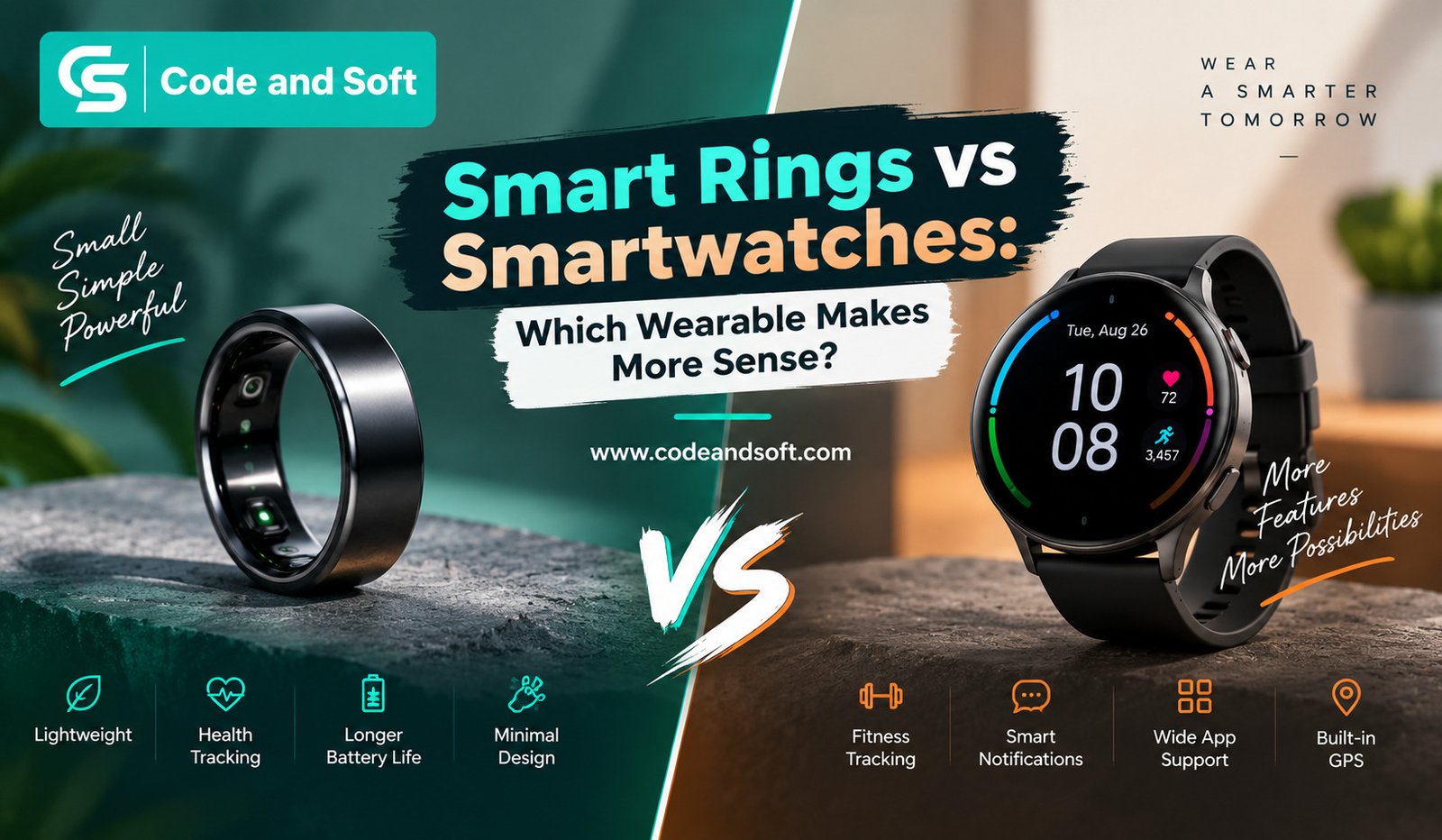

Wearables have changed quite a bit in the last few years. You no longer have to choose between a basic fitness band and a bulky smartwatch. Today, you can track your health, monitor workouts, check notifications, understand your sleep, and keep an eye on daily activity with devices that are much smaller and smarter.
That brings you to an interesting choice: Smart Rings vs Smartwatches.
At first glance, the two may seem completely different. A smartwatch sits visibly on your wrist and works almost like a mini smartphone, while a smart ring quietly sits on your finger and focuses more on health and wellness tracking. But choosing between them is not simply about size. You need to consider what you actually want from a wearable.
If you mainly want health tracking without another screen demanding your attention, a smart ring can make a lot of sense. If you want notifications, apps, GPS, workout controls, and a more interactive experience, a smartwatch may be the better fit.
Let’s break down the differences so you can decide which wearable makes more sense for your everyday life.
What Is a Smart Ring?
A smart ring is a compact wearable designed primarily around health, fitness, and wellness tracking. Despite its small size, it can include sensors that monitor things such as heart rate, sleep patterns, blood oxygen levels, skin temperature, activity, and other health-related metrics, depending on the model.
The biggest advantage is that you barely notice it during the day. There is no large display, no constant stream of notifications, and usually no need to interact with the device itself.
Instead, you typically use a companion smartphone app to view your data.
This makes a smart ring particularly appealing if you want passive tracking. You put it on your finger and go about your day. There is less temptation to constantly check a screen, while your wearable continues collecting useful information in the background.
What Is a Smartwatch?
A smartwatch takes a much broader approach. It combines health and fitness tracking with smartphone-like features.
Depending on the model you choose, you can receive calls and messages, control music, use apps, navigate with GPS, make payments, monitor workouts, check the weather, and even use voice assistants.
The screen is the biggest difference.
Instead of opening your phone every time you receive a notification or want to check a statistic, you can simply look at your wrist. For many people, this convenience is what makes a smartwatch much more useful than a smart ring.
However, that extra functionality also means smartwatches tend to be larger and require more interaction.
Smart Rings vs Smartwatches: Size and Comfort
If comfort is your biggest concern, a smart ring has a natural advantage.
You don’t have a display or bulky case sitting on your wrist. Once you get used to wearing it, the ring can become almost invisible during normal activities. This can be especially useful when you’re sleeping because you don’t have to deal with a large watch pressing against your wrist.
A smartwatch, on the other hand, can feel more noticeable. Larger models can become uncomfortable during sleep or certain exercises, although modern smartwatches are considerably slimmer and lighter than older generations.
Your personal preference matters here.
If you don’t like wearing something on your wrist all day, a smart ring could be a refreshing alternative. If you’re already comfortable with a watch, the difference may not bother you.
Health and Fitness Tracking
Smart rings are designed with health tracking as one of their primary purposes. Because you can comfortably wear them throughout the night, they can be particularly useful for sleep and recovery monitoring.
You can use the data to understand your sleep duration, resting heart rate, activity levels, and other wellness indicators. Some devices also provide readiness or recovery scores that help you understand whether your body may need more rest.
Smartwatches also offer extensive health tracking. Depending on the model, you can get heart-rate monitoring, workout tracking, sleep tracking, blood oxygen measurements, ECG functionality, GPS-based activity tracking, and more.
For serious workouts, however, a smartwatch generally gives you more information while you’re exercising because you can see your metrics in real time.
For example, when you’re running, you can look at your pace, distance, heart rate, and workout duration directly on your wrist.
With a smart ring, you’ll usually need to check your phone later.
So if your priority is passive health and recovery tracking, a smart ring can be excellent. If you want real-time workout information, a smartwatch usually makes more sense.
Notifications and Smart Features
This is probably the biggest advantage of a smartwatch.
Your smartwatch can act as an extension of your smartphone. You can see incoming messages, calls, calendar reminders, emails, and other notifications without reaching into your pocket.
Some smartwatches also let you respond to messages, answer calls, control music, navigate routes, and install applications.
A smart ring generally doesn’t compete here.
It may provide basic alerts or vibration-based notifications on certain models, but you don’t get a full interactive display. That’s actually a benefit if you’re trying to reduce screen time.
Think about your daily routine.
If you constantly need to check messages for work or want quick access to important notifications, a smartwatch can save you plenty of phone interactions. If you prefer to keep your phone and notifications out of sight, the simplicity of a smart ring may be more attractive.
Battery Life
Battery life can also influence your decision.
Smart rings generally don’t have large displays, GPS systems, speakers, and powerful processors constantly running. As a result, some models can deliver several days of use before needing a recharge.
Smartwatch battery life varies significantly between models. Some need charging every day or two, while others can last several days or longer depending on the features you use.
If you hate charging devices frequently, a smart ring can be easier to live with.
However, you should also consider the charging method and your routine. If you rely heavily on sleep tracking, you need a wearable that can comfortably stay charged without forcing you to remove it for long periods.
Smart Rings vs Smartwatches for Exercise
Your workout habits should play a major role in your decision.
If you’re mainly interested in walking, general activity, sleep, recovery, and wellness, a smart ring can provide plenty of useful information.
But if you’re a runner, cyclist, swimmer, gym enthusiast, or outdoor athlete, a smartwatch offers more practical features.
Built-in GPS is especially useful. You can track your route and workout distance without carrying your smartphone. The display also lets you monitor important metrics while you’re exercising.
You can quickly check your heart rate, pace, calories, distance, or workout time without stopping.
A smart ring can still track your activity, but it’s generally designed to collect information quietly rather than present it to you during the workout.
Design and Everyday Style
Smart rings have another advantage: they’re subtle.
You can wear one with casual clothes, formal clothing, or business attire without making it look like you’re wearing a piece of technology. This minimalist appearance is one reason smart rings are becoming interesting to people who don’t want a traditional smartwatch on their wrist.
Smartwatches are more noticeable, but that isn’t necessarily a disadvantage.
For some users, the smartwatch becomes part of their everyday style. You can change watch faces, use different straps, and match the device with different outfits.
So your choice comes down to whether you prefer technology that blends in or technology that you can see and interact with.
Which One Is Easier to Use?
A smartwatch gives you more features, but that also means there is more to learn.
You may need to configure notifications, install apps, manage settings, customize watch faces, connect wireless accessories, and adjust health tracking options.
A smart ring is generally simpler.
You wear it, connect it to the companion app, and let it collect data. Most of the detailed analysis happens on your smartphone.
If you enjoy customizing gadgets and exploring features, you’ll probably appreciate a smartwatch more. If you want something that works quietly in the background, a smart ring can feel much less complicated.
Price and Overall Value
Price varies widely for both categories, so you shouldn’t choose based solely on the device’s initial cost.
A smartwatch can offer a huge number of features in a single device, including fitness tracking, notifications, GPS, communication, music controls, and apps. That can make it a strong all-round purchase.
A smart ring is more focused. You’re paying for a compact wearable centered around health, wellness, and convenience.
You should therefore ask yourself what features you’ll actually use.
Buying a smartwatch with dozens of features doesn’t make sense if you only care about sleep and activity tracking. Similarly, spending money on a smart ring may not be worthwhile if you want GPS navigation and instant access to notifications.
Smart Rings vs Smartwatches: Which One Should You Choose?
There’s no universal winner in the Smart Rings vs Smartwatches debate.
You should choose a smart ring if you:
- Prefer a lightweight and discreet wearable
- Care heavily about sleep and recovery tracking
- Don’t need a display on your wearable
- Want fewer notifications during the day
- Prefer longer battery life
- Like minimalist technology
- Mostly want passive health monitoring
A smartwatch is probably the better choice if you:
- Want notifications on your wrist
- Need GPS for outdoor workouts
- Want real-time workout statistics
- Make or receive calls from your wearable
- Use music controls frequently
- Want apps and smart features
- Prefer having a screen available at all times
Can You Use Both?
Interestingly, you don’t necessarily have to choose one.
Some people use a smart ring for continuous health and sleep tracking while using a smartwatch during workouts and throughout the day.
This combination can give you the strengths of both devices. The ring can focus on wellness and recovery, while the smartwatch handles notifications, GPS, workouts, and everyday interaction.
Of course, buying two wearables costs more, and you may not need both.
For most people, starting with one device that matches their actual habits is the smarter approach.
Final Verdict
When you compare Smart Rings vs Smartwatches, the biggest difference isn’t really about which device has better technology. It’s about how you want technology to fit into your life.
A smart ring gives you a quieter, more discreet experience. You can wear it throughout the day and night, collect health and wellness information, and check detailed insights when you actually want them.
A smartwatch is much more interactive. You get a screen, notifications, GPS, workout information, apps, calls, music controls, and many other features directly on your wrist.
So, if your priority is health tracking, sleep, comfort, and minimal distractions, a smart ring may make more sense.
If you want fitness features, notifications, GPS, communication, and smartphone-like functionality, a smartwatch is likely the more practical choice.
Ultimately, the right wearable is the one you’ll actually enjoy wearing every day. The smartest device isn’t necessarily the one with the longest feature list—it’s the one that fits naturally into your routine.