
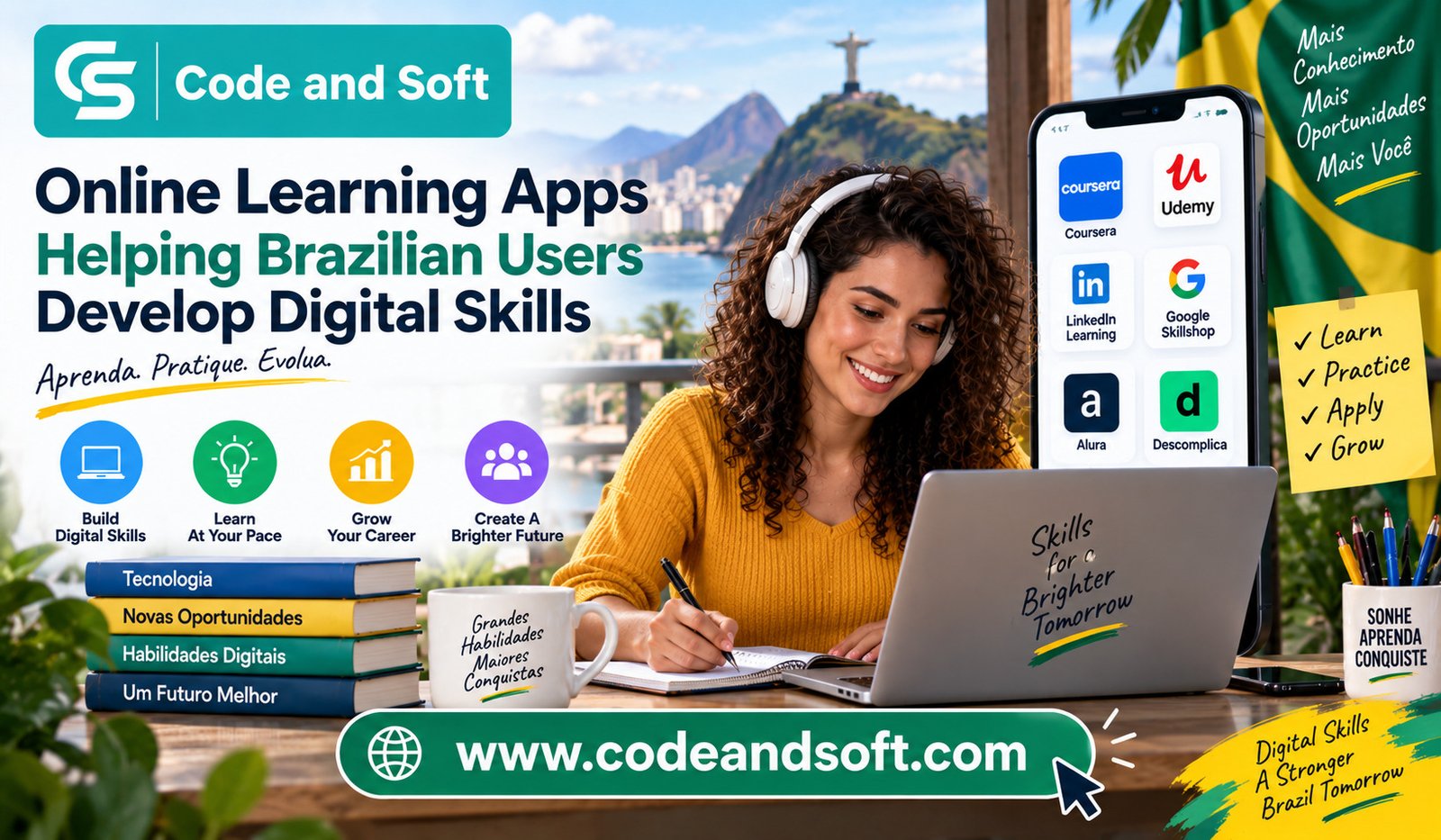

If you want to improve your digital skills without committing to a traditional classroom, online learning apps can give you a practical place to start. In Brazil, smartphones have become an important part of how you study, communicate, work, and access information. That makes learning apps especially useful when you want to build new skills around your existing schedule.
Whether you are learning English, improving your computer knowledge, keeping up with school assignments, or developing skills that can help you professionally, you can find an app suited to your needs. Some platforms focus on formal education, while others make learning feel more like a daily habit.
The way Learning Apps Use Brazilian users is also changing. Instead of depending entirely on physical classrooms, you can now use your phone or computer to access lessons, assignments, communication tools, language practice, and educational resources from almost anywhere.
Here are some of the learning apps and platforms you can consider if you want to develop your digital skills in Brazil.
Moodle & Google Classroom
When you think about online education, Moodle and Google Classroom are two platforms you are likely to encounter. Both are widely used for organizing digital learning, although they work in slightly different ways.
Moodle is a flexible learning management system that can support courses, assignments, quizzes, discussions, learning materials, and progress tracking. If your school, university, training center, or professional course uses Moodle, you can access much of your learning through one digital environment.
This can help you develop skills beyond the subject you are studying. For example, regularly submitting assignments online teaches you how to manage digital documents, navigate online platforms, communicate electronically, and organize your coursework.
Google Classroom offers a straightforward way to manage classes and assignments. You can receive work from teachers, submit your responses, check announcements, and keep track of upcoming tasks.
For you as a learner, platforms like these can make education more organized. They also give you valuable experience with digital tools that are increasingly common in workplaces.
Duolingo
If improving your language skills is one of your goals, Duolingo offers a convenient way to practice from your phone.
Language learning can sometimes feel difficult because you need regular exposure to vocabulary, pronunciation, reading, and sentence structure. Duolingo breaks learning into smaller activities, allowing you to practice for a few minutes at a time rather than waiting until you have an entire free afternoon.
For Brazilian users, learning English can be particularly useful when you want to access international content, communicate with people from other countries, or improve your professional opportunities. You can also explore other languages depending on your interests.
The biggest advantage is consistency. Instead of treating language learning as something you only do during a formal course, you can make it part of your everyday routine.
You might complete a lesson while commuting, during a break, or before going to bed. Those small sessions can gradually build your confidence.
Agenda Edu
If you are looking for an education-focused platform connected to the Brazilian school environment, Agenda Edu is another name worth knowing.
The platform is designed to support communication and interaction between schools, students, and families. Depending on how a school uses the platform, you may find information about school activities, communications, schedules, academic updates, and other educational matters.
For students, having these details available digitally can make everyday school life easier to manage. Instead of depending exclusively on printed notices or remembering everything that was discussed in class, you can use a digital platform to stay connected with important information.
It also gives you experience with managing information through an app—something that may seem simple but is part of becoming comfortable with digital technology.
ClassApp
ClassApp is another education platform that can help connect schools, students, parents, and teachers through digital communication.
If your educational institution uses ClassApp, you may use it to receive school announcements, communicate with the institution, and stay informed about activities and important updates.
This type of platform demonstrates how education is becoming more connected. You are not limited to what happens during classroom hours. Communication can continue digitally, allowing you to access relevant information when you need it.
For younger learners especially, this digital environment can also help build familiarity with online communication and responsible technology use.
Coursera and Other Online Course Platforms
Your digital learning options do not have to stop with school-related applications. If you are interested in professional development, online course platforms can give you access to subjects that may not be available through your local educational institutions.
Platforms such as Coursera offer courses covering areas such as technology, business, data, marketing, communication, and other professional subjects.
You can choose a course based on what you want to accomplish. For example, if you want to move toward a technology-related career, you might begin with programming or data-related lessons. If you are interested in running a small business, courses in marketing, finance, or entrepreneurship could be more relevant.
The important part is choosing something that matches your actual goal rather than collecting courses without using what you learn.
Khan Academy
Sometimes you do not need a complicated learning system. You simply need clear explanations and opportunities to practice.
Khan Academy can be useful for this type of learning. It provides educational content across subjects, making it possible for you to revisit concepts at your own pace.
This can be particularly helpful when you struggle with a topic in school or want to strengthen your understanding before moving on to something more advanced.
One advantage of digital learning is that you can repeat lessons. If you do not understand something the first time, you can go back and try again without feeling pressured to keep up with an entire classroom.
Alura
If your main objective is developing technology and professional skills, you can also explore Brazilian-focused learning platforms such as Alura.
Its courses cover areas related to technology, programming, data, design, business, and other digital fields. This can make it relevant if you are thinking about developing skills that could support your career.
You do not necessarily need to become a programmer to benefit from digital education. Understanding basic technology, data, productivity tools, digital marketing, or user experience can be valuable in many different types of jobs.
The key is to identify which skills are actually useful for the direction you want your career to take.
Why Digital Skills Matter in Brazil
Digital skills are no longer limited to people who work in technology.
You may need to use online systems to apply for jobs, communicate with colleagues, complete administrative tasks, attend meetings, manage documents, promote a business, or interact with customers.
Even everyday activities increasingly involve technology.
That is why learning apps can have value beyond formal education. When you use them regularly, you become more comfortable navigating digital interfaces, searching for information, communicating online, organizing files, and learning independently.
This is where the idea behind Learning Apps Use Brazilian learners becomes particularly relevant. The value is not simply in having an app installed on your phone. The real benefit comes from how you use these tools to solve problems and build useful knowledge.
You Can Turn Learning Apps Into a Daily Routine
One mistake you can make is downloading several learning apps and expecting them to change your skills automatically.
They will not.
You need a simple routine.
Start by choosing one main skill. Maybe you want to improve your English. Perhaps you want to understand spreadsheets, learn programming, strengthen your mathematics, or prepare for a new career.
Then choose an app or platform that supports that goal.
Give yourself a realistic amount of time each day. Even 15 or 20 minutes can be useful when you remain consistent. Once the habit becomes comfortable, you can increase your study time.
You should also avoid passive learning. Watching videos or reading lessons is useful, but try to put your knowledge into practice. Write something, complete an exercise, create a small project, speak a new language, or solve a problem using what you have learned.
That is when digital learning starts becoming a real skill.
Choosing the Right App for You
With so many options available, you do not need to use every platform.
Think about three things before choosing an app: your goal, your learning style, and your available time.
If you need to manage schoolwork, Moodle, Google Classroom, Agenda Edu, or ClassApp may be relevant depending on what your institution uses. If languages are your priority, Duolingo can help you establish regular practice. For broader academic or professional development, platforms such as Coursera, Khan Academy, and Alura can offer additional options.
You should also consider whether you learn better through short exercises, videos, structured courses, practical projects, or interaction with teachers and other learners.
Final Thoughts
Online learning apps are giving you more flexibility in how you develop your skills. You no longer have to rely entirely on a fixed classroom schedule to continue learning.
From Moodle and Google Classroom to Duolingo, Agenda Edu, and ClassApp, different platforms can support different parts of your educational journey. You can also explore services such as Coursera, Khan Academy, and Alura when you want to move beyond traditional school learning.
The most important thing is not how many apps you use. It is whether you are using them consistently and applying what you learn.
If you are a Brazilian learner hoping to become more confident with digital technology, start small. Choose one skill, find the right learning app, create a routine, and keep practicing. Over time, those small digital learning sessions can become skills that support your education, career, and everyday life.