
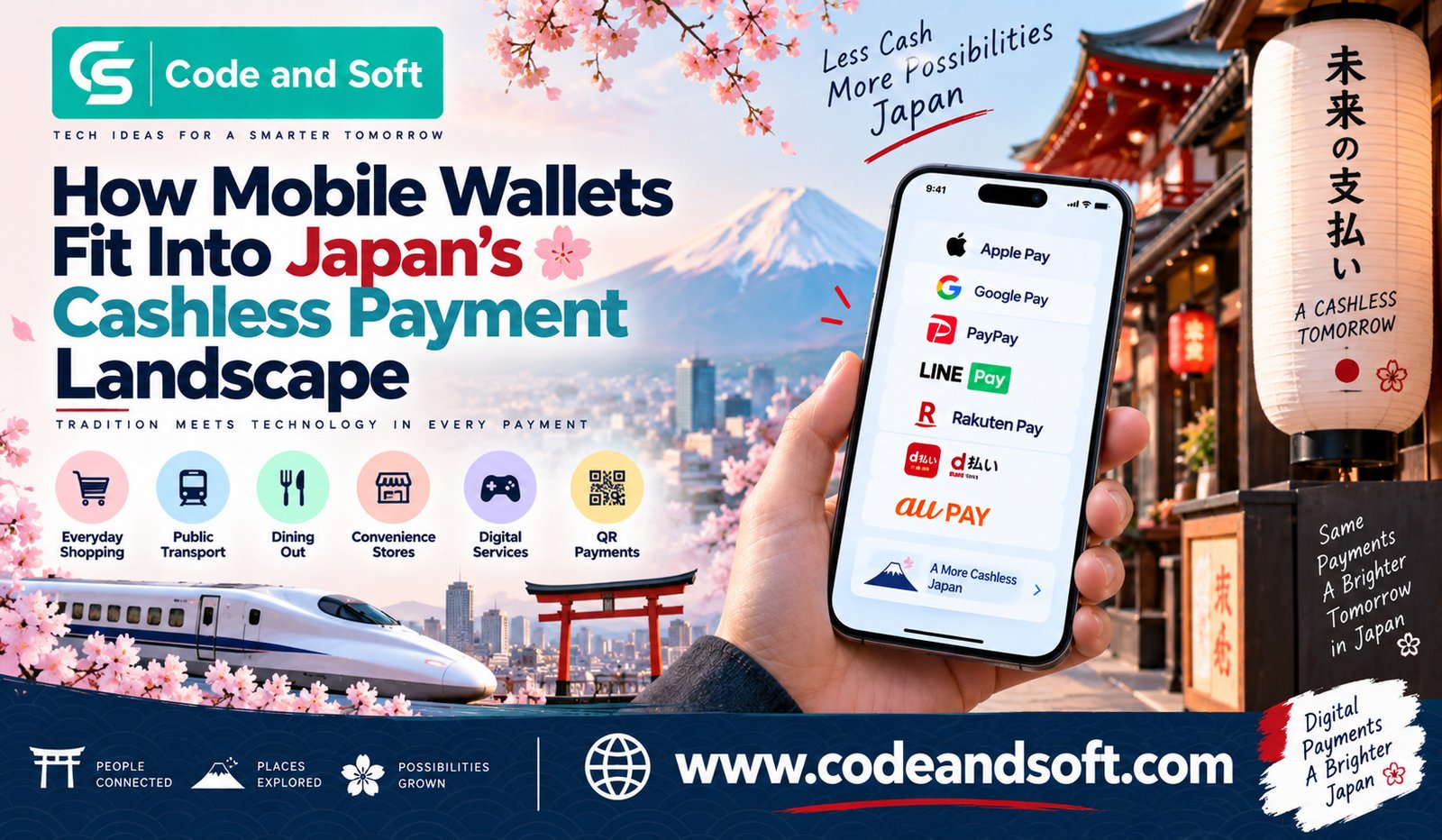

If you are used to thinking of Japan as a country where cash is still king, you may be surprised by how quickly the payment experience is changing. Cash remains important, especially at smaller businesses and in certain everyday situations, but your smartphone can now handle a growing share of your purchases.
From buying a coffee to paying for dinner, shopping online, sending money to someone, or collecting loyalty points, mobile wallets are becoming a practical part of everyday life in Japan.
The growth is not happening in isolation. Japan’s wider cashless payment market has been expanding steadily. According to Japan’s Ministry of Economy, Trade and Industry (METI), cashless payments accounted for 58.0% of consumer payment value in 2025, equivalent to ¥162.7 trillion. Code payments, which include many smartphone-based QR payment services, represented 10.2% of that cashless payment value.
So, if you want to understand Digital Wallets Use In Japan, you need to look beyond the idea of simply replacing coins and banknotes. Mobile wallets are becoming part of a broader digital lifestyle.
Why Mobile Wallets Are Becoming More Useful in Japan
When you use a mobile wallet in Japan, convenience is usually the biggest attraction.
Instead of taking out your wallet, counting coins, or handling change, you can often open an app or use your phone at the payment terminal. QR-based services also allow you to pay by scanning a code or presenting your own payment code, depending on the merchant.
This can make everyday transactions feel much quicker.
There is another reason mobile wallets appeal to you: rewards. Many Japanese payment apps combine payments with loyalty programs, coupons, campaigns, and points. That means your choice of wallet can sometimes be influenced not only by how you pay, but also by what you buy and which companies you already use.
Japan’s cashless landscape is therefore quite different from a simple “cash versus card” choice. You may have credit cards, electronic money, QR payments and smartphone wallets available at the same time.
PayPay: One of the Biggest Names in Mobile Payments
If you are exploring mobile payments in Japan, PayPay is difficult to overlook.
PayPay has become one of the most widely recognized QR payment services in the country. The company reported that its number of registered users reached 75 million in July 2026, while transactions through PayPay reached 8.88 billion during 2025.
For you as a consumer, the appeal is fairly straightforward. You can use PayPay at participating stores, restaurants and other businesses, while the service also connects payments with its broader digital ecosystem.
PayPay is particularly interesting if you regularly look for payment campaigns or rewards. Promotional offers can change over time, so it is worth checking the app rather than assuming that every payment method will provide the same benefits.
Its popularity also illustrates an important point about Digital Wallets Use In Japan: QR payments have moved well beyond being a novelty. They are now a recognizable part of the country’s everyday payment environment.
Rakuten Pay: Useful If You Already Live in the Rakuten Ecosystem
If you frequently use Rakuten services, Rakuten Pay can make sense as your preferred mobile wallet.
The biggest advantage is the connection with the wider Rakuten ecosystem. If you already collect Rakuten Points through shopping or other services, using Rakuten Pay can make your payment habits feel more connected.
For you, this means that choosing a wallet does not necessarily come down to which app has the most features. Your existing shopping habits can be just as important.
Someone who frequently shops through Rakuten may naturally find more value in Rakuten Pay, while another person may prefer PayPay because it fits better with the stores and services they use.
This is one reason Japan’s mobile payment market has several major players rather than one wallet completely dominating every situation.
d払い: Bringing Payments Into the NTT DOCOMO Ecosystem
d払い, often written as dPay in English-language discussions, is another major mobile payment option you may encounter in Japan.
It is closely connected with the NTT DOCOMO ecosystem and can be particularly relevant if you already use DOCOMO-related services.
Like other QR payment platforms, d払い gives you a way to make purchases using your smartphone rather than relying on physical cash. Its relationship with the broader DOCOMO ecosystem also shows how Japanese mobile wallets are often connected to larger technology, telecommunications and loyalty platforms.
For you, that can make choosing a wallet a matter of convenience across several services rather than simply selecting a payment application.
Merpay: Payments Connected to Mercari
If you use Mercari, Japan’s popular marketplace for buying and selling second-hand goods, Merpay may already be familiar to you.
Merpay is closely associated with the Mercari ecosystem, giving users another example of how mobile wallets in Japan can develop from an existing digital platform.
This type of integration can be particularly convenient. Instead of treating your payment app as a completely separate service, you can use a wallet that is already connected to an activity you perform online.
The broader lesson is important: mobile wallets are becoming useful because they connect payments with other parts of your digital life.
Apple Pay: Turning Your iPhone Into a Payment Tool
If you use an iPhone, Apple Pay provides a different approach to mobile payments in Japan.
Rather than relying entirely on a QR code application, you can use compatible cards and supported payment services through your Apple device. Depending on the card, service and terminal, you may be able to pay by holding your iPhone or Apple Watch near a compatible reader.
This can be particularly convenient when you are already accustomed to contactless payments.
Apple Pay also fits into Japan’s existing electronic-payment infrastructure, where contactless and stored-value payment options have long played an important role. Japan’s cashless statistics separately classify electronic money from code payments, showing that smartphone payments are only one part of the country’s wider move away from cash.
Google Pay: Another Smartphone-Based Option
If you prefer Android, Google Pay gives you another way to bring payment cards and supported services onto your smartphone.
For you, the biggest benefit can be simplicity. Rather than carrying multiple physical cards, you may be able to manage supported payment methods directly from your phone.
However, it is worth remembering that mobile payment compatibility can vary depending on your device, card, service and merchant terminal. If you are visiting Japan, checking your specific card and phone compatibility before relying entirely on a mobile wallet is a sensible step.
And More: Japan Has a Surprisingly Diverse Payment Mix
The Japanese mobile payment market does not stop with PayPay, Rakuten Pay, d払い, Merpay, Apple Pay and Google Pay.
You will also encounter other electronic money and payment options, including services connected with transport and retail ecosystems. Suica and other IC-based payment systems, for example, remain important for everyday transactions and transportation.
This variety can initially seem confusing.
But there is a practical reason for it. Different wallets can be useful in different situations. One may offer better rewards at a particular retailer, another may connect with your loyalty points, while another may be more convenient for transit or contactless purchases.
You do not necessarily need to choose one wallet and use it for everything.
Cash Still Has a Place
Despite the rapid growth of cashless payments, you should not assume that Japan has become completely cashless.
Cash remains useful, particularly when you visit smaller businesses, traditional establishments, local markets or places that have not adopted every type of digital payment.
That is why carrying some cash can still be a smart idea.
At the same time, the overall direction is clearly changing. Japan’s cashless payment ratio increased from 42.8% in 2024 to 58.0% in 2025 under METI’s revised domestic indicator. The government has also set a 2030 interim goal of 65%, with a longer-term ambition of reaching 80%.
The important thing for you is not that cash is disappearing overnight. Instead, you are gaining more choices.
What Digital Wallets Mean for Your Everyday Experience
The real significance of Digital Wallets Use In Japan is the way payments are becoming integrated into ordinary activities.
You might use PayPay when buying something at a local shop, Rakuten Pay when you want to make use of Rakuten Points, d払い if you are already within the DOCOMO ecosystem, Merpay if you use Mercari, and Apple Pay or Google Pay when you prefer contactless payments through your smartphone.
Your payment method can therefore become part of your wider digital routine.
For visitors, this also means that understanding Japan’s payment landscape can make everyday experiences easier. For residents, it can mean fewer reasons to carry a large amount of cash and more opportunities to connect payments with rewards and digital services.
The Future of Mobile Payments in Japan
Japan’s cashless transition is unlikely to mean that one payment app suddenly replaces everything else.
Instead, you are likely to see a more connected payment environment where QR payments, contactless cards, electronic money and smartphone wallets continue to exist alongside cash.
The numbers already show that change is well underway. In 2025, Japan recorded ¥162.7 trillion in cashless payment value, while code payments reached ¥16.6 trillion.
For you, the biggest change may be surprisingly simple: paying becomes something you think about less.
Your phone, your loyalty points, your bank or card, your shopping accounts and your favorite services can increasingly work together in the background.
That is where mobile wallets fit into Japan’s cashless landscape. They are not simply digital replacements for your physical wallet. They are becoming another layer of the digital infrastructure you use every day.
And as Japan continues moving toward its cashless targets, the smartphone is likely to become an increasingly familiar part of how you pay, save, collect rewards and manage everyday spending.