
Introduction
Call centers are becoming increasingly technology-driven as businesses look for faster, more efficient ways to manage customer conversations. Traditional call center systems can handle calls effectively, but they often require employees to perform repetitive tasks such as searching for customer information, documenting conversations, categorizing calls, and creating follow-up notes.
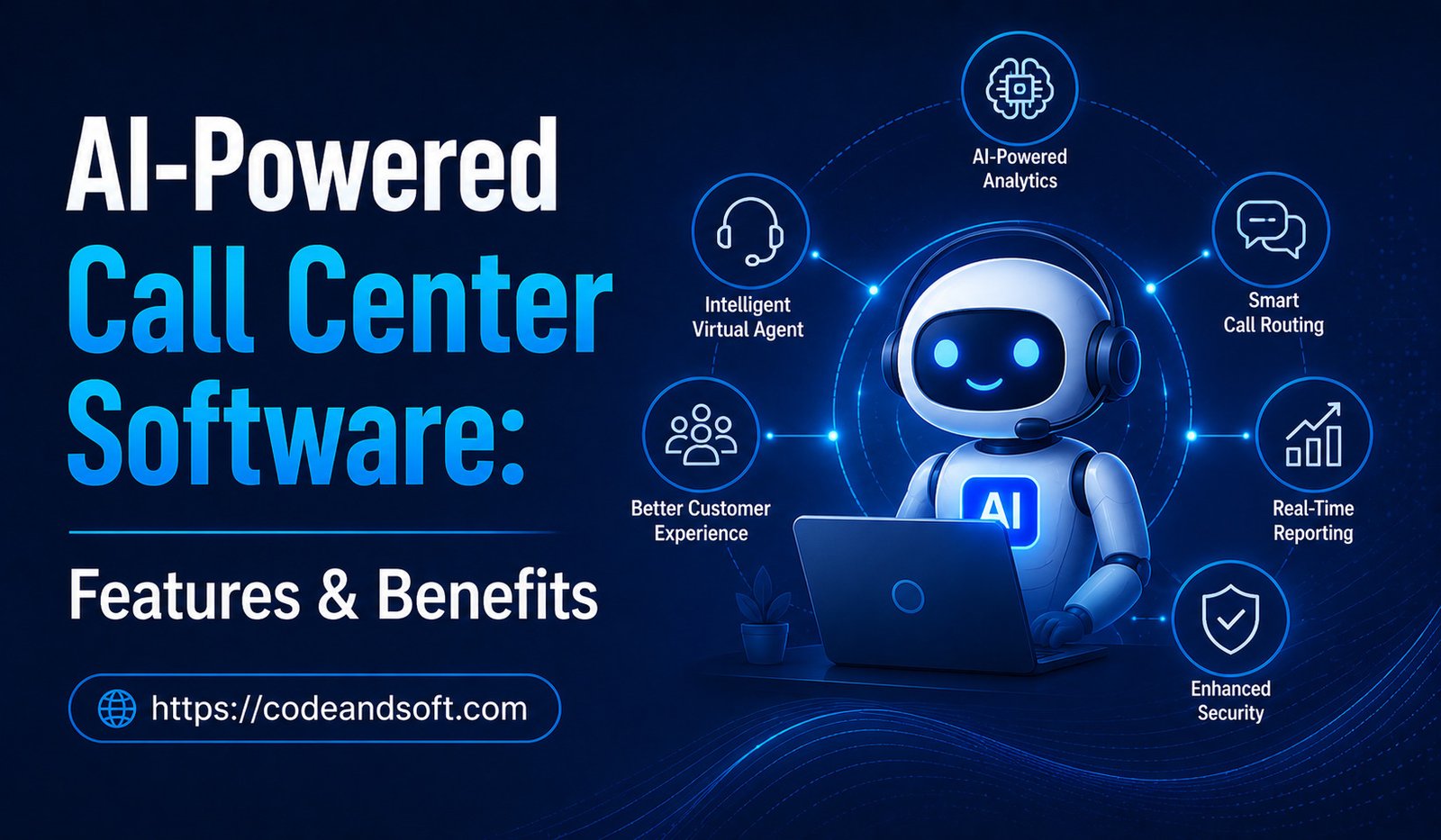
AI-powered call center software is changing this process by combining traditional contact center technology with artificial intelligence. These platforms can analyze conversations, automate routine activities, assist agents, route customers intelligently, and provide managers with deeper insights into call center performance.
Artificial intelligence does not necessarily replace human agents. Instead, it can work alongside them by reducing repetitive work and providing information at the right moment.
For businesses that handle large volumes of customer interactions, AI-powered call center software can improve productivity, customer experiences, and operational visibility.
What Is AI-Powered Call Center Software?
AI-powered call center software is a customer communication platform that uses artificial intelligence and machine learning to automate or improve different parts of call center operations.
Traditional call center software generally focuses on functions such as call routing, queues, recordings, and agent management. AI-powered systems add intelligent capabilities to these functions.
Depending on the platform, AI may be used for:
- Automatic call routing
- Speech recognition
- Call transcription
- Conversation analysis
- Customer sentiment detection
- Agent assistance
- Automated summaries
- AI voice agents
- Predictive analytics
- Quality monitoring
- Customer intent detection
The exact capabilities vary between providers, but the overall goal is to help call centers handle customer interactions more efficiently.
How AI Works in a Call Center
For example, when a customer calls a support team, AI may identify the reason for the call, determine the appropriate department, and route the interaction to an available agent.
During the conversation, AI can potentially identify important information, suggest responses, transcribe the conversation, and detect customer sentiment.
After the call, the system may create a summary, identify action items, and update relevant customer records.
This creates a workflow in which AI supports the customer journey before, during, and after the conversation.
Key Features of AI-Powered Call Center Software
1. Intelligent Call Routing
Traditional call routing often depends on predefined rules.
AI-powered routing can use additional information to determine which agent is most appropriate for a particular customer.
Factors may include:
- Customer intent
- Previous interactions
- Agent expertise
- Customer history
- Language
- Availability
- Priority level
Intelligent routing can help reduce unnecessary transfers and connect customers with suitable agents more quickly.
2. AI Voice Agents
AI voice agents can handle certain customer conversations without direct human involvement.
They may be used for tasks such as:
- Answering common questions
- Checking basic account information
- Scheduling appointments
- Collecting information
- Confirming details
- Routing calls
AI voice agents can operate outside traditional business hours and help reduce the volume of routine calls reaching human agents.
However, businesses should design clear escalation paths so customers can reach human representatives when their requests are complex.
3. Automatic Call Transcription
AI-powered transcription converts spoken conversations into written text.
Instead of requiring agents or supervisors to manually document every conversation, the system can create a transcript automatically.
Transcriptions can be useful for:
- Quality reviews
- Training
- Compliance processes
- Customer service analysis
- Searching previous conversations
Organizations should establish appropriate policies for storing and accessing transcripts because they may contain sensitive customer information.
4. Automated Call Summaries
After a conversation ends, AI can summarize the most important points.
A summary may identify:
- Customer concerns
- Problems discussed
- Solutions provided
- Follow-up requirements
- Important commitments
This can save agents from spending several minutes manually writing notes after every call.
It can also make customer records easier for other employees to understand.
5. Real-Time Agent Assistance
AI can assist agents while a conversation is taking place.
Depending on the platform, it may provide:
- Suggested responses
- Relevant knowledge-base information
- Customer details
- Troubleshooting guidance
- Next-step recommendations
The purpose is not necessarily to control the conversation. Instead, AI can give agents useful information so they spend less time searching for answers.
6. Sentiment Analysis
AI can analyze language and speech patterns to estimate customer sentiment.
The system may identify conversations that appear:
- Positive
- Neutral
- Frustrated
- Angry
- At risk of escalation
Managers can use this information to identify difficult interactions and review them more quickly.
Sentiment analysis should be treated as an analytical aid rather than a perfect measurement of how a customer feels.
7. Conversation Intelligence
Conversation intelligence analyzes customer and agent interactions to identify patterns.
It can help businesses understand:
- Frequently discussed topics
- Common customer complaints
- Sales objections
- Product issues
- Agent performance
- Customer expectations
These insights can help companies improve training, products, marketing, and customer service processes.
8. Automated Quality Monitoring
Traditional quality assurance often requires supervisors to manually listen to a limited number of recorded calls.
AI can analyze a much larger percentage of conversations.
It can identify interactions that may require additional review based on predefined criteria.
This allows managers to spend more time improving performance instead of manually reviewing every conversation.
9. Predictive Analytics
AI-powered analytics can use historical information to identify potential patterns.
Businesses may use predictive capabilities to estimate:
- Call volume
- Staffing requirements
- Customer demand
- Potential churn
- Sales opportunities
Better forecasting can help call centers schedule employees more efficiently and prepare for periods of increased demand.
10. Automated Call Categorization
AI can automatically categorize calls based on their content or customer intent.
For example, conversations may be classified as:
- Billing questions
- Technical support
- Product inquiries
- Complaints
- Sales opportunities
- Account changes
Automated categorization can reduce manual data entry and improve reporting.
Benefits of AI-Powered Call Center Software
Improved Agent Productivity
Agents often spend significant time completing administrative tasks.
AI can automate activities such as transcription, summarization, categorization, and information retrieval.
This allows employees to spend more time interacting with customers.
Faster Customer Service
Intelligent routing and AI-assisted agents can help customers reach appropriate resources faster.
Automated systems can also handle simple requests without requiring human intervention.
Better Customer Experiences
Customers generally want quick and accurate answers.
AI can help agents access relevant information during conversations and reduce repetitive transfers.
Reduced Administrative Work
Automatic summaries and transcriptions can reduce the amount of manual documentation agents need to complete after calls.
More Consistent Service
AI-powered recommendations can help agents follow approved processes and provide more consistent responses.
This can be especially useful when businesses have large customer service teams.
Better Management Insights
AI analytics can uncover patterns that may be difficult to identify through manual reporting.
Managers can gain greater visibility into customer concerns, agent performance, call volume, and service quality.
24/7 Customer Availability
AI voice agents can operate outside normal business hours.
This allows customers to receive assistance with certain routine requests even when human agents are unavailable.
Easier Employee Training
Call transcripts, summaries, and conversation analytics can provide useful material for agent training.
Managers can identify common mistakes and create targeted coaching programs.
AI Call Center Software for Different Industries
AI-powered call center systems can be adapted to many industries.
Retail
Retailers can use AI to handle order questions, returns, product inquiries, and delivery-related requests.
Healthcare
Healthcare organizations can use automated systems for appointment scheduling and basic information, while maintaining appropriate privacy and compliance controls.
Financial Services
Financial organizations can use AI for customer inquiries, routing, documentation, and service analytics while applying strict security measures.
E-Commerce
Online businesses can use AI to manage order status questions, returns, delivery information, and customer support.
Telecommunications
Telecom companies can use AI to identify technical issues, route customers, and analyze large volumes of support interactions.
Challenges of AI-Powered Call Center Software
AI provides significant opportunities, but businesses should also understand its limitations.
Implementation Costs
Advanced AI platforms may require higher investment than basic call center software.
Costs can include subscriptions, integrations, implementation, training, and usage-based AI services.
Data Privacy
Call recordings, transcripts, and customer information must be handled responsibly.
Businesses should understand how their provider stores, processes, and protects customer data.
AI Accuracy
AI systems can make mistakes.
Speech recognition may struggle with accents, background noise, technical terminology, or unclear audio.
Human oversight remains important for sensitive or complex conversations.
Employee Training
Agents need training on how to use AI recommendations and understand when human judgment should take priority.
Customer Acceptance
Some customers may prefer speaking with a human rather than an automated system.
Businesses should make escalation to human agents straightforward when AI cannot effectively resolve an issue.
How to Choose AI-Powered Call Center Software
Businesses should consider several factors before purchasing a platform.
Identify Your Main Problem
Determine whether your primary challenge is:
- High call volume
- Long wait times
- Agent workload
- Poor reporting
- Customer dissatisfaction
- Manual documentation
- Staffing difficulties
The software should address a real operational problem.
Evaluate AI Features
Compare specific capabilities rather than simply looking for a provider that advertises AI.
Determine whether you need transcription, summaries, AI voice agents, predictive analytics, or real-time assistance.
Check Integrations
Make sure the platform works with your existing:
- CRM
- Help desk
- Customer database
- Knowledge base
- Communication tools
Review Security
Examine authentication, access controls, encryption, data storage, and administrative permissions.
Test the Platform
Use a demo or trial to test actual workflows.
Ask agents to evaluate the system because they will use it every day.
Best Practices for Implementing AI in a Call Center
Businesses should introduce AI strategically rather than attempting to automate everything at once.
Start with repetitive tasks that provide clear benefits, such as call transcription or automated summaries.
Then evaluate performance and expand AI capabilities gradually.
Organizations should also:
- Train employees
- Monitor AI accuracy
- Protect customer data
- Maintain human escalation options
- Review AI-generated information
- Measure customer satisfaction
- Track productivity improvements
A balanced implementation allows businesses to gain the benefits of automation without losing the human element of customer service.
Conclusion
AI-powered call center software is transforming how businesses manage customer communication. By combining traditional contact center features with artificial intelligence, these platforms can automate repetitive tasks, support agents, improve call routing, analyze conversations, and provide deeper operational insights.
Features such as AI voice agents, automatic transcription, call summaries, real-time assistance, sentiment analysis, conversation intelligence, and predictive analytics can help organizations improve productivity while creating more efficient customer experiences.
However, AI should not be viewed as a complete replacement for human agents. Complex problems, sensitive situations, and emotionally demanding conversations often require human judgment and empathy.
Businesses should therefore choose AI call center software based on their specific requirements. Security, data privacy, integration capabilities, AI accuracy, scalability, pricing, and customer experience should all be considered before making a decision.
When implemented thoughtfully, AI can become a valuable partner for call center employees. It can take care of repetitive work, provide useful information at the right time, and help managers understand customer interactions more clearly.
The result is a more intelligent call center where technology handles routine processes while human employees focus on conversations that require expertise, empathy, and problem-solving.