C programming remains one of the most valuable languages for computer science students. Even though modern developers have access to languages such as Python, Java, JavaScript and C++, learning C provides a strong understanding of how programs work at a lower level. It introduces important concepts such as memory, pointers, data structures, functions and compilation that are useful far beyond the language itself.
For students beginning their programming journey, understanding the fundamentals of C can make many advanced computer science subjects easier to learn. From operating systems and embedded programming to algorithms and system software, C continues to play an important role.
Understanding the Basic Structure of a C Program
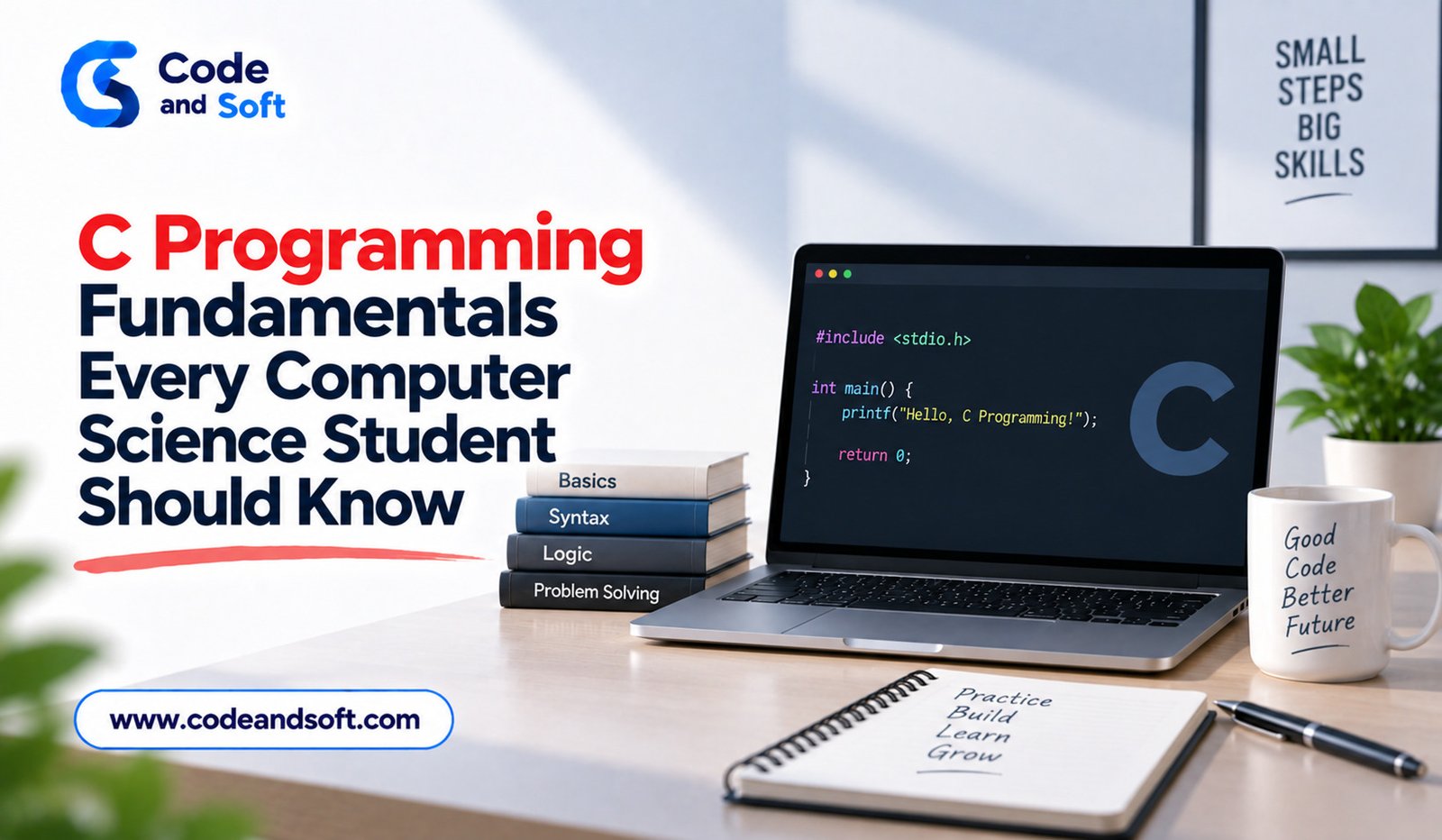
The first step in learning C programming is understanding how a simple program is organized. A C program generally contains functions, statements, variables and preprocessor directives.
The main() function is particularly important because it acts as the starting point for program execution. Students should become comfortable reading the structure of a basic C program before moving toward more complicated concepts.
Understanding how source code moves through compilation and eventually becomes an executable program is also useful. Unlike interpreted environments where code may be executed more directly, C programs are normally compiled before they run.
This basic knowledge helps students understand errors and recognize the difference between writing code and actually building an executable application.
Variables and Data Types
Variables allow programs to store information that can change while a program is running. C provides several fundamental data types that students should understand early.
Common types include integers for whole numbers, floating-point types for decimal values, characters for individual symbols and other types for different storage requirements.
Choosing an appropriate data type is not simply about making a program work. It can also affect memory usage and the range of values that a program can handle.
Students should learn how variables are declared, initialized and modified. They should also understand that C is a statically typed language, meaning the type of a variable is determined as part of the program’s declaration.
Operators and Expressions
Operators allow programmers to perform calculations, comparisons and logical operations. Arithmetic operators are used for mathematical calculations, while relational operators help compare values.
Logical operators are particularly important when creating conditions. Operators such as AND, OR and NOT allow multiple conditions to be combined.
Students should also understand assignment operators and the difference between assignment and comparison. A small mistake between these concepts can produce unexpected program behavior.
Learning operator precedence is another useful skill. When an expression contains multiple operators, C follows specific rules to determine the order in which operations are evaluated. Using parentheses can make complicated expressions easier to understand and reduce mistakes.
Conditional Statements
Real programs rarely perform the same operation every time. They need to make decisions based on data or user input.
C provides conditional statements such as if, else if and else for this purpose. Students can use them to create programs that respond differently depending on whether certain conditions are true or false.
The switch statement is another useful option when a program needs to select between multiple known cases.
Learning conditional logic is essential because the same reasoning appears in almost every programming language. Once students understand how conditions work in C, transferring that knowledge to another language becomes much easier.
Loops and Repetition
Loops allow programmers to repeat instructions without writing the same code again and again. C provides several looping structures, including for, while and do-while.
A for loop is often useful when the number of repetitions is known. A while loop can be useful when repetition depends on a condition, while a do-while loop guarantees that its body executes at least once.
Students should practice creating loops for tasks such as calculating totals, displaying sequences, processing arrays and searching for values.
It is equally important to understand how loops terminate. An incorrect condition can create an infinite loop, which may cause a program to continue running unexpectedly.
Functions and Modular Programming
As programs become larger, putting all instructions inside main() makes the code difficult to manage. Functions solve this problem by dividing a program into smaller, reusable sections.
A function can accept input through parameters and return a result to the part of the program that called it.
Learning functions teaches students an important programming principle: break a complicated problem into smaller problems.
Functions also improve readability and make debugging easier. If a particular operation is handled by its own function, developers can test that part separately instead of examining the entire program at once.
Students should understand function declarations, definitions, parameters, return values and function calls.
Arrays and Strings
An array stores multiple values of the same data type in a collection that can be accessed using indexes. Arrays are fundamental because they introduce students to organized data storage.
For example, instead of creating separate variables for several test scores, a student can store the scores in an array and process them using a loop.
Strings require special attention in C because the language does not provide a separate built-in string data type in the same way some higher-level languages do. Strings are generally represented using arrays of characters and terminated with a special null character.
Understanding arrays and strings prepares students for more advanced topics such as sorting, searching and data structures.
Pointers and Memory
Pointers are among the most important and sometimes challenging concepts in C programming. A pointer stores the memory address of another variable.
At first, pointers can seem confusing because students have to think about both a value and the location where that value is stored. However, learning pointers provides a much deeper understanding of computer memory.
Pointers are important for dynamic memory allocation, arrays, functions, structures and many system-level programming tasks.
Students should learn how to declare pointers, obtain addresses and access values through pointers. They should also understand the risks associated with incorrect pointer usage, including invalid memory access.
Structures and User-Defined Data
C provides structures that allow programmers to group different types of information under one name. This becomes useful when a program needs to represent something containing multiple related properties.
For example, a student record could contain an identification number, name and marks. Instead of keeping unrelated variables scattered throughout a program, a structure can organize the information logically.
Structures are an important stepping stone toward understanding more sophisticated data organization techniques.
Dynamic Memory Allocation
C allows programs to request memory while they are running. This is known as dynamic memory allocation.
This concept is important because programs do not always know in advance how much data they will need to store. Dynamic memory techniques allow applications to manage memory according to runtime requirements.
Students should understand the purpose of functions used for allocating and releasing memory and, more importantly, learn why allocated memory must eventually be handled correctly.
Memory management errors can lead to leaks, crashes and unpredictable behavior, making this an important area of C programming.
File Handling
Programs often need to store information beyond their current execution. C provides file-handling capabilities that allow applications to read from and write to files.
Students should learn the basic process of opening a file, performing the required operation and closing it afterward. File handling introduces the idea that programs can interact with persistent data stored outside memory.
This knowledge can later help students understand databases, data processing applications and other forms of persistent storage.
Understanding Compilation and Debugging
Learning C is not complete without understanding how programs are compiled and debugged.
Students should become familiar with compiler errors, warnings and runtime problems. A program may fail because of incorrect syntax, invalid logic or an error that only appears while the program is running.
Debugging teaches an important professional skill: solving problems systematically rather than simply changing random lines of code.
Students should learn to read error messages carefully, isolate problems and test individual sections of their programs.
Why C Fundamentals Matter in Computer Science
The importance of C programming goes beyond learning one language. C introduces students to concepts that are often hidden by higher-level programming languages.
Memory management, pointers, compilation, data representation and efficient execution provide a foundation for understanding how software interacts with computer hardware.
These concepts become especially valuable when studying operating systems, computer architecture, networking, compilers, embedded systems and data structures.
Final Thoughts
C programming fundamentals give computer science students a strong foundation for both practical programming and deeper technical learning. Variables, data types, conditions, loops and functions teach the basic principles of programming, while arrays, pointers, structures and memory management provide insight into how software operates closer to the machine.
Students do not need to master every advanced C feature immediately. The better approach is to understand each fundamental concept, write small programs and gradually combine those concepts into larger projects.
Once these foundations become comfortable, learning other programming languages and advanced computer science subjects can become significantly easier. C may be an older language, but its ability to teach how programs actually work makes it an important part of a computer science student’s learning journey.