

Introduction
Call centers generate enormous amounts of information every day. Every customer conversation, missed call, waiting time, agent interaction, support request, and service outcome can produce useful data. However, collecting information is only the beginning. Businesses need effective tools to turn this data into insights that can improve customer service and operational performance.
Call center analytics software helps organizations analyze customer interactions and contact center activities through dashboards, reports, metrics, and artificial intelligence. Instead of relying on assumptions or manually reviewing individual calls, managers can use data to understand what is working, identify problems, and make informed decisions.
Modern analytics platforms can evaluate voice calls, digital interactions, agent performance, customer sentiment, call volumes, and service trends. Some systems also use predictive analytics and AI to identify patterns before they become significant operational issues.
This complete guide explains what call center analytics software is, how it works, the most important features, key metrics, benefits, challenges, and how businesses can choose the right solution.
What Is Call Center Analytics Software?
Call center analytics software is a technology solution that collects and analyzes data generated by customer service operations.
The software can gather information from sources such as:
- Phone calls
- Call recordings
- Customer relationship management systems
- Support tickets
- Live chat
- Agent activity
- Customer surveys
- Call queues
Managers can use the results to understand customer behavior, agent productivity, service quality, and operational efficiency.
Some advanced platforms also use artificial intelligence to analyze conversations and identify topics, sentiment, trends, and potential problems.
How Call Center Analytics Works
The analytics process generally involves several stages.
Data Collection
The software collects information from calls, agents, customer records, and communication systems.
Data Processing
Collected information is organized and processed so that it can be analyzed.
Analysis
The system identifies patterns and calculates performance metrics.
Visualization
Results are presented through dashboards, charts, reports, and alerts.
Decision-Making
Managers use the insights to improve staffing, training, customer service, routing, and operational processes.
For example, analytics may show that customer wait times increase significantly every Monday morning. Management can respond by adjusting staffing schedules during that period.
Types of Call Center Analytics
Descriptive Analytics
Descriptive analytics explains what happened.
Examples include:
- Number of calls received
- Average call duration
- Number of abandoned calls
- Average waiting time
This information helps managers understand historical performance.
Diagnostic Analytics
Diagnostic analytics focuses on why something happened.
For example, if customer satisfaction declines, diagnostic tools may help identify whether longer wait times, increased call transfers, or specific service problems contributed to the decline.
Predictive Analytics
Predictive analytics uses historical information to estimate future outcomes.
Businesses may use it to forecast:
- Call volumes
- Staffing requirements
- Customer demand
- Potential customer churn
- Service bottlenecks
Prescriptive Analytics
For example, a system may recommend increasing staffing during specific periods based on expected call volume.
Key Features of Call Center Analytics Software
Real-Time Dashboards
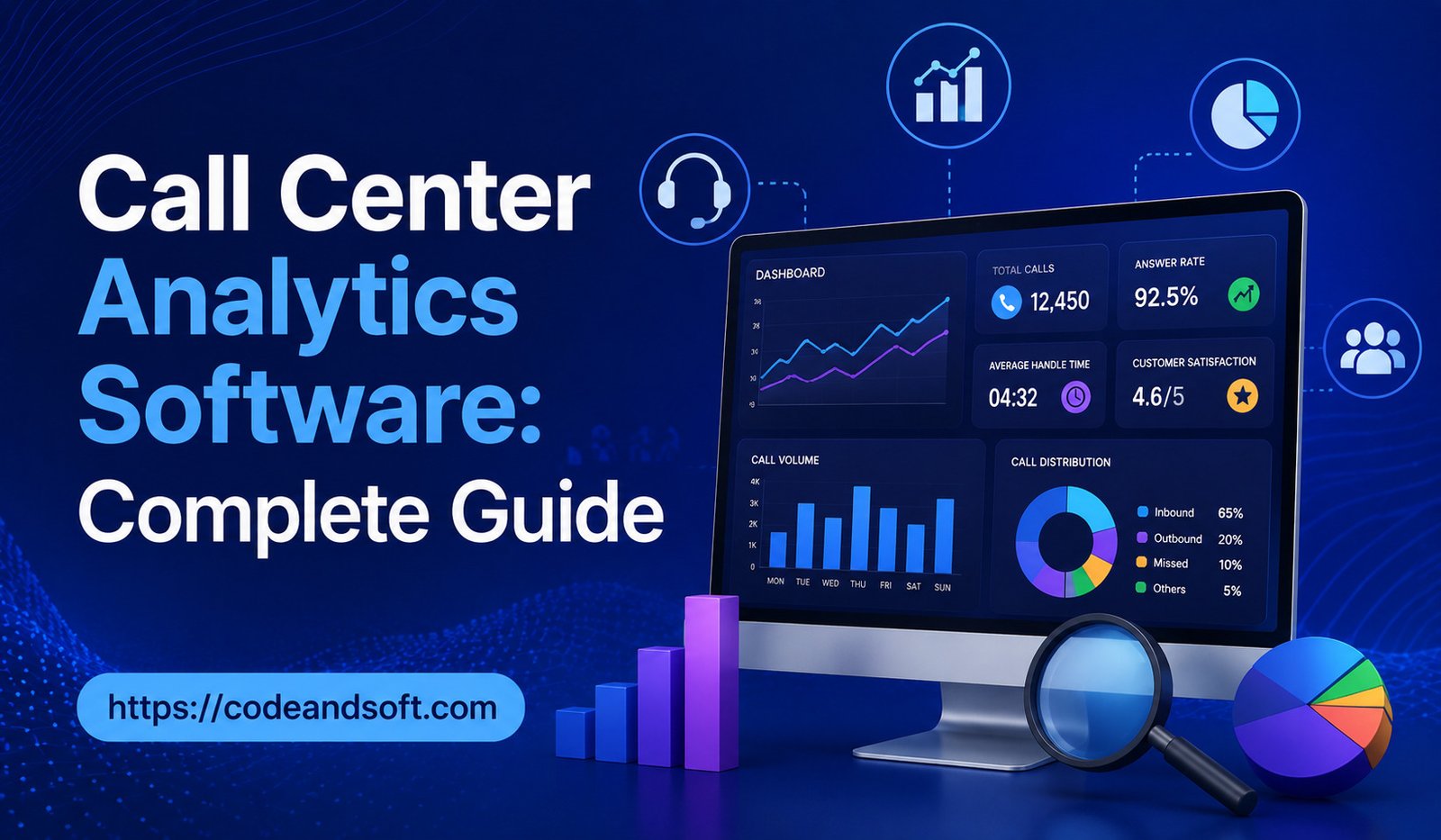
Real-time dashboards provide current information about call center operations.
Managers may see:
- Active calls
- Agents available
- Calls waiting
- Queue length
- Average wait time
- Service levels
Real-time visibility allows supervisors to respond quickly to operational issues.
Historical Reporting
Historical reports help organizations analyze performance over days, weeks, months, or years.
Managers can compare trends and identify long-term changes.
Agent Performance Analytics
Agent analytics can measure individual and team performance.
Metrics may include:
- Average handling time
- Calls handled
- First-call resolution
- Customer satisfaction
- Transfer rates
- Hold time
These measurements can support coaching and performance improvement.
Call Volume Analysis
Call volume analytics identifies when customers are most likely to contact the business.
This can help organizations schedule employees more efficiently.
Call Quality Analytics
Quality analytics can evaluate recorded conversations and identify potential issues.
Advanced systems may analyze:
- Keywords
- Topics
- Sentiment
- Silence
- Interruptions
- Customer objections
Speech Analytics
Speech analytics converts conversations into data that can be searched and analyzed.
Businesses can use it to identify recurring questions, complaints, and customer concerns.
Sentiment Analysis
Sentiment analysis attempts to determine the emotional tone of a conversation.
It may identify interactions that appear positive, neutral, frustrated, or negative.
Managers can use these insights to prioritize conversations for review.
AI-Powered Analytics
Artificial intelligence can analyze large numbers of interactions much faster than manual review.
AI may identify:
- Common customer issues
- Sales opportunities
- Compliance risks
- Agent coaching opportunities
- Emerging service problems
Custom Reports
Every organization has different priorities.
Custom reporting allows managers to create dashboards around their most important metrics.
Important Call Center Metrics
Analytics software is only useful when businesses track meaningful metrics.
Average Handling Time
Average handling time measures how long agents typically spend managing an interaction.
A high number may indicate complicated customer issues or inefficient workflows.
However, businesses should not automatically try to minimize handling time because rushing customers can reduce service quality.
First Call Resolution
First-call resolution measures how often customers receive a solution during their initial interaction.
A higher rate generally indicates effective customer support.
Average Speed of Answer
This measures how long customers typically wait before an agent answers.
Long waiting times can negatively affect customer satisfaction.
Abandonment Rate
Abandonment rate shows how many customers leave the queue before reaching an agent.
A high rate may indicate staffing or routing problems.
Customer Satisfaction
Customer satisfaction scores provide direct feedback about service quality.
Businesses can collect this information through surveys after interactions.
Service Level
Service level measures how many calls are answered within a defined period.
It can help managers determine whether staffing levels are appropriate.
Transfer Rate
A high transfer rate may indicate poor call routing or insufficient agent training.
Agent Occupancy
Agent occupancy measures how much of an employee’s available working time is spent handling customer interactions.
This can help managers understand staffing efficiency.
Benefits of Call Center Analytics Software
Better Customer Experience
Analytics can identify customer frustrations and service delays.
Improved Agent Performance
Managers can identify training opportunities using objective data.
Smarter Workforce Planning
Call volume forecasting can help organizations schedule employees according to expected demand.
Faster Problem Detection
Real-time analytics can identify unusual changes in call volume or service performance.
Better Business Decisions
Managers can replace assumptions with measurable information.
Improved Customer Retention
Understanding customer complaints and service problems can help businesses address issues before customers leave.
AI and the Future of Call Center Analytics
Artificial intelligence is rapidly changing call center analytics.
Traditional analytics focuses heavily on numerical metrics.
AI can analyze the content of conversations themselves.
AI can also generate summaries, detect sentiment, identify recurring topics, and provide coaching recommendations.
Predictive AI may eventually become more deeply integrated into staffing, routing, customer retention, and service management.
Call Center Analytics for Different Industries
Retail
Retail businesses can analyze customer questions about orders, deliveries, returns, and products.
Banking and Financial Services
Financial organizations can monitor service quality, customer concerns, and compliance-related interactions.
Healthcare
Healthcare providers can analyze appointment calls, patient inquiries, and service experiences while maintaining appropriate privacy protections.
Telecommunications
Telecom companies can use analytics to understand technical support requests and recurring network complaints.
E-Commerce
Online retailers can identify common delivery problems, refund requests, and purchasing questions.
How to Choose Call Center Analytics Software
Define Your Goals
Start by identifying what you want to improve.
Your objective might be:
- Reduce waiting times
- Improve customer satisfaction
- Increase first-call resolution
- Improve agent performance
- Forecast staffing requirements
- Identify customer complaints
Check Data Sources
Make sure the software can collect information from your communication and business systems.
Evaluate Integration
Look for compatibility with:
- CRM software
- Help desk platforms
- Call center systems
- Workforce management tools
- Customer survey platforms
Review Real-Time Capabilities
If managers need immediate visibility, choose a platform with real-time dashboards and alerts.
Evaluate AI Features
Determine whether AI transcription, sentiment analysis, speech analytics, or predictive forecasting is useful for your organization.
Check Customization
Your analytics platform should allow you to customize dashboards and reports.
Review Security
Call center data may contain sensitive customer information.
Check authentication, permissions, encryption, data storage, and retention controls.
Compare Pricing
Consider the complete cost, including users, data storage, AI features, integrations, implementation, and support.
Common Call Center Analytics Mistakes
Tracking Too Many Metrics
More metrics do not automatically mean better management.
Focus on measurements that directly support business goals.
Ignoring Data Quality
Incorrect or incomplete data can produce misleading conclusions.
Focusing Only on Speed
Reducing call duration should not come at the expense of customer satisfaction or issue resolution.
Not Acting on Insights
Analytics has little value if managers collect reports but do not make operational changes.
Ignoring Employee Feedback
Agents can provide valuable context that numerical reports cannot capture.
Using AI Without Oversight
AI-generated insights should be reviewed, especially when decisions involve customers, employees, or compliance.
Best Practices for Using Call Center Analytics
Start with a small group of meaningful metrics.
Create dashboards for different users. Agents may need performance information, while executives may want high-level customer experience and operational trends.
Review data regularly and compare current results with historical performance.
Use analytics to identify specific problems rather than simply ranking employees.
Combine quantitative data with customer feedback and agent observations.
Most importantly, turn insights into action.
If analytics identifies long waiting times, management should investigate staffing and routing. If customers repeatedly report the same product problem, the issue may need to be addressed outside the call center.
Final Thoughts
Call center analytics software gives businesses a clearer understanding of how their customer service operations actually perform. Instead of relying solely on individual complaints or manual reports, managers can use real-time data, historical trends, conversation analytics, and AI-powered insights to make better decisions.
The most useful analytics platforms combine operational metrics with customer and agent insights. Metrics such as average handling time, first-call resolution, service level, abandonment rate, customer satisfaction, and transfer rate provide valuable information about performance.
However, analytics should not become an exercise in collecting numbers. The real value comes from using those numbers to improve processes, staffing, training, routing, and customer experiences.
As artificial intelligence becomes more capable, call center analytics will likely move beyond reporting what happened toward explaining why it happened and predicting what could happen next.
For businesses willing to use data strategically, call center analytics software can become an important tool for creating more efficient operations, supporting employees, reducing service problems, and delivering better customer experiences.