
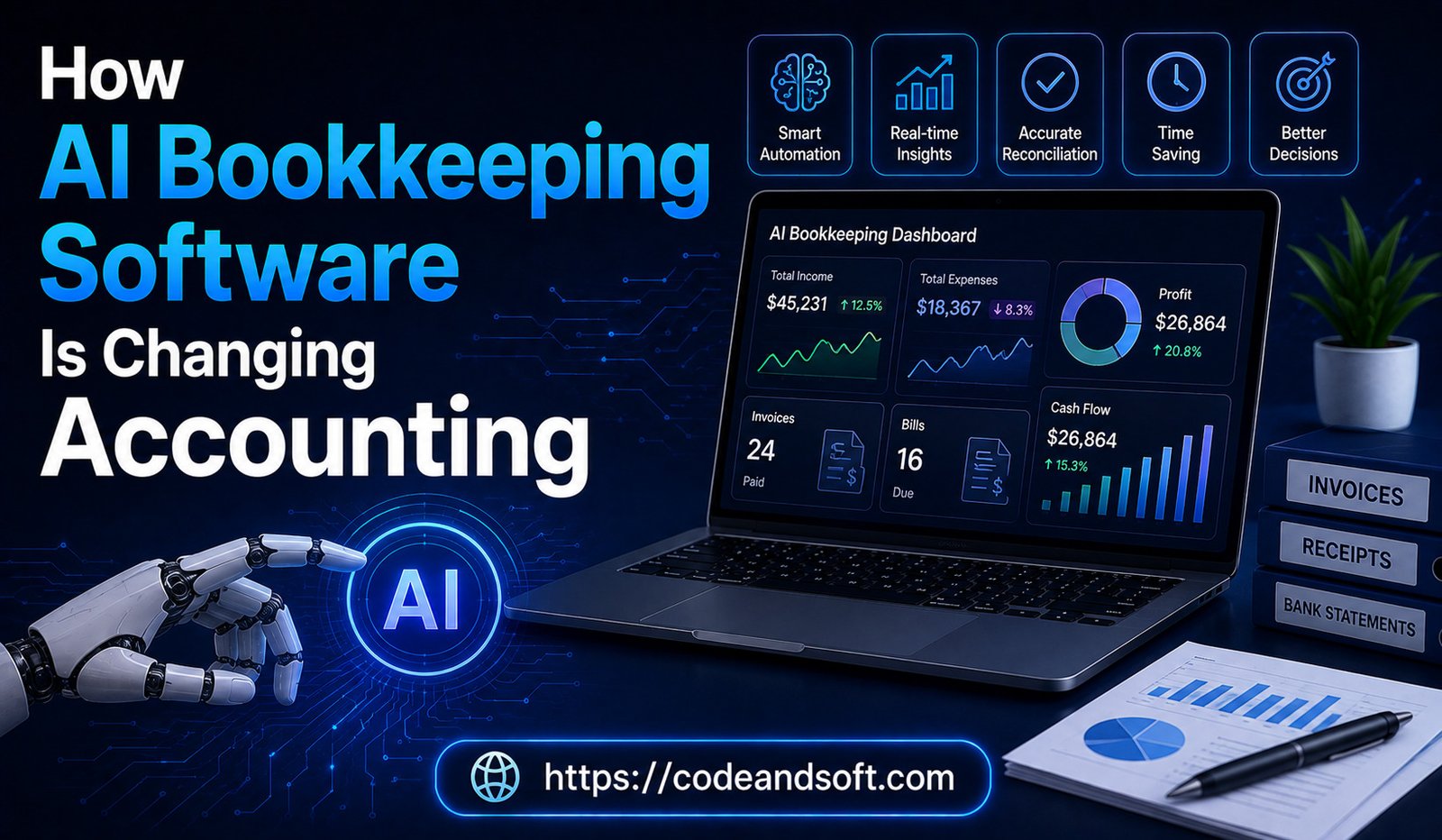

Artificial intelligence has become one of the most influential technologies in modern accounting. In 2026, AI bookkeeping software is no longer viewed as an optional tool but as an essential part of financial management for accounting firms and finance professionals. Businesses of every size are adopting AI-powered bookkeeping solutions to improve accuracy, automate repetitive tasks, reduce operational costs, and provide deeper financial insights.
Professional accountants are experiencing a significant transformation in their daily responsibilities. Instead of spending countless hours on manual data entry, bank reconciliations, invoice processing, and transaction categorization, they are increasingly focusing on advisory services, financial planning, risk management, and strategic decision-making.
As AI continues to evolve, bookkeeping software has become smarter, faster, and more reliable. This article explores how AI bookkeeping software is changing accounting in 2026, its major benefits, practical applications, challenges, and what accountants should expect in the years ahead.
The Evolution of Bookkeeping
Traditional bookkeeping relied heavily on manual processes. Accountants had to collect invoices, verify receipts, record transactions, reconcile bank statements, and prepare financial reports manually. Although accounting software simplified some tasks, human intervention remained essential for most bookkeeping activities.
The introduction of artificial intelligence has dramatically changed this landscape. AI-powered bookkeeping software can now learn from historical financial data, recognize transaction patterns, automate repetitive processes, detect anomalies, and continuously improve its accuracy.
Modern bookkeeping systems combine artificial intelligence with machine learning, cloud computing, automation, and predictive analytics to create intelligent financial management platforms.
What Is AI Bookkeeping Software?
AI bookkeeping software is an accounting solution that uses artificial intelligence technologies to automate financial tasks while continuously learning from financial data. Instead of following fixed rules alone, AI systems analyze historical transactions and improve their decision-making over time.
Typical AI bookkeeping software includes features such as:
- Automatic transaction categorization
- Invoice data extraction
- Receipt scanning
- Bank reconciliation
- Expense management
- Cash flow forecasting
- Fraud detection
- Financial reporting
- Tax preparation assistance
- Predictive financial analytics
Rather than replacing accountants, these systems function as intelligent assistants that reduce manual workloads.
Major Ways AI Is Transforming Accounting in 2026
Automated Transaction Categorization
One of the biggest improvements in bookkeeping software is automated transaction classification.
AI algorithms analyze merchant names, payment descriptions, previous transactions, and business rules to classify expenses accurately.
Instead of manually reviewing hundreds of transactions, accountants only need to verify exceptions, significantly reducing processing time.
Faster Bank Reconciliation
Reconciling bank statements used to require hours of manual matching.
AI software now compares:
- Bank transactions
- Accounting records
- Payment gateways
- Credit card statements
The software automatically matches entries while highlighting discrepancies that require human attention.
This speeds up month-end closing and improves financial accuracy.
Intelligent Invoice Processing
Invoice management has become much more efficient with AI.
Modern bookkeeping software can:
- Read invoices automatically
- Extract supplier details
- Capture invoice numbers
- Identify payment terms
- Recognize tax information
- Record purchase entries
Optical Character Recognition (OCR) combined with AI eliminates most manual invoice entry.
Automated Receipt Management
Employees simply upload receipt images using their smartphones.
AI instantly extracts:
- Vendor name
- Purchase date
- Total amount
- Tax details
- Expense category
The information is automatically recorded within the accounting system, reducing paperwork and minimizing lost receipts.
Real-Time Financial Reporting
Traditional financial reports were often generated weekly or monthly.
AI bookkeeping platforms now provide real-time dashboards displaying:
- Revenue
- Expenses
- Profit margins
- Cash flow
- Outstanding invoices
- Budget performance
Professional accountants can monitor financial health continuously instead of waiting until month-end.
AI Improves Accuracy
Manual bookkeeping is prone to human error.
Common mistakes include:
- Duplicate entries
- Missing invoices
- Incorrect calculations
- Wrong account classifications
- Data entry errors
AI minimizes these risks by validating transactions, comparing historical records, and detecting inconsistencies before they become significant issues.
Better Fraud Detection
Fraud prevention has become a major strength of AI bookkeeping software.
Examples include:
- Duplicate vendor payments
- Suspicious transactions
- Unauthorized expenses
- Unusual payment timings
- Abnormal invoice amounts
When suspicious activity is detected, the software immediately alerts accountants for further investigation.
This proactive monitoring strengthens internal financial controls.
Predictive Cash Flow Forecasting
Cash flow management remains one of the biggest challenges for businesses.
AI software analyzes:
- Historical revenue
- Customer payment behavior
- Seasonal trends
- Recurring expenses
- Outstanding invoices
Using this information, it predicts future cash flow with impressive accuracy.
Professional accountants can use these forecasts to help businesses plan investments, manage working capital, and avoid liquidity problems.
Smarter Tax Preparation
Tax compliance has become easier with AI-assisted bookkeeping.
The software automatically:
- Tracks deductible expenses
- Calculates tax liabilities
- Identifies missing documents
- Flags unusual tax positions
- Organizes financial records
Accountants still review final returns, but AI significantly streamlines the process.
Improved Client Advisory Services
As bookkeeping becomes increasingly automated, accountants are spending less time on repetitive administrative work.
Instead, they are providing higher-value services such as:
- Financial consulting
- Business performance analysis
- Profitability improvement
- Investment planning
- Budget optimization
- Risk assessment
AI enables accountants to shift from data processors to trusted financial advisors.
Cloud-Based Collaboration
Most AI bookkeeping software now operates in the cloud.
This allows:
- Remote access
- Multi-user collaboration
- Automatic backups
- Secure document sharing
- Real-time updates
Accounting firms can work with clients from anywhere while maintaining synchronized financial records.
AI-Powered Expense Management
Expense management has become far more intelligent.
AI software can:
- Detect duplicate expense claims
- Identify policy violations
- Categorize expenses automatically
- Recommend approval workflows
- Analyze spending patterns
This improves financial governance while reducing administrative effort.
Continuous Learning
Unlike traditional accounting software, AI systems improve over time.
Each correction made by an accountant helps train the software.
As more financial data is processed, the AI becomes increasingly accurate in:
- Categorizing transactions
- Identifying anomalies
- Forecasting trends
- Recommending actions
This continuous learning makes bookkeeping software smarter every year.
Benefits for Professional Accountants
Professional accountants gain numerous advantages from AI-powered bookkeeping.
Increased Productivity
Automation reduces repetitive work, allowing accountants to manage more clients without increasing workload.
Higher Accuracy
AI minimizes manual mistakes while improving consistency across financial records.
Faster Financial Close
Automated reconciliations and transaction processing significantly reduce month-end closing time.
Better Client Relationships
With more time available, accountants can offer strategic advice rather than simply preparing reports.
Competitive Advantage
Accounting firms using AI can provide faster services, better insights, and improved customer experiences.
Challenges of AI Bookkeeping
Despite its benefits, AI bookkeeping software is not without challenges.
Data Privacy
Financial information is highly sensitive.
Organizations must ensure that AI software complies with security standards and data protection regulations.
Initial Implementation
Migrating historical financial data and training employees requires time and careful planning.
Human Oversight
AI is highly capable but not perfect.
Professional accountants remain responsible for reviewing complex transactions, interpreting financial information, and ensuring regulatory compliance.
Changing Skill Requirements
Modern accountants need skills beyond bookkeeping.
Professionals increasingly require knowledge of:
- Data analytics
- AI systems
- Cloud accounting
- Financial technology
- Cybersecurity awareness
Continuous learning is becoming essential.
Emerging Trends in 2026
Several innovations are shaping the future of AI bookkeeping.
Generative AI
Generative AI assists accountants by producing financial summaries, explaining reports, answering accounting questions, and drafting management commentary.
Voice-Based Accounting
Users can ask natural language questions such as:
“What were last month’s travel expenses?”
The AI instantly retrieves the answer.
Predictive Financial Intelligence
Future bookkeeping systems will recommend actions before financial problems occur, helping businesses make proactive decisions.
Autonomous Accounting
Some routine bookkeeping tasks are becoming almost entirely autonomous, requiring minimal human involvement while maintaining oversight for compliance and strategic decisions.
Will AI Replace Accountants?
This question continues to generate debate.
The reality in 2026 is that AI is transforming—not replacing—the accounting profession.
AI excels at repetitive, rule-based tasks, but accountants provide expertise that machines cannot fully replicate.
Professional accountants contribute:
- Ethical judgment
- Regulatory interpretation
- Business strategy
- Client communication
- Financial planning
- Complex decision-making
The future belongs to accountants who embrace AI as a productivity tool rather than viewing it as competition.
Best Practices for Adopting AI Bookkeeping Software
Accounting firms considering AI implementation should:
- Evaluate business requirements carefully.
- Select software with strong security features.
- Train staff on AI-assisted workflows.
- Maintain regular data backups.
- Monitor AI-generated results for accuracy.
- Keep software updated.
- Combine automation with professional judgment.
- Focus on delivering higher-value advisory services.
These practices maximize efficiency while minimizing implementation risks.
Conclusion
AI bookkeeping software has fundamentally reshaped the accounting profession in 2026. By automating repetitive processes, improving financial accuracy, enhancing fraud detection, and providing predictive insights, artificial intelligence enables accountants to focus on strategic, value-driven work. Rather than replacing accounting professionals, AI serves as a powerful assistant that increases productivity and strengthens decision-making.
For professional accountants, adopting AI-powered bookkeeping solutions is no longer simply a matter of staying current with technology—it is a strategic investment in delivering better client outcomes and remaining competitive in a rapidly evolving financial landscape. Firms that embrace AI responsibly, while maintaining strong professional judgment and ethical standards, will be well positioned to thrive as accounting continues to evolve in the years ahead.