
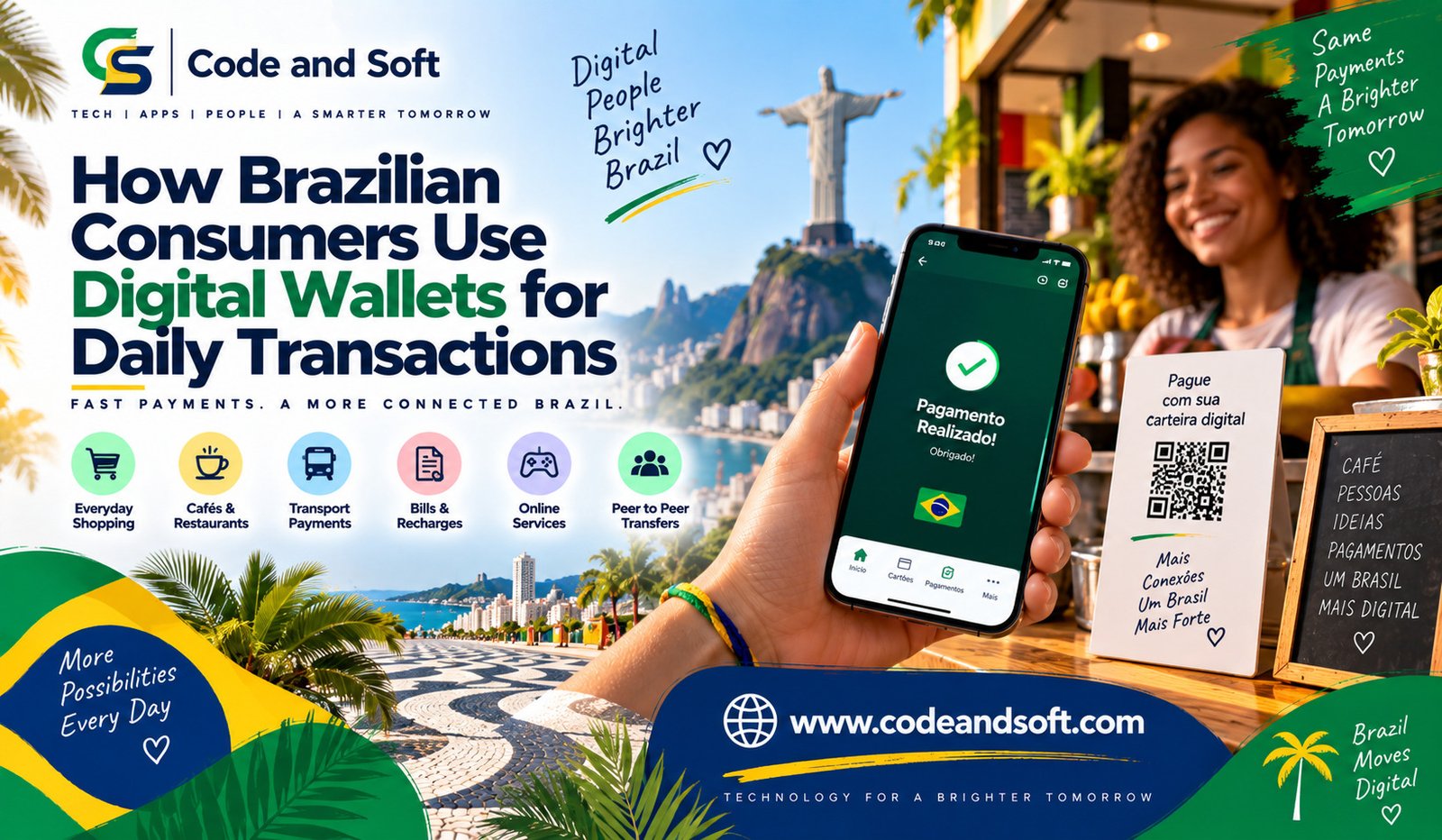

Imagine leaving home with nothing but your smartphone in your pocket. No bulky wallet, no search for loose change, and no need to remember which card you brought with you. When you want to buy a coffee, pay a restaurant bill, send money to a friend, or shop online, your phone can handle much of it in seconds.
That is increasingly how everyday payments work in Brazil.
The Digital Wallets Use In Brazil story is not simply about replacing cash or plastic cards with mobile apps. It is about making payments fit more naturally into your daily routine. From familiar international services such as Apple Pay, Google Pay and PayPal to Brazilian platforms such as PicPay, NuPay and PagBank, you have plenty of ways to manage payments digitally.
At the center of this changing payment environment is Pix, Brazil’s instant payment system. According to Brazil’s Central Bank, more than 170 million individuals had used Pix by January 2026, representing around 80% of the population. The system processed more than seven billion transactions in January 2026 alone.
So, how are you actually using digital wallets in everyday life?
Your Smartphone Is Becoming Your Everyday Wallet
For many Brazilian consumers, the smartphone has become more than a communication device. It can now act as a payment card, banking tool, shopping assistant and money-transfer platform all at once.
You can store payment cards in a digital wallet, use your phone at a contactless terminal, scan a QR code or make an instant Pix payment. In many situations, you do not even need to take out a physical card.
Contactless payments are particularly convenient when you are buying something quickly. You can hold your phone or smartwatch near a compatible payment terminal, authenticate the transaction and move on.
Brazil’s Central Bank describes Pix by proximity as a way to make an instant Pix payment through NFC by bringing your phone or smartwatch close to a compatible terminal.
That means your morning coffee, lunch, supermarket purchase or ride home can potentially be handled without opening a traditional wallet.
Apple Pay Makes Card Payments More Convenient
If you use an iPhone, Apple Pay can give you a simple way to keep eligible payment cards digitally available.
Instead of carrying several physical cards, you can add supported cards to your Apple Wallet and use your device at participating contactless terminals. The experience is especially useful when you are already accustomed to paying with your phone or Apple Watch.
For you as a consumer, the biggest advantage is convenience. You do not have to repeatedly pull out your physical card or enter card details for every supported online purchase.
Apple Pay is also part of Brazil’s wider digital commerce infrastructure. Payment providers operating in Brazil support Apple Pay for relevant transaction types, helping merchants offer the option during online and mobile checkout.
Google Pay Brings Pix Into the Digital Wallet Experience
If you use Android, Google Pay, through Google Wallet, provides another route to mobile payments.
One particularly important development for Brazilian users is the integration of Pix. Google announced the addition of Pix as a payment option in Google Wallet in Brazil, with PicPay and C6 Bank among the first institutions involved in the rollout.
You can also link eligible financial accounts to Google Wallet and use Pix through options such as contactless payment, Pix keys, QR codes and copy-and-paste payment information.
This makes Google Wallet more relevant to the way you already pay in Brazil. Rather than thinking of card payments and Pix as completely separate experiences, you can increasingly find both within the same mobile environment.
PayPal Remains Useful for Online Shopping
While local payment habits have evolved rapidly, PayPal still has a place in the digital payment landscape, particularly when you are shopping online or dealing with merchants that support PayPal checkout.
For you, the appeal can be simple: you may prefer not to enter your card information directly on every website. Instead, you can use your PayPal account where it is accepted.
PayPal can be particularly useful when your online shopping habits extend beyond everyday local purchases. If you buy from international websites, use online services or work with businesses that accept PayPal, having the account ready can make the payment process more familiar.
It is therefore not always about choosing one wallet. You may use Pix for everyday Brazilian transactions, Apple Pay or Google Pay for contactless purchases, and PayPal when shopping online.
PicPay Fits Into Everyday Brazilian Spending
PicPay is one of the names that naturally comes up when discussing Brazil’s digital payment habits.
The platform combines payment and financial services within a mobile environment, making it useful for people who want more than a simple card-storage application.
You might use PicPay to make payments, transfer money or manage other financial activities without constantly switching between different services.
Its connection with the Pix ecosystem is also important. The Central Bank has highlighted digital-wallet models involving institutions such as PicPay and has discussed how wallets can support Pix payments through authorized payment initiation arrangements.
For you, that means the boundary between a “digital wallet” and a broader financial app is becoming less obvious. One application can increasingly cover several everyday money tasks.
NuPay Gives Online Shoppers Another Payment Option
NuPay, associated with Nubank, is another example of how Brazilian digital payments are becoming integrated into online shopping.
Instead of thinking only about traditional card checkout, you can encounter payment options that connect your shopping experience with your financial account.
This matters because convenience is often what determines which payment method you actually choose. If you can complete a purchase quickly without manually entering card information, you may be more likely to use that method.
The wider Nubank ecosystem also supports contactless payments. Nubank explains that its app and compatible digital wallets can allow customers to make Pix, debit or credit payments by bringing a compatible device close to a payment terminal.
PagBank Connects Payments With Digital Commerce
PagBank is another major part of Brazil’s digital payment environment, particularly because of its connection with merchants and online commerce.
If you are shopping online, you may encounter checkout options involving PagBank, Apple Pay or Google Pay. PagBank’s own documentation says its checkout can automatically identify the device being used and suggest Apple Pay for Apple devices or Google Pay for Android devices.
For you, this creates a smoother checkout experience. Instead of filling out lengthy card information forms, you can select a supported digital payment option and authenticate the transaction.
PagBank also highlights tokenization and biometric authentication as technologies used by supported digital wallets to improve payment security.
Pix Is Changing What You Expect From a Wallet
If you want to understand Digital Wallets Use In Brazil, you cannot ignore Pix.
Unlike a traditional digital wallet that primarily stores cards, Pix has become a fundamental part of how Brazilians send and receive money.
You can use Pix to split a restaurant bill with friends, pay a local business, transfer money to a family member or complete an online purchase. Because payments are processed instantly, you do not necessarily need to wait for traditional banking processes.
The scale is significant. Brazil’s Central Bank reports more than 170 million individual Pix users and billions of transactions each month.
This widespread adoption has also encouraged digital wallets to incorporate Pix into their experiences.
For you, this means that choosing a digital payment method is no longer simply a choice between Visa, Mastercard or cash. You may be deciding between Pix, a stored card, a QR code, contactless payment or a wallet-integrated payment depending on what you are buying.
You May Use Different Wallets for Different Situations
One of the interesting things about digital payments in Brazil is that you do not necessarily have to be loyal to a single platform.
You might use Apple Pay when paying with your iPhone at a physical store. If you use Android, Google Pay may be your preferred option. You could use PicPay for everyday financial transactions, NuPay when shopping with participating online merchants, or PagBank during supported checkout experiences.
Meanwhile, PayPal can remain useful for certain online and international purchases.
Your choice may depend on the device you own, the merchant’s payment options, rewards, convenience, account integration and the type of transaction you are making.
This flexibility is one reason digital wallets continue to become more useful. You are not necessarily replacing one payment method with another. You are building a collection of digital options that fit different parts of your life.
Security Is Part of the Appeal
Convenience gets most of the attention, but security also plays an important role.
When you use a digital wallet, you may have additional authentication layers such as a fingerprint, facial recognition, device passcode or other verification. Tokenization can also reduce the need to expose your actual card information during supported transactions.
However, you still need to be careful. A digital wallet does not make you immune to scams. You should check the recipient before confirming a Pix transfer, avoid suspicious links and never share authentication codes or banking credentials.
Brazil’s Central Bank is also continuing to strengthen Pix fraud protections. New rules scheduled for 2027 will make it easier for users to submit evidence when contesting certain fraudulent Pix transactions.
What the Future Looks Like for Brazilian Consumers
The biggest change may be that digital payments are becoming almost invisible.
You are less likely to think about the technology behind a payment when you simply tap your phone, scan a QR code or confirm a transaction inside an app. The payment becomes a small part of the overall shopping experience rather than a separate activity.
Pix by proximity is one example of this direction. The Central Bank says the technology can provide a payment experience similar to using a card while retaining the instant nature of Pix.
As wallets, banks, fintech apps and payment platforms continue to connect their services, you can expect more situations where your phone becomes the main tool for managing everyday payments.
Final Thoughts
The Digital Wallets Use In Brazil trend is ultimately about convenience and choice.
You can use Apple Pay or Google Pay for contactless purchases, PayPal for supported online transactions, PicPay for everyday financial activities, NuPay for participating online shopping experiences and PagBank for digital commerce and payments.
But the real force behind Brazil’s payment transformation is the combination of these services with Pix. With more than 170 million individual users recorded by the Central Bank, Pix has become deeply embedded in everyday financial life.
As a consumer, you no longer need to think of your wallet as something you carry in your pocket. Increasingly, your wallet is the phone in your hand — and the payment options inside it can change depending on where you are, what you are buying and how you prefer to pay.